
“I want to enter into the history of the world, or even just hold an apple in my hand.”
For just a moment, we see the trapeze artist in full color. The camera gazes up at her from below as she sways from one side of the frame to the other, striking acrobatic poses. She’s confident, and makes that known to her clapping circus colleagues: “I’d have fallen on your heads long ago if I wasn’t.” This colorful shot appears unexpectedly after more than 26 minutes of black-and-white scenes featuring people whose interwoven inner monologues narrate a loosely connected story of struggle, depression, and loss. Its vibrant palette visualizes the trapeze artist’s joyful freedom in stark contrast to everything we had seen in the film before.
But, as abruptly as color appears, it is gone. “Listen, everybody,” a man says to the performers as the scene returns to black-and-white. “We can’t pay the rent or electricity. We’re broke.” We watch the trapeze artist sway back and forth as narration betrays her thoughts to us. They are morose. The moment of joy is gone.
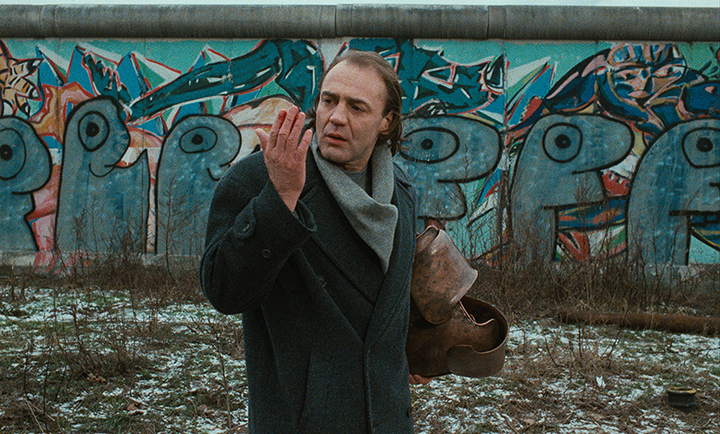
Wings of Desire is mostly shot in black-and-white, but switches to (almost) full color during its final half-hour, when the angel Damiel decides to experience the world as a human, even if that means giving up his immortality. This concluding sequence begins with Damiel waking up in a field. Children throw a chestplate of armor at his head, which we see in painful close-up. Shortly after he walks away, Damiel raises his hand to his scalp. We see blood on his fingers in close-up. Director Wim Wenders then cuts back to his reaction shot. It’s not what you’d expect: Damiel’s face lights up in wonder as he licks some blood off of his fingertips. He smiles. “It has a taste,” he remarks incredulously.
He asks a bystander if the blood is red. The bystander confirms, then confirms Damiel’s other inquiries, too — the pipes beside them are yellow, and the face painted on the mural behind those is grey-blue.
The camera follows Damiel through the city of Berlin from then on out, tracking his movements from ground level, observing him from afar. Damiel gazes up in wonder at the U-Bahn tracks and the falling snow. He wears funny, colorful clothes; he tries to sneak on to a film set; he attends a concert; he recklessly, thoughtlessly falls in love. And we see his world in these moments in full, vibrant color. The camera lingers mostly at his and other characters’ levels — fewer scenes are shot from dramatically high or low angles during this final stretch of the film.
Wim Wenders starts Wings of Desire with voiceover narration that speaks poetically about the mentality of children; this motif then recurs throughout the film. “When the child was a child, it walked with its arms swinging. It wanted the stream to be a river, the river a torrent, and this puddle to be the sea. When the child was a child, it didn’t know it was a child. Everything was full of life, and all life was one. When the child was a child, it had no opinion about anything, no habits. It often sat cross-legged, took off running, had a cowlick in its hair, and didn’t make faces when photographed.”
The scenes recorded in color are Wenders’ representation of adults living in this childlike state of mind. They span moments both grand and small: the trapeze artist soaring above the circus, and mortal Damiel sipping a cup of coffee. In these scenes in color, the characters are curious, joyful… free. And so the world around them feels more vibrant, even when the circumstances that they find themselves in are objectively negative or dull. They walk with arms swinging, as it were.
This aesthetic shift from black-and-white to color — and the changes in camera movement and positioning that accompany it — visually represents Wenders’ call-to-action: to live life kindly, present, and full of wonder: as a child.
The opposite mentality looks far more chaotic and bleak, and is filmed as such.
In Wings of Desire, two angels — Damiel and Cassiel — soar through Berlin on a quest to comfort people in need. Much of the film is shot from their point of view, in black-and-white. Early on, the camera observes Berlin from the air, as if we were flying with them. In a particularly dizzying montage, the free-flowing camera glides from the sky into a residential building, then drifts through walls and windows of various apartment units, briefly settling on shots of men and woman going about their day-to-day lives in their homes before moving on to the next. Their neurotic thoughts string together a disjointed narration that can simply be summed up as: life is full of mundane suffering.
The angels try to help whomever they can. The camera follows them with sweeping movements wherever they go, unencumbered — unlike the later scenes in color — by the laws of physics that plague mere mortals. The angels pass by suffering man after suffering woman, listening to their internal cries for help.
The erratic camera, disconnected narration, and black-and-white aesthetics make the lives of these angels feel as overwhelming to us as the lives of those they strive to help.
In one scene, Damiel and Cassiel hear a choir dramatically sing inside of their heads; senses flooded, they stop in their tracks, close their eyes, and rest until the cacophony in their minds subside. In another scene, Cassiel’s gentle touch cannot convince a man to reconsider jumping off of a skyscraper. Wenders dramatically cuts out of the scene in the middle of Cassiel’s agonized scream, then later cuts together a frenetic montage of images that represent the angel’s emotional chaos: a child screams in the city streets, the camera speeds erratically through the streets of Berlin, we see an empty table in a restaurant, archival footage of a war shows us bombers in the sky.
Later, lights at a concert cast multiple shadows of Cassiel on the wall — a fractured vision of himself.
To be an angel seems to be a burden, too.

Mortal adults cannot see the angels. However, in a touching moment, Wenders reckons that we can still feel them if we try.
The camera lingers on a medium shot of a man riding the subway, hanging his head in despair. Damiel sits beside him and places his hand on his shoulder as we start to hear the man’s inner thoughts: “Disowned by your parents, betrayed by your wife. Your children only remember your speech defect. You feel like slapping yourself when you look in the mirror.”
But the comforting touch of an angel he cannot see encourages the man to hold his head up, and the tone of his inner monologue shifts. Perhaps if he can pull himself together and look at the world through a new lens, he can get his life in order. Maybe then, more of his days will be seen in color.
 Story / Telling
I was overjoyed to see the image as I browsed through my Google. Wings of Desire was a film that overwhelmed me when I saw it with its honesty and deep touching of my soul. And I cried just reading your description. Thank you for doing this. I must see it again and hopefully can find it. You didn’t mention the actors but Bruno Ganz, in his long overcoat and translucent wings, was my idea of an angel. He was superb. Yes, I will find a way to see it again..at my age of 86, it will be even more meaningful.
LikeLike