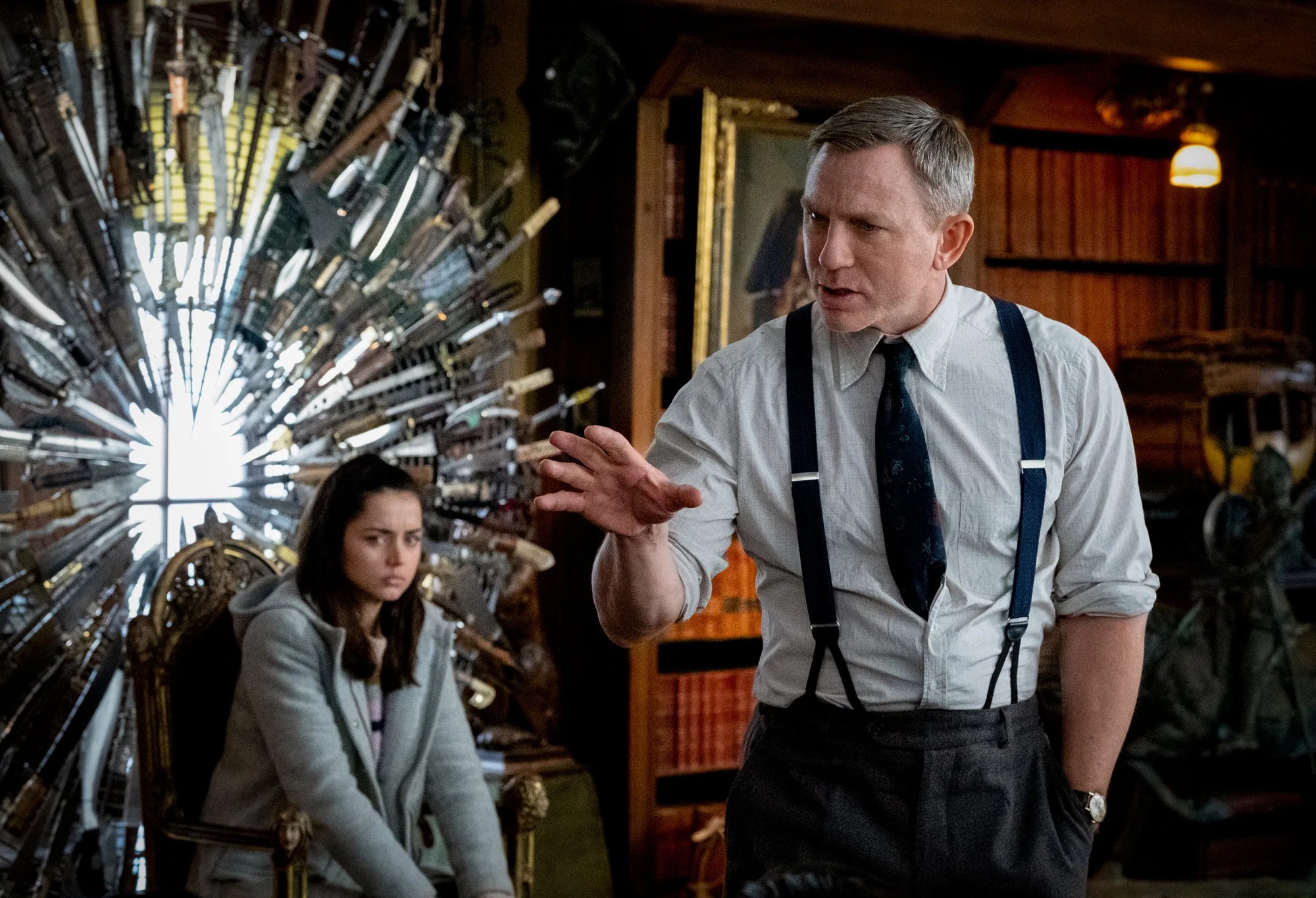
“You have a regurgitative reaction to mistruths.”
A good whodunit keeps you guessing. If the perpetrator of the fictional crime is too obvious, the story becomes predictable and boring. It is essential, however, that the story doesn’t end with an unjustifiable plot twist for the sake of surprise — the crime and criminal both have to make sense. The challenge for anyone crafting a whodunit, then, is to simultanouesly reveal clues in a way that the audience at large can’t fully solve the crime before the detective does, and have the outcome make fully logical sense in hindsight. It’s easier said than done.
One of the best ways to do this is to establish an unreliable narrator. Misdirection caused by human fallibility (or malice) is both dramatic satisfying and suspenseful; it makes us question which ‘facts’ we can and cannot trust. Rian Johnson doesn’t just stick with one unreliable narrator in Knives Out; in the first few scenes alone, we learn about the crime from the points of view of several.
Their stories don’t all add up.
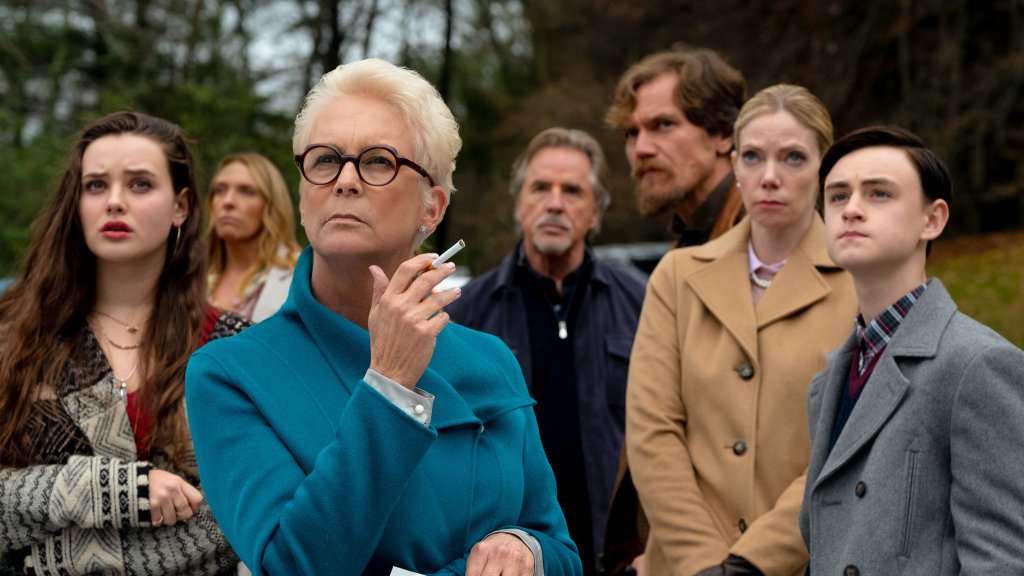
There is a running joke in Knives Out about how no one in the deceased Harlan Thrombey’s family actually knows where the family of Marta, Harlan’s young nurse and friend, immigrated to the United States from. “Marta, Harlan’s caregiver — good girl, hard worker. Family’s from Ecuador,” Harlan’s daughter Linda tells detectives during their initial interrogation. In his own interrogation, that character’s husband, Richard, tells detectives that “her family’s from Paraguay.” Later, in a flashback, Richard casually tells Marta that her “family came from Uruguay, but you did it right.”
Johnson uses humorous discrepancies in these and other instances to establish two things: that we can’t trust everything we hear to be true, and that the characters are nearly all self-absorbed and kind of petty… and therefore, unreliable. It seems as though everything that they tell the detectives and each other is true, at least from their point of view. But, as is the case in real life interactions, that doesn’t mean that what they say is actually true.
If characters haven’t been paying close enough attention to know that someone who has been “part of the family” for years is originally from Ecuador, Paraguay, or Uruguay, then how can we trust that they reliably remember the details of anything?
It’s not just errors of memory that make us question the veracity of these characters’ remembrances. Johnson also uses dramatic irony — by cutting between characters telling detectives that a situation happened one way, and then showing us in flashback that it happened another — to reveal that certain characters are outright liars.
Johnson uses deflection and lies in the dialogue of some of the expository interrogations that start the film, and then shows us what really happened intercut with those conversations. We see a flashback scene in which Harlan fires his son Walt from the family publishing company; instead of telling the detectives this — out of fear that it would be considered motive and that he would become a suspect — he tells them that he and his father “had a business discussion, about e-books” and then quickly deflects, saying, “you want to talk about an argument? Hell, Ransom had an argument with him…”
The ultimate misdirection — which Johnson executes especially humorously in Knives Out — is to make the audience think that they know the outcome, then reveal to them in the end that they’re wrong.
Marta is the key to making this deception work in Knives Out. It’s quite funny that she’s established as a character who pukes any time that she lies, and such a people pleaser that she never corrects people when they get information about her and her family wrong or tell her sister to shut off a TV show about murder days after her employer was murdered. But it’s also a suspenseful character trait, because Johnson pulls off this ultimate, bold deception: he makes us believe — and Marta believe — that she accidentally committed the crime at the center of the plot.
Because of this fact and Marta’s disposition, we spend the majority of our time watching Knives Out either missing clues or interpreting them a specific way, because we think that we know what’s going on when we — and the characters themselves — really don’t.
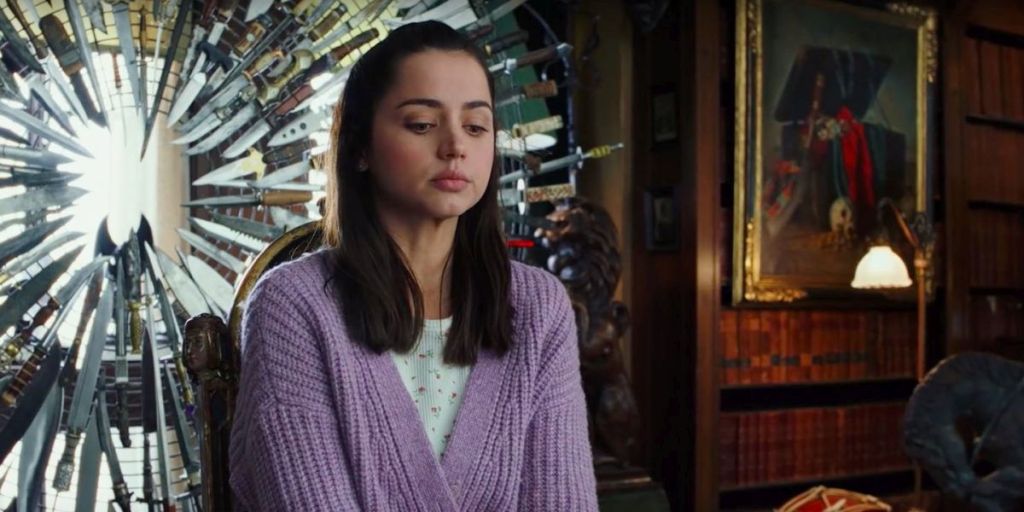
All of this misdirection, established through deceptive dialogue, dramatic irony, and suspenseful plotting, is what makes Knives Out “a case with a hole in the center — a doughnut.” And, what makes it a compelling whodunit.
I’d be remiss, though, if I didn’t also acknowledge how beautifully production design, art direction, and set decoration enrich our viewing experience and how elegantly these crafts communicate tone and character development. From the opening scene, we learn so much about the Thrombey family from the tchotchkes on their bookshelves, the Harlan Thrombey mystery novels on display, the elaborate interior design in the many rooms of their mansion, and the quirky decorations that populate them. The attention to detail in the film’s environments elevates Knives Out above lesser whodunits as much as the sharp, witty dialogue and memorable characters do.
As if that wasn’t enough, some of the most elaborate set design elements come into active use in the plot in surprising — though unforced — ways; most notable among these is the stunningly unsettling wheel of knives that sits conspicuously in the mansion’s parlor room.
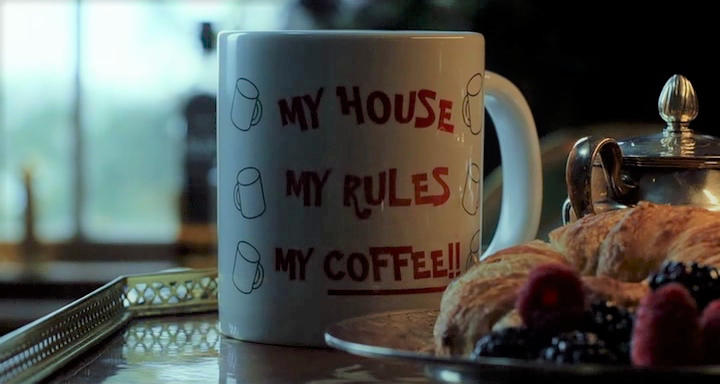
And then there’s that mug, which so perfectly bookends the story — a prop that takes on new meaning from start to finish, visualizes a shift in power and character development, and ends the movie on a final cathartic laugh. “My House, My Rules, My Coffee!!”