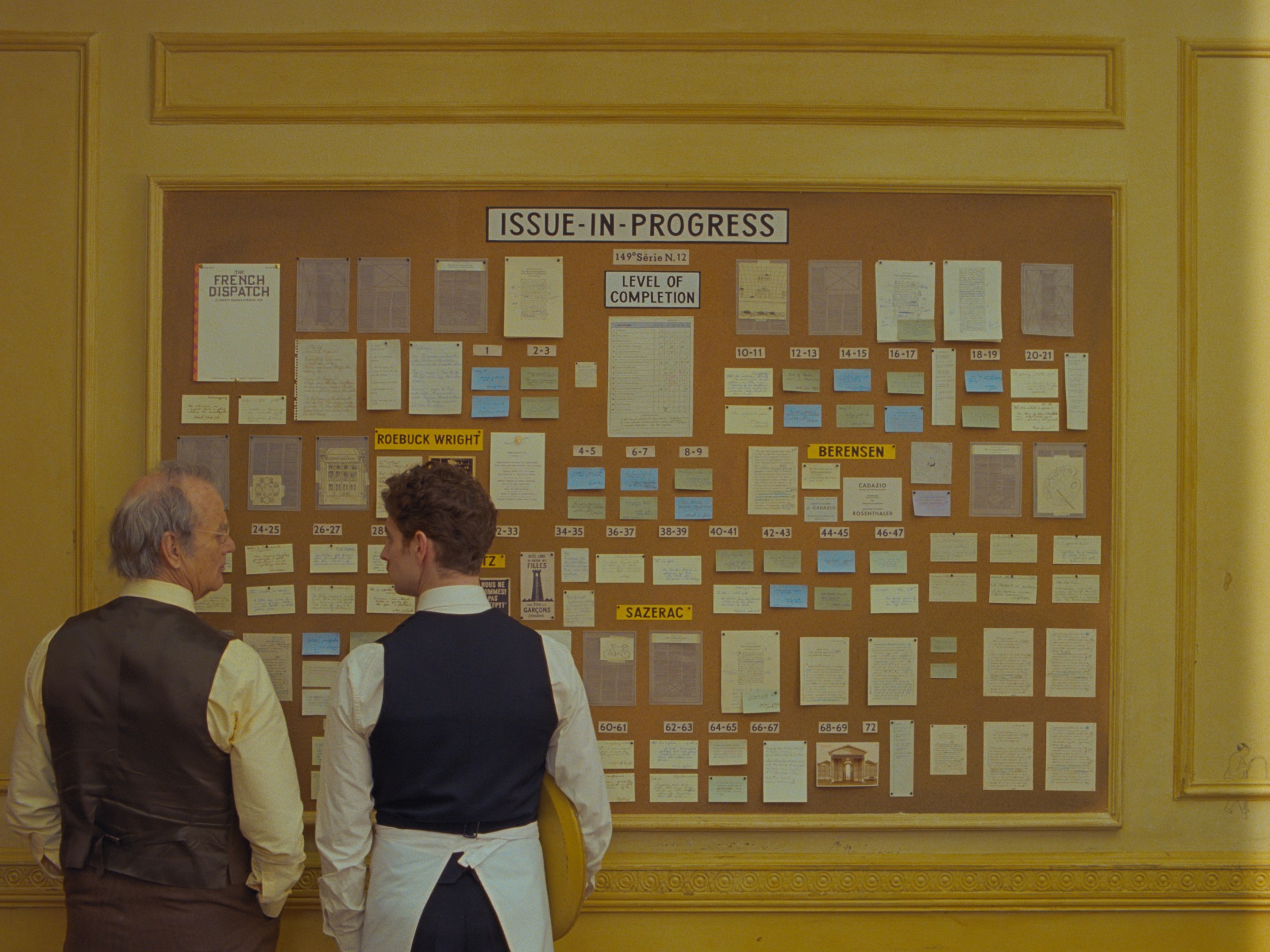
“Just try to make it sound like you wrote it that way on purpose.”
The French Dispatch is, perhaps, Wes Anderson’s most esoteric film to date. It’s less a cohesive feature and more an anthology of short films that are stylistically linked, thematically and dramatically distinct, and bookended and wrapped in an connective narrative about a team of journalists for a Kansas publication based out of a small French town called Ennui-sur-Blasé.
The name of that town is as important and carefully selected as any other detail in a Wes Anderson film.
Ennui | a feeling of listlessness and dissatisfaction arising from a lack of occupation or excitement
sur | the French word for on
Blasé | unimpressed or indifferent to something because one has experienced or seen it so often before
It seems like an almost defiant moniker for an aesthetically beautiful town that so mystifies and enraptures one of the Dispatch’s reporters that, after he describes the metro rats, rooftop cats, nighttime gigolos, elderly failures, and dead bodies that populate it in an essay, he muses that “all grand beauties withhold their deepest secrets.”
It’s telling, though, that what that particular reporter focuses on when describing the city are those aforementioned details; perhaps Ennui-sur-Blasé is, in fact, an appropriate name for a town where the most notable details are so mundane, and the people so prone to listlessness and reckless indulgence.
Those two conflicting truths, and the loving way in which the reporter describes them, hold the key to understanding the somewhat disjointed narrative of The French Dispatch. What the short film stories, in all of their quirkiness and extravagance, seem to collectively say is that if you look closely enough at the mundane, you can find unique, poignant beauty.
The other key aspect of the framework of the story of The French Dispatch is the character of Arthur Howitzer, Jr., the founder and editor of The French Dispatch, who is discussed extensively in the film’s opening voiceover narration and then sporadically seen throughout the film in conversation with the journalists who narrate the individual tales. One of his key catch phrases, which bemuse his writers, is “try to make it sound like you wrote it that way on purpose.” Any story at all, recited with enough intention and detail can become intriguing to an open-minded audience — at least according to Howitzer.
The movie opens with a lengthy sequence establishing the history of The French Dispatch, the people on its staff, and the personality and priorities of its editor. The most important line of dialogue in this sequence comes at the end of it, when a reporter debates with Howitzer about what articles should be edited or “killed,” because the latest copy of the Dispatch is far too long (in large part because Howitzer refuses to actually edit anything). On one particular essay, “we asked for twenty-five hundred words, and she [the reporter] came in at 14,000 plus footnotes, endnotes, a glossary, and two epilogues.”
Howitzer replies: “Shrink the masthead, cut some ads, and tell the foreman to buy more paper. We’re not killing anybody.”
It is with that line of dialogue — and the narrated explanation that follows — that we enter into the overview of Ennui-sur-Blasé and the ensuing stories that take place within it. All of those stories, like the town, are narrated by a reporter and filled with mundane details, bored characters, and strange circumstances.
But the visuals are vibrant and captivating, the music whimsical and enchanting, and the performances compelling and earnest. Wes Anderson has called The French Dispatch a love letter to journalism, and this is true, but it also seems like The French Dispatch, in the way that it frames and tells these random stories, is a love letter to the stories of our lives in general. The film seems to posit that there are lessons to be learned in many of the mundane and beautiful details of our everyday lives, and that interesting stories don’t always come from the most obvious places.
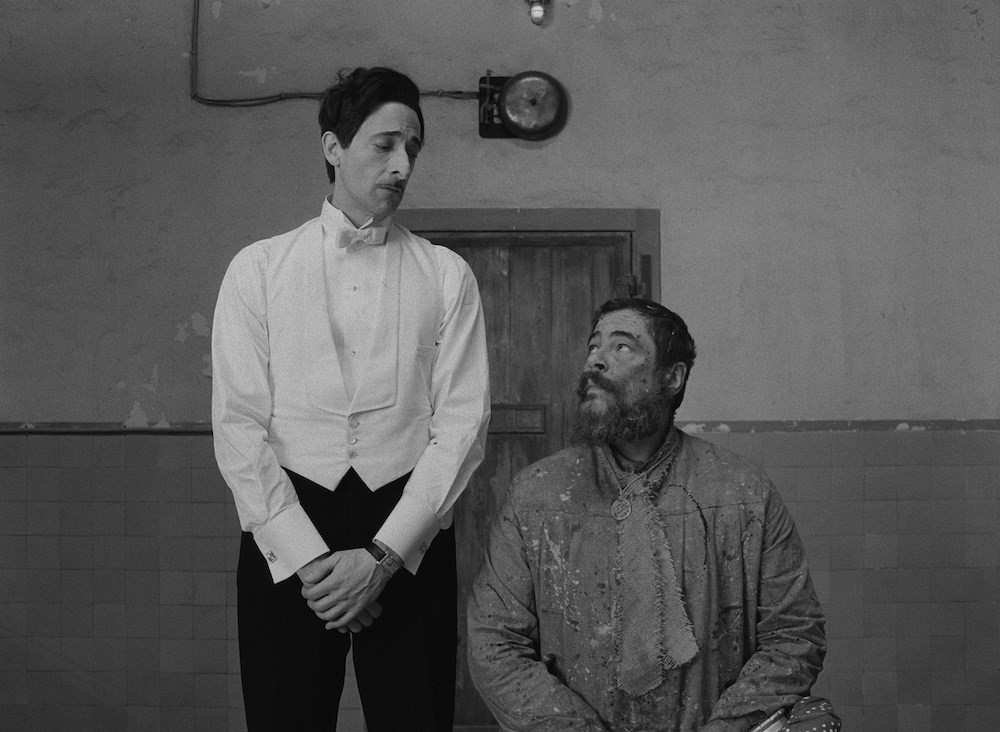
The characters of each sub-story, wrapped up in their own narrative, don’t always recognize this.
Anderson’s choice to frame all of the scenarios in a 4:3 box and showcase the scenes predominantly in black-and-white indicates this. Their stories, to the characters in them, are full of ennui and blasé — and while they might seem colorful or quirky to us, they are normal and mundane to their subjects.
But every so often, Anderson shifts this approach to highlight a moment in vibrant color: the revelation of beautiful abstract paintings that have been carefully crafted by a serial killer in a maximum security prison, the energetic exchange of ideas between young wannabe revolutionaries in a café, and the beautiful cuisine (and harrowing chase sequences) that entangle a reporter, a police commissioner, and a world-renowned chef in a shoot-out and mass poisoning.
Color, in these scenes, highlights those brief moments in which the characters’ inner spark lights up — when the ennui of their existence is broken up by something meaningful and new that will last with them in memory for the rest of their lives. In the first two stories, the colorful moments arise infrequently and for short periods of time. In the third story, the twists and turns of the narrative draft such a dramatic and unexpected narrative that color alone is not enough to distinguish between these particular goings-on and the characters’ usual lives, so Anderson breaks form not just by shifting from black-and-white to color, but from live action to animation.
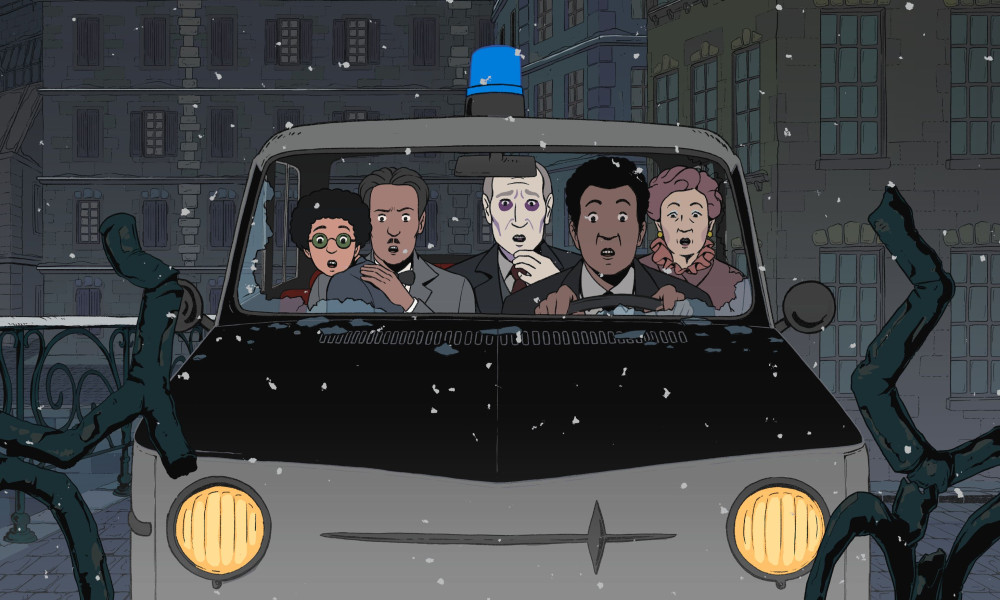
This stylistic play with form and structure, while seemingly disjointed, is actually unifying — it gives us visual cues and meaning even when the narratives don’t connect.
That, coupled with the context provided at the start of the movie and the beautiful sentiments communicated in voiceover narration by the reporters of The French Dispatch, all adds up to something that is greater than the sum of its parts. So while, yes, The French Dispatch is a disjointed anthology, it is also a singular statement… if you look closely enough.
“Maybe with good luck we’ll find what eluded us in the places we once called home.” — Roebuck Wright, reporter for The French Dispatch
 Story / Telling