
“What the hell is wrong with freedom? That’s what it’s all about.”
A few minutes into Easy Rider, we see Peter Fonda’s character Wyatt (also known as “Captain America”) neatly rolling up money and stuffing it inside a long plastic tube. He caps the tube and stuffs it inch by inch into the fuel tank of his motorcycle. We watch it slide in in an extreme close-up for a moment before the camera pulls back to reveal the fuel tank’s stars-and-stripes paint job. It’s an obvious metaphor: America runs on money.
Easy Rider is full of in-your-face metaphors like this. It is a thinly-plotted movie heavy on themes and attitude.
The money opens in a junkyard. Wyatt and his friend Billy, played by Dennis Hopper, pull up to a dilapidated shack on their bikes and are greeted by drug dealers. Few words are spoken — most of them in Spanish — as they snort cocaine between crushed up cars while leering men, some missing teeth, watch them from afar. Wyatt and Billy score their drugs, then sell them to another buyer on a road beside the runways at LAX; planes take off and land loudly over their heads as the lucrative transaction closes on the ground below largely without words.
Then, the money is stuffed into the fuel tank in a garage back home.
Hopper, who also directed the film, has said in interviews that he wanted to see the characters get their “junk” from a “junkyard.” It’s hardly glamorous; the drugs and the aimless meandering that follow are portrayed with a certain level of melancholy. Drug dealing is a quick and dirty way for them to buy their freedom… or at least try to find it.
Their search for freedom begins at ruins in the California desert. Wyatt takes off his gold watch and tosses it on to the dusty ground beside him. The camera zooms in and out erratically at this moment, then lingers for a beat on the watch in the dirt before Wyatt kicks his bike into gear and the two friends ride off on to the highway. The metaphor here, too, is clear: they are rejecting time — now that they have all of the money that they need, they are beholden to no one.
What follows is less a story and more a series of vignettes tied together by lengthy driving sequences — often accompanied by folk and rock music — following the motorcycles on their journey. Intercut with all of these driving shots are sweeping pans and beautiful, wide, open shots of the countryside passing them by. A particularly long interstitial panorama fixes our gaze on the rocky buttes of Monument Valley, an iconic symbol of the lawless American Wild West.
The first meaningful conversation in the film takes place between these nomads and a farmer they meet along the way, at the farmer’s dinner table. The farmer asks Wyatt where they’re from. “LA,” Wyatt replies. “L.A.?” the farmer asks, confused — it’s clear that these are people who don’t care much for the self-importance ascribed to certain metropolitan areas… or regularly think about them at all. “Los Angeles,” Wyatt clarifies. “Los Angeles, is that a fact?” the farmer says, before mentioning that he once thought that he was going to move to California, but stayed where he was at instead. He smiles at his family. He isn’t impressed and doesn’t ask many follow-up questions.
Wyatt, however, is impressed at his company — he thinks highly of the man’s farm and his big, happy family. “It’s not every man that can live off the land, you know,” he says. “You do your own thing in your own time. You should be proud.”
That line is the movie’s definition of freedom: doing your own thing in your own time. The only way that Wyatt and Billy can figure out how to gain that freedom, however, is by gaming the system to make as much money as quickly as possible… and then living on the fringes of “civilized” society after that.
Wyatt and Billy aren’t welcome in the normal towns that they stop at along the way. They’re turned away in the middle of the night from a motel; the owner takes one look at them, slams the front door shut, and illuminates the word NO over the neon VACANCY sign. From then on, they light campfires on the side of the road in the most remote places they can find, and sleep in the dirt.
They are arrested in a small town, and meet an ACLU lawyer (played by Jack Nicholson) in their jail cell. The lawyer, George, joins them on the road. They stop to get food at a diner; bigoted men leer at them from adjacent booths and make loud comments about them to let them clearly know that they aren’t welcome.
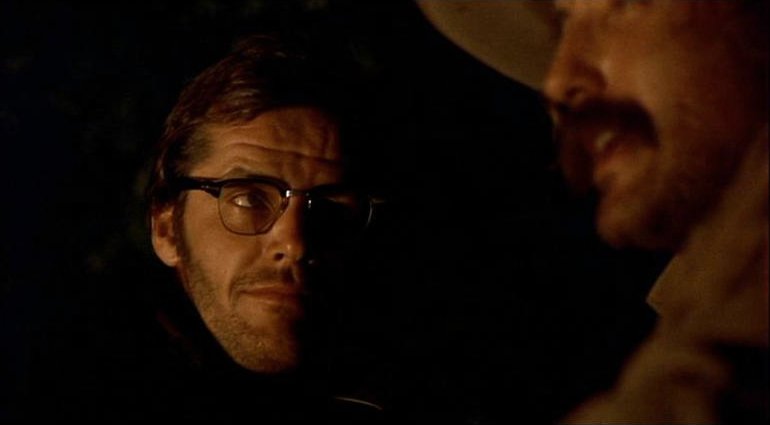
“They ain’t scared of you,” George tells Billy around a campfire that night. “They’re scared of what you represent.” Most people think that they’re free, he continues on to say, but they’re not… because “it’s real hard to be free when you’re bought and sold in the marketplace.” Men in society will do anything to delude themselves into thinking that they have the autonomy and freedom that they’ve been told that they have, and they don’t like anyone who represents the notion that they’re buying into a lie.
The men from the diner track down their hippie campsite. They leave the wanderers alone, but they target the ACLU lawyer specifically because he is the most like them — and in their minds, he should have stayed in his place.
Shunned by “normal” society, but anxious and existentially lost in aimless hippie communes, Billy and Wyatt become ever more isolated. Their loneliness comes to a head in a brothel in New Orleans, where they hire prostitutes to just sit with them and talk. Then, they spontaneously head out into the streets to celebrate Mardi Gras together, buying companionship with their drug money and then dulling their senses with drugs in a cemetery.
They are directionless without other people telling them what to do. As Wyatt wanders that artful New Orleans brothel, he reads from a sign: “If God did not exist, it would be necessary to invent him.”
Billy and Wyatt strive for something that they can never achieve in our society. They live for the freedom of the road, but the status quo won’t let them enjoy it for long. Their free-spirited rejection of the existing order of society was too loud, too proud — and that’s why they’re hunted down, and the film ends not with their triumphant arrival on the east coast, but with brutal, abrupt violence from ugly people, and a flaming motorcycle on the side of a desolate country road.
The characters defy convention, and so does the filmmaking. Montage transitions, in which scenes cut back and forth between one another three times in rapid succession before resolving into a new sequence, disorient us. When Wyatt, Billy, and the prostitutes venture into the streets of New Orleans, the polished 35mm film images give way to a lengthy guerrilla-style 16mm film sequence that devolves quickly into chaotic debauchery and disconnect as the rebels drop acid by gravestones and Easy Rider turns briefly into a fully experimental film. Conversations between characters throughout the movie are largely improvisational and establish a mood and themes rather than context for a plot. And throughout Billy and Wyatt’s journey, their sadness and defiance are vividly echoed in the movie’s popular music soundtrack, a stylistic choice that changed the way that music was used in movies forever.
 Story / Telling
I finally decided to see Easy Rider when I spotted it on DVD for just $5 at a Staples store. I’m glad I did because I finally understood the great importance of this film. Thanks for your review.
LikeLiked by 1 person