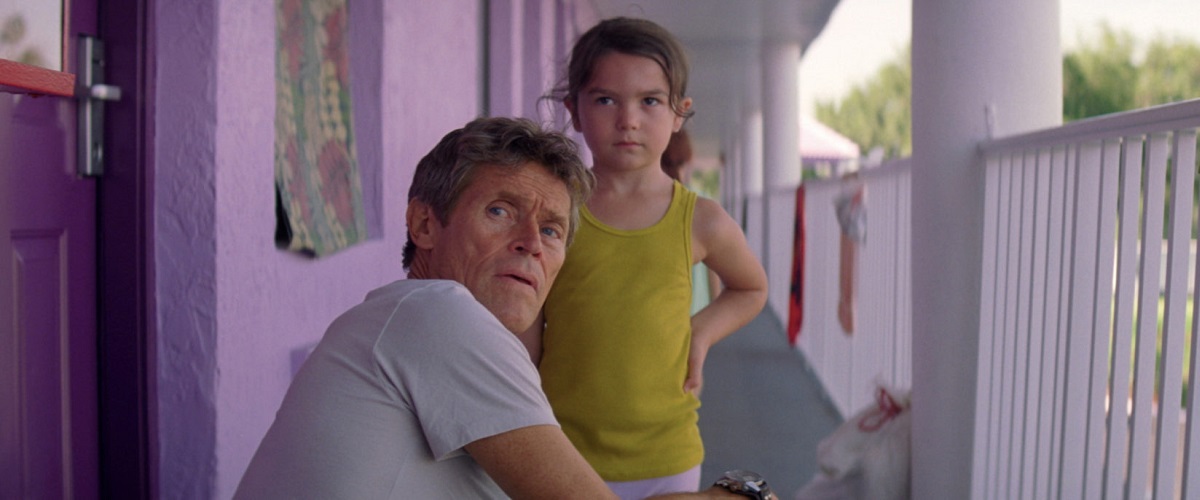
“If you’re working, who’s looking after Moonee?”
Just a few miles outside of Disney World, kids at the Magic Castle Inn & Suites create their own Magic Kingdom within the motel rooms, diners, ice cream booths, open fields, and souvenir shops of Kissimmee, Florida. They are too young to understand that they’re one bad month away from homelessness, or one parental misstep away from Department of Children & Families swooping in to take them away. For these kids, growing up in motel rooms below the poverty line is just… normal.
In one of the film’s opening scenes, the main character, Moonee, walks with her friends down the exterior corridors of the Magic Castle, telling them about who lives in each room: “The man who lives up there fought in some wars. And he drinks beer.” “The man who lives in here gets arrested a lot.” “This woman in here thinks she’s married to Jesus.”
She speaks as matter-of-factly as if she was saying that the sky is blue. By the age of six, Moonee has become desensitized to the kind of heavy adult tragedy that more privileged kids are often shielded from.
For viewers, it is clear that this is not an ideal environment for children to grow up in.
Several scenes reinforce this. After Moonee tells her friends who lives in what room, they turn to walk down a staircase: “Watch out for the water,” she says. “I went to the hospital one time.” Halfway through the film, a brawl breaks out in the parking lot and the motel tenants — including Moonee’s mom — drink beer and cheer on the fight from the balconies as men get thrown around and roll off of the roof of a car. Moonee and her friends watch from afar as a woman sunbathes topless by the pool without regard for who can see her. All of the adults smoke and curse and encourage bad behavior; Moonee’s mom steals Disney Magic Bands from one tourist and sells them at a discounted price to another with Moonee’s help.
In addition to the internal drama, outside danger is always lurking. In one particularly harrowing scene, a group of kids run and play around the picnic tables in the yard next to the motel while Bobby, the motel’s manager, paints the motel walls from atop a ladder. Without warning, a leering old man appears next to the kids. Bobby notices and flinches, accidentally letting his paint can fall to the ground. We see the paint splatter across the parking lot from overhead.
Bobby leads the old man away from the kids with a smile on his face… but when they are alone, the pleasantries drop.
Bobby is a stern but compassionate man; his job is often thankless, but he takes his role seriously as the guardian angel for these misfortunate families — especially when it comes to keeping the children safe. He’s a pseudo-father-figure for kids who have none. Without his empathy and willingness to help them out every time they’re in a bind, it would be so much easier for their lives to shatter.
If the film had focused predominantly on the adults, it could’ve easily drifted into melodramatic territory. But it doesn’t. Instead, we see this world predominantly through the eyes of the kids. Over time, this perspective gives us a deeper, more complex story. The children are free from responsibility and mostly shielded from the rougher edges of their lives. They are still full of audacity, hope, and wonder.
The tonal conflict generated by shifting between the adult and childlike points of view is what makes this story feel so tragic when it all comes crashing down. The ending of The Florida Project is heartbreaking, and the characters’ circumstances are harrowing… but from their perspective, they’re just normal kids having fun.
The movie opens with the main character, Moonee, running with her friends Scooty and Dicky between the Magic Castle and the neighboring Futureland motel to play. As long as we’re with them, there isn’t a hint of potential tragedy. As they move from one place to the other, Kool & The Gang’s “Celebrate Good Times” breaks out on the soundtrack. “There’s a party goin’ on right here.”
From there, The Florida Project unfolds as a series of vignettes; the movie doesn’t tell a story so much as capture a way of life. Like most kids, Moonee and her friends spend much of their time getting lost in their own imaginations. It’s easy for them to disappear into fantasy in this environment as the world around them feels larger-than-life. The locations are simultaneously gaudy and whimsical: a gift shop adorned with the head and arms of a wizard, an orange-domed fruit shop called Orange World, and an ice cream stand shaped like an ice cream cone. For adults, the locations could come across as ostentatious; for kids, they inspire the imagination.

The Magic Castle itself is a far cry from a luxury hotel; in one comedic scene, a tourist couple arrives to check in and are horrified as the reality of what they booked does not at all live up to their expectations. But for the kids, it offers so many opportunities to escape from reality. They hide behind the stairwells, bother the staff in the reception office, and race through the exterior corridors as if they own the place.
For most of its sequences, The Florida Project is filmed in an observational style; there is a spontaneous quality to many of the scenes that makes it feel like director Sean Baker just set his camera down in a wide shot and let the actors play.
In one scene, the camera sits behind a fan as the children do nothing but make silly noises in it to try to make each other laugh. In another, Moonee and her friend Scooty sit in the lobby of the Magic Castle eating ice cream and barely keeping their composure together as Bobby watches them sternly to make sure not one drop of melted ice cream drops on to the floor.
There is a wonderful improvisational nature to the performances that makes the characters feel authentic and adds a level of unpredictability to our experience of watching the film. The off-the-cuff nature to the scenes gives The Florida Project an almost documentary-like feel.
So much in this movie feels spontaneous because it was, in fact, crafted spontaneously. The production didn’t have the budget to shut down the aerial tours that take off next to the real-life motel, so we see the kids in the film yelling at the helicopters while Moonee’s mom Halley flips one off.
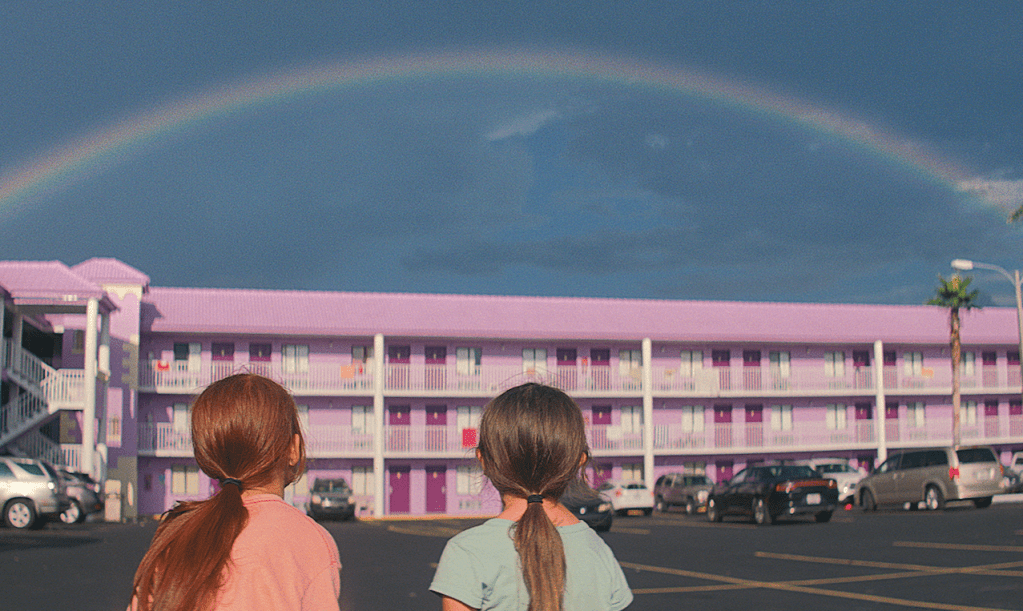
And, when a rainbow appeared over the motel in real-life, Baker and his team changed their shooting plans for the day to run down to the parking lot, set the camera down, and roll on a wide shot of the kids talking about the leprechaun that lives at the end of it… and how they should go beat it up.
In this scene, from afar, we contemplate the motel; the purple hues of its walls contrast the bright white railings and staircases that tie together the stacked tiers of exterior corridors. As much as it is clearly not a suitable home, seen through the eyes of the children, it does occasionally feel magical.
The characters in The Florida Project don’t wallow in their misfortunes; they make the most of their situation.
In another of the film’s most beautiful scenes, Halley takes Moonee and her friend Jancey hitchhiking at sunset. As night falls, they set up a picnic for themselves by a lake. They light a candle on a small cake to celebrate Jancey’s birthday, then turn their attention to the sky. Fireworks erupt in the distance as the nightly show at Disney World begins.
They may not be able to afford to go to the park, but they can still experience some of the park’s magic from afar. For the kids, the setting makes little difference — their eyes still light up with wonder as they watch the brilliant explosions.
Throughout all of the film’s loosely connected scenes, Moonee and her friends get into all sorts of mischief. Some of it is joyful, some of it is harmless, and some of it is extremely dangerous. When shooting from their perspective, Baker doesn’t distinguish between the three. The kids have no adequate role models to teach them right from wrong, so it’s fitting that no major stylistic distinction is drawn between how we see Moonee and her friends accidentally burning down a dilapidated home, and how we see the more frivolous scenes with the ice cream and the fan.
Because of this tonal conflict, the ending feels both inevitable and emotionally jarring.
In the film’s climactic moments, the gentler observational editing pattern that pervades the rest of the movie is broken as Baker cuts more frenetically between Halley struggling to keep her composure in front of social workers, another social worker unsuccessfully explaining to Moonee what is going on, and Bobby comforting the kids and then removing himself from the situation to smoke a cigarette out back.
In this montage, we often see Bobby from behind in a shallow depth of field or from afar in a wide shot as he feigns detachment by telling another tenant that he intends to fix the broken laundry machines later that week. Talking about day-to-day business is his way to distract from his own inner conflict.
These moments with Bobby are intercut with handheld, low angle footage of the distressed Moonee and wider, shakier handheld camerawork inside of Halley’s motel room; the drama builds and builds until it culminates with a grotesque close-up of Halley’s mouth as she screams defiantly at the people tearing her life apart.

It’s a visceral, emotional resolution to a situation that could have had no possible positive outcome. The warning signs were there all along, but the kids, in their bubble, could never have seen them.
After this climactic montage, Baker includes a heartbreaking coda. Moonee and Jancey run away to Disney World. We see happy families enjoying the extravagant park as these two kids, their lives upended, desperately try one more time to escape into fantasy to remove themselves from the cruelty of reality. It’s a small sliver of tragedy in a setting of peak capitalism.
That we become so emotionally invested in what happens to these characters in spite of the abstract nature of the storytelling is a testament to the quality of the performances, the effectiveness of the script’s point-of-view shifts, and the emotional pull of the film’s documentary-style look and feel.
All of these qualities together makes The Florida Project a compassionate piece of cinematic storytelling that offers audiences a poignant, empathetic opportunity to reflect on the lives of women and children like these characters, who exist on the fringes of society.
 Story / Telling