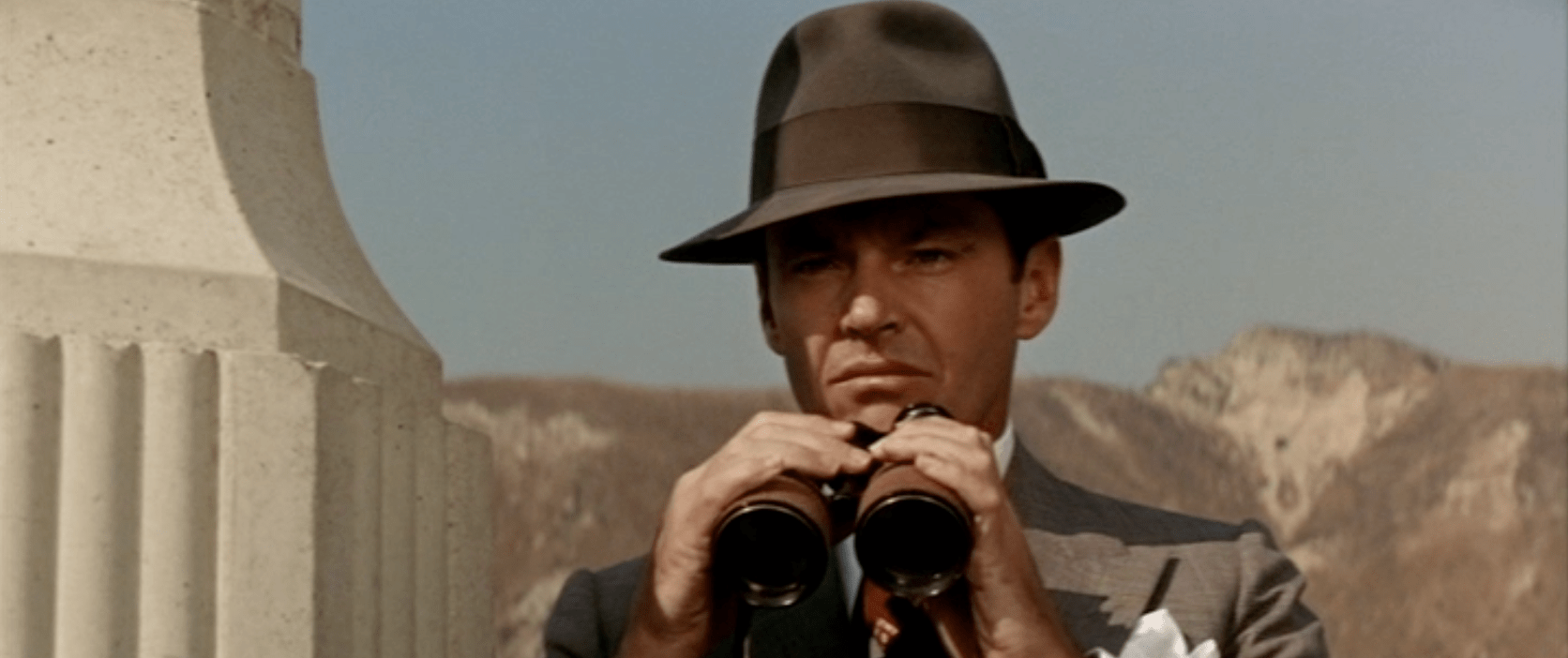
“Forget it, Jake. It’s Chinatown.”
Part period-piece, part film noir, Chinatown unfolds its version of a key event in the history of Los Angeles with a level of cynicism that befits that great American genre of crime cinema. As in most noirs, the story revolves around a hardboiled private investigator, here named Jake Gittes. As he begins to investigate an affair, the narrative becomes increasingly complicated — another noir commonality — with new crimes unveiling corruption after corruption until the whole world seems bleak.
Chinatown eschews the glamour frequently associated with the city of Los Angeles. In this vision of late-1930s LA, we only go to the beach to see water spilling out of a drain pipe at night, never get so much as a glimpse of the HOLLYWOODLAND sign or any other famous landmarks, and spend most of our time traveling from sprawling residential area to sprawling residential area, with trips to the dried-up LA River, dying orange groves, and Catalina Island to break it up.
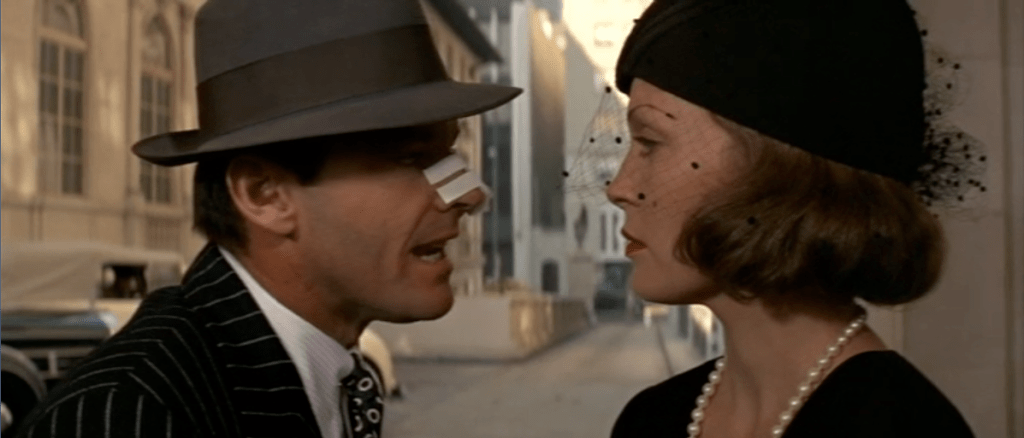
The characters, too, do not exactly embody traditional Hollywood glamour. Gittes, played by Jack Nicholson, spends more than half of the film with a bandage around his nose. “You’re a very nosey fellow,” a thug says before slicing his left nostril.
Everyone we meet is some level of corrupt, unfaithful, or victimized. Gittes, cynical as he may be, might be the most righteous of them all. That gets him into some serious trouble.
The opening scenes of Chinatown give us all of the context that we need to understand Gittes, his philosophy, and his line of work. “All right, Curly. Enough’s enough. You can’t eat the venetian blinds; I just had ’em installed on Wednesday,” he says to his client. He spins around in his chair, pulls a bottle of bourbon out of his well-stocked office liquor cabinet, and hands a shot glass to the crying Curly. Curly moves away from the blinds and takes the shot. “Down the hatch,” Gittes says.
As Curly leaves the office, Gittes pats him on the back, reassures him that he won’t nickel-and-dime him for his services, and leaves him with, “Call me Jake. Careful driving home, Curl, huh?”
This exchange serves as a compelling introduction to Gittes — it shows that he will go to great lengths to gather incriminating evidence for his clients, but that he derives no pleasure from it. He has a blunt, matter-of-fact way of speaking, but it’s not because he lacks empathy. He cares about his clients, but maintains professional detachment, too.
As soon as Curly leaves, Gittes meets with the story’s first femme fatale, a woman who calls herself Mrs. Mulwray and claims to be the wife of the Los Angeles Department of Water & Power’s Chief Engineer, Hollis Mulwray. This meeting kicks off the plot — it’s the “inciting incident” — but we cannot possibly guess where it’ll go from here.
Gittes is dressed in an off-white suit and speaks to this woman bluntly. He is relaxed and his dialogue is forthright; he lays all of his cards on the table. Mrs. Mulwray is dressed in all black; a veil obscures her face. She looks like a mourner at a funeral and speaks in guarded language as she enlists Gittes to follow Hollis to find out once and for all if he is having an affair with another woman.
Before he accepts the job, Gittes tells her, “Have you ever heard the expression, ‘let sleeping dogs lie’? You’re better off not knowing.” She tells Gittes that she has to know the truth. After a long pause, Gittes begrudingly says that he’ll take on the job.
Within the first five minutes of Chinatown, this dialogue and these costume choices provide us with essential context needed to understand the character of Jake Gittes and set up the primary theme of the movie: what are the perils and privileges of “letting sleeping dogs lie,” who can afford to ignore wrongdoings in order to maintain the status quo, and who benefits — and who suffers — from maintaining that status quo?
The costume choices in this scene and the woman’s guarded dialogue also make us feel uneasy. It’s evident that she isn’t giving us the whole story here.
The script by Robert Towne is great in large part because it does this kind of economical storytelling so well — and because it gives us just enough context to develop a clear understanding of what’s going on but not get bored as the fairly convoluted plot about land ownership, water management, incorporating the Valley into Los Angeles, incest, and the insidious motivations of people in power unravels.
It’s a complicated story, but we usually know what’s going on, and as the plot becomes more and more complex, Towne and director Roman Polanski find opportunities to catch us up to speed through situations in which explanatory dialogue feels organic.
In a scene mid-way through the movie, the real Mrs. Mulwray meets with Gittes in a dimly-lit restaurant. She’s hesitant to open up; it seems like she knows that it would be safer to “let sleeping dogs lie” in the case of her dead husband.
“Ok, go home. But in case you’re interested,” Gittes tells her as they wait for their cars to be retrieved by valets, “your husband was murdered. Somebody’s been dumping thousands of tons of water from the city’s reservoirs and we’re supposed to be in the middle of a drought. He found out about it, and he was killed. There’s a water-logged drunk in the morgue, involuntary manslaughter if anybody wants to take the trouble, which they don’t. It seems like half the city is trying to cover it all up, which is fine by me. But Mrs. Mulwray, I goddamn near lost my nose. And I like it. I like breathing through it. And I still think that you’re hiding something.”
This catches us up and convinces her to come along for the ride.
It doesn’t end well for her.
Chinatown might be almost fifty years old, but it remains as fresh and timely as ever. What starts out as an investigation into an extra-marital affair turns into a murder investigation, then turns into something bigger: a study of how money corrupts all levels of society, and how old white men with money hold so much power that they can get away with anything — incest, corruption, identity theft, and murder — and face no consequences as they accumulate more and more wealth and power while the working class struggles to get by.
Gittes becomes determined to discover who is responsible for all of the wasteful water dumping and the murder of Hollis Mulwray, and he intends sue them until the truth comes out to the press. When he tells this to his associates, they laugh: “Sue people like that, they’re liable to be having dinner with the judges trying the ‘suit.” So what’s the point?
There is only one scene in Chinatown that takes place in the titular low-income neighborhood of LA. This is because the story revolves around mostly well-off white people. But the script adds a layer of thematic complexity by maintaining a mostly subtle, peripheral focus on non-well-off and non-white people, particularly Chinese-American immigrants, from start to finish.
The servants at the Mulwrays’ estate are all Chinese; their labor allows the Mulwrays to live an indulgent, high-class lifestyle.
Gittes used to work in Chinatown for the District Attorney’s office; he tells Mrs. Mulwray that he was told to do “as little as possible” while working there, and we come to realize that the DA’s office covered up rampant corruption in Chinatown for years. Why Chinatown? Because low-income minorities do not have any power to fight back when they see that something is wrong.
The film ends with a shoot-out in Chinatown; the drama is between only a small handful of white people, but their dispute disrupts and shocks a minority neighborhood caught in the crossfire.
And then there are the farmers of the Valley, poor white men whose land is being purposefully dried up so that it can be purchased cheaply by wealthy white men, who plan on selling it later for a hefty profit once water — which they also own — is redirected back to the land.
And there are the elderly, whose autonomy and identity are taken away from them to cover up the paper trails without their knowledge.
Chinatown is a dark movie from start to finish, but one of its most cynical and astute thematic statements is that poor people and minorities are not just taken advantage of by the overtly corrupt people with money and power… but that that’s allowed to continually happen because everyday white and well-off people — even the “good” ones — have an ingrained, systemic tendency to look down upon people without money, power, or influence, and the consequences of standing up for these communities can often put someone who is already well-off at risk of losing their own status and comfort.
“Forget it, Jake… it’s Chinatown.”
Not even Gittes respects minorities or poor people; listen to his raucous laughter over an off-color, race-based joke about a “Chinaman.” Later in the movie, an angry Gittes calls one of the poor white farmers a derogatory term, “You dumb okie.”
We also never see anyone who isn’t white in a non-servant role.
It’s this sort of condescension that helps to maintain the status quo, even when the well-intentioned white characters refuse to “let sleeping dogs lie.”
“Go home, Jake,” the police officer forcibly says at the end. He adds, in a near-whisper, “I’m doin’ you a favor.” Jake is made to feel lucky for getting away with just a warning. The rich and wealthy Noah Cross “owns the police,” and there is no way that he would ever be incriminated for his misdeeds. So it’s best to ignore them, or risk losing everything else that Gittes holds dear.
Cross relishes his power. When Gittes makes a veiled threat to him over their lunch on Catalina, Cross isn’t the least bit concerned: “You may think you know what you’re dealing with, but believe me, you don’t.”
Chinatown may not be a traditional film noir; much of the movie takes place in the light of day, in sunny Los Angeles, in full color. But the images that I recall most vividly are as dark as the story and its themes: Gittes being pushed by an unexpected cascade of water down a pipe before getting his nose cut open by thugs. The fight outside of the retirement home in Mar Vista that ends with gunfire. And, of course, the final scene in Chinatown… in particular that long, wide shot looking down the neon-lit street as Mrs. Mulwray’s car rolls to a stop after gunfire. Pause. A car horn. Pause. A scream.

