
“Their knowledge of the art of the occult gives them tremendous powers.”
A bold red light illuminates Suzy Bannion as she passes through customs at an airport in Germany. Suzy, a young woman from New York, has arrived in Europe to attend a prestigious ballet academy. Her trip feels unsettling from the start.
We watch her walk down the hallway toward the airport’s exit in relative silence. Far ahead of her, a woman dressed in red approaches the automatic doors that lead outside.
As soon as the automatic doors open, a musical motif begins: a march of ascending and descending bell chimes playing a melody that would sound fitting coming from an old music box, punctuated by dramatic hits from other instruments and the sinister sound of raspy, disembodied voices.
As she leaves the airport, the woman in red is pelted by rain; her blonde hair blows in the wind. The automatic doors close, and the music ceases.
Suzy continues to walk in near silence. As the doors ahead of her open for someone else, the ominous music begins again.
When Suzy herself exits the airport, she is drenched by the pouring rain. Crashes of lightning illuminate her face as she attempts to hail a taxi.
The creepy music plays on.
A taxi finally stops for her. She struggles to cram her bags inside of the vehicle. In the cab, a dripping-wet Suzy tells the driver where she wants to go. Rain rapidly rolls down the back window, which is lit by brilliant blue light and the occasional bright white hit of lightning. Suzy herself is lit with orange and red hues.
As the taxi drives away and the music swells, the camera pans away from the car to reveal two raging floods of water cascading through a wall. Editing cuts our view of these ominous streams closer… and closer… to the water.
Through lighting, atmosphere, and music editing choices, director Dario Argento and his collaborators make it very, very clear in the opening scene of Suspiria that Suzy has landed in a strange and hostile world.
Then, they make it stranger.
More and more unsettling voices get layered into the soundtrack as the taxi pulls up to the academy, and the music swells as the camera tracks toward the front door. The facade of the building is painted bright red, with ostentatious gold and black decorative flourishes. Argento cuts to a shot of a sign on the facade. The water rushing down the bright red exterior wall almost makes it look like it’s raining blood.
Innocent Suzy, wearing all white, watches in confusion as a distressed woman bursts out from behind the front door and runs away, muttering in terror, into the night.
Suzy then tries to enter the academy and is turned away; she is forced to fend for herself for the night.
Argento intercuts the moodily-lit footage of Suzy getting back into the taxi with frightening footage of the distressed woman stumbling through a forest of dead trees in the rain until she arrives inside of a boldly designed housing complex decorated with red walls and geometric designs.
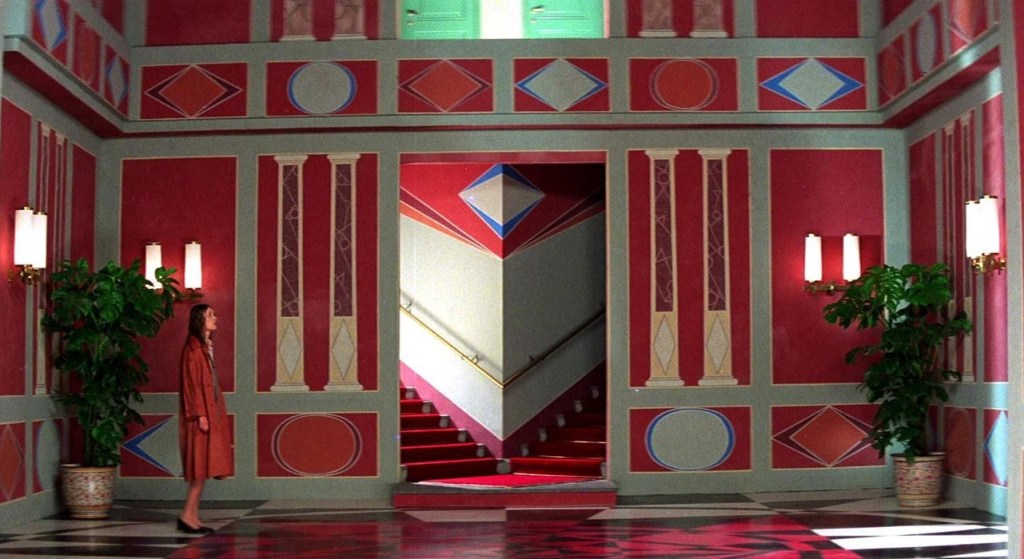
The music becomes more and more horrifying as the woman slows down her pace in the presumed safety of this space. Argento cuts away repeatedly to a stained glass window on the ceiling. This irregular editing pattern and unsettling score make us increasingly certain that something awful is going to happen as the woman enters an elevator and triangular red lights above it indicate her ascent.
Inside of her friend’s apartment, she is illuminated by a deep, unnatural blue light. She tells her friend that she needs to get as far away from here as she possibly can and that she cannot go back to the academy. When the friend asks why, the woman won’t tell her… “It all seems so… absurd.”
Alone in her friend’s spare bedroom, the woman watches laundry sway outside in the night, illuminated in that same moody, unnatural blue. She moves closer and closer to the window. We see her terrified reflection in the glass.
The violence that follows is unsettling and its execution is abstract. We lose our sense of where we are within the building as the woman is murdered while bathed in both blue and red light in a variety of visually conflicting spaces. After a short burst of brutality, neither character makes it out alive. The sequence ends with that stained glass window…
The next scene takes place the following morning at the academy. Without the rain, darkness, and foreboding music, it seems like a much more innocent place. The contrast in tone is jarring to the point of being disturbing on its own.
In these opening ten minutes or so, Argento boldly sets the tone and aesthetic standard by which he will tell this story. Though the stylistic choices become momentarily more grounded in reality as Suzy adjusts to her new environment, the abstract visual style returns as the horror grows.
The plot of Suspiria is, to borrow the first victim’s description, “… absurd.” But the way in which the absurdity is told is uniquely compelling.
Horror movies often take craft elements — lighting, shot composition, music, production design, costuming, performance, and editing — to the extreme in order to play with our emotions. Few do so as artfully as Suspiria.
The movie is ineffective when it tries to over-explain its story (i.e., the silly scenes in which Suzy meets with a psychologist outside of a college to talk about witch covens). The movie is effective, however, when its storytelling functions more like ballet — visual splendor and hypnotic movement working in harmony to convey emotions. Suspiria is best when events play out as a dance of color and light. Form is the most dynamic content here.
The rooms and hallways of the academy are all lined with walls of bold, extravagant colors and designs. As Suzy becomes acclimated to the academy, we see these rooms lit in a mostly natural manner. But as the horror begins to escalate around her, emotions are conveyed and events are increasingly shot with bold, abstract, extravagantly colored lighting designs that evoke the intensity established by the visual style of those foreboding opening scenes.
The colors of the light throughout the scenes of horror in this movie are distinct, unnatural, and bold. Suzy is first afflicted with a horrible headache as she is flashed in the face with a bright yellow-white light that cuts through shimmering dust. After maggots start to fall from the ceilings of the residences, we see swarms of them illuminated in the dark attic by a deep, bold blue. As the academy fumigates them out, the students are all forced to sleep in a common room together. Once the students settle in to their cots, this makeshift dormitory is lit with a moody, unsettling red light that shines through the white sheets draped all around them. It feels surreal, and it’s a clear sign that for most of them, it’s all downhill from there.

Hallways thereafter increasingly become illuminated by stylistic lighting that is colored either red or blue. The coloration is not motivated by any visible natural or artificial sources.
As the style becomes more and more heightened, Suzy and her friend Sara learn more and more about what is really going on behind-the-scenes at the academy. This does not bode well for the characters.
One night, Suzy passes out in bed. Sara, scared that they are being targeted by the powers-that-be, begins to panic. Afraid that someone might be watching them, she shuts off the light switch in the bedroom. The overhead lamp goes dark. Instead of filming the rest of the scene in realistic darkness, Argento and his DP Luciano Tovoli fill the room with vibrant, bold green light… for the audience, it looks as if we’ve made the shift from normal sight into night-vision.
As Sara tries to escape, she opens the door to the hallway, letting a bright red light mix with the green. She ultimately meets her demise in hallways and pits of wrapped wire that are bathed in that deep, dark blue.
All the while, the same unsettling music motif continues to haunt us, and the disembodied voices call out to us on the soundtrack.
There is a distinct, admirable boldness to the way in which Argento and his team eschew naturalism in the pursuit of abstract lighting and extravagant production designs that elicit heightened emotion. Lighting, editing, score, and art direction carry the story along far more compellingly than the plot or the dialogue do. It isn’t Suzy’s triumph over the witch coven, per se, that leaves us smiling with her in the end as she is soaked once again in both torrential rain and unsettling red light.
It’s the way in which we’ve been told that story that ultimately makes Suspiria so thrilling.

 Story / Telling