“A time will come when we will know what all this is for.”
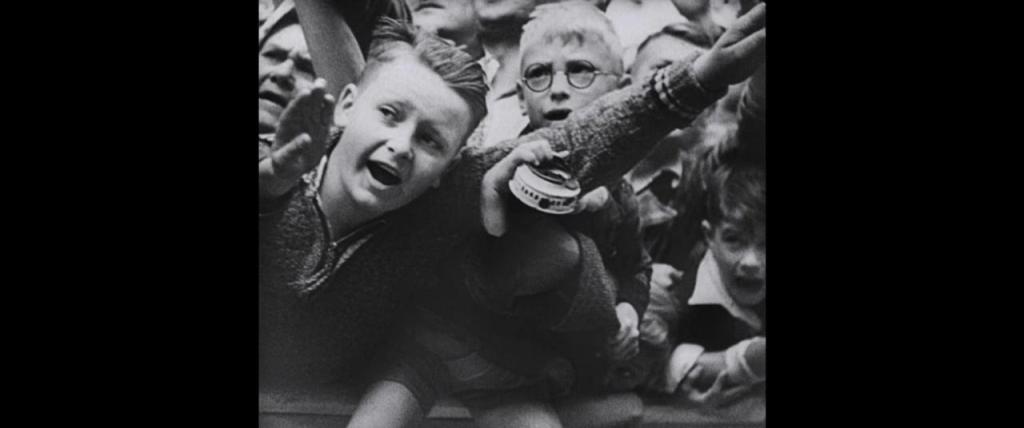
The newsreel footage at the beginning of Terrence Malick’s A Hidden Life shows a parade, and its star is Adolf Hitler. Hundreds of adoring fans salute as he passes by. Children push each other aside to get a better view of the Führer. A crowd, numbering in the tens (if not hundreds) of thousands, gathers to hear him speak. We faintly hear their cheers on the soundtrack as fireworks erupt in the sky and seemingly endless rows of torches march toward an unknown target in the night.
Later, German soldiers play newsreel footage of their army’s devastation of Europe for a group of Austrian recruits, including the film’s main character, Franz Jägerstätter. Franz is the only one among them who does not vigorously clap. Still later, when Franz is forcibly placed on a train and shipped off to Tegel Prison, Malick shows newsreel footage of trains racing toward the nearby city of Berlin.
The newsreel footage spliced throughout A Hidden Life serves two purposes. First, it vividly shows us how popular Hitler and the Nazi party had become by the late 1930s. Second, its recurrence as a motif interrupts the main story enough to remind us not to mistake the dramatization of Franz’s story for fiction. The reality of what happened during this time period can never be forgotten, and the film, as such, should be viewed as dramatized history.
A George Eliot quote concludes the film and gives it its title: “the growing good of the world is partly dependent on unhistoric acts, and that things are not so ill with you and me as they might have been is half owing to the number who lived faithfully a hidden life, and rest in unvisited tombs.”
A Hidden Life is not about Nazis, or Hitler, or the Allies, or even the war itself — though all of those forces alter the lives of the film’s cast of characters. A Hidden Life is, instead, about ordinary people on the war’s edges: men and women whose lives could carry on as normal if they swore an oath of loyalty to Nazi Germany, and others who performed quiet, unhistoric acts to keep some small amount of evil at bay.
The heavy focus on normal, everyday citizens in the film’s archival montages is important because it plainly shows us that the alternative to the noble conscientious objector, Franz, is not a full-blown Nazi, but an average man or woman who, driven by bigotry or fear or indifference, allowed grave injustices to occur.
Much of the film focuses on the mundane, day-to-day activities of its main characters to reinforce the notion that these are not the people on the front lines of World War II — they are those on its periphery trying to keep their lives moving forward in the face of societal upheaval. A Hidden Life is about the unhistoric acts performed by one of them, Franz — and how his convictions upset his and his family’s established lives.
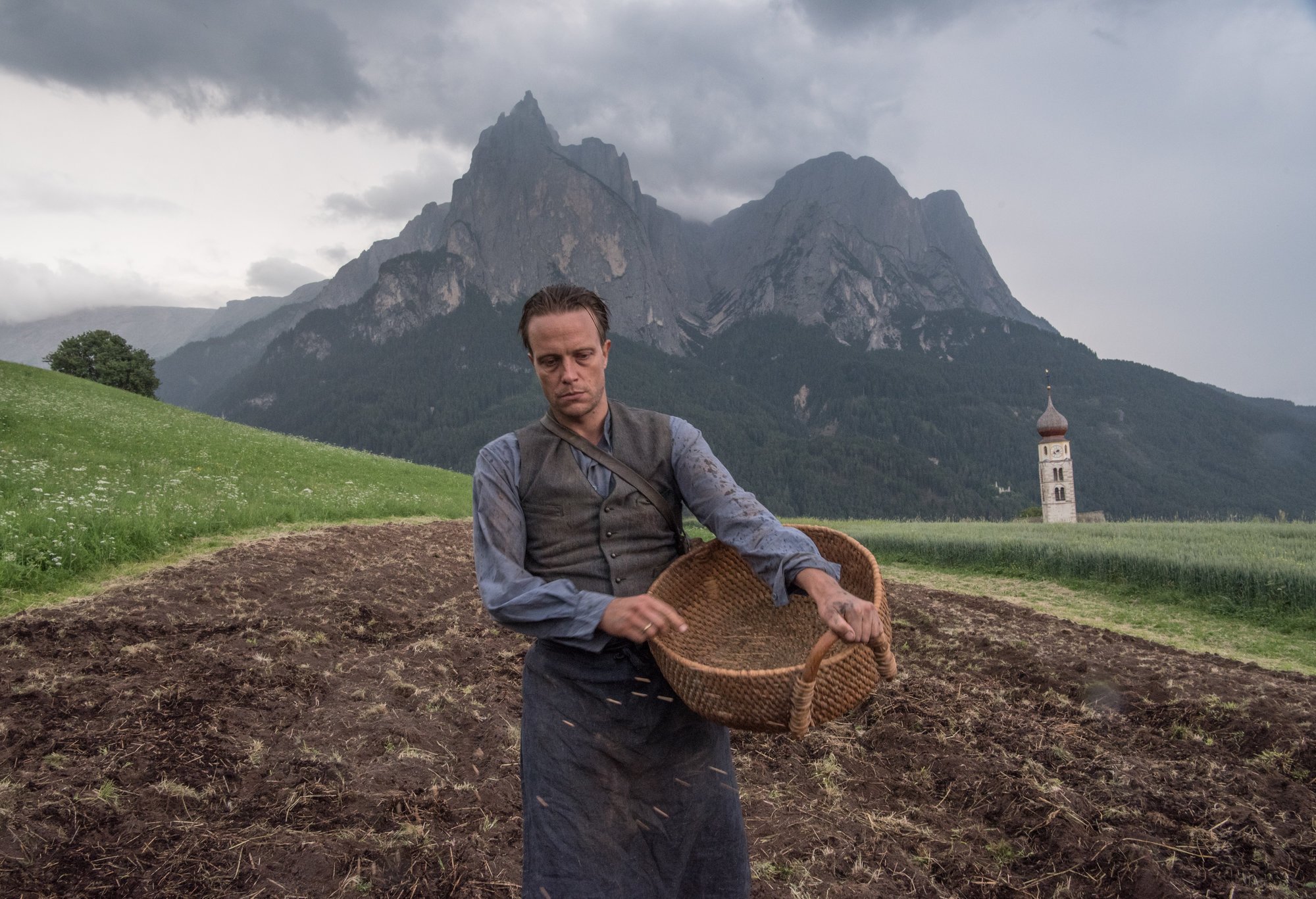
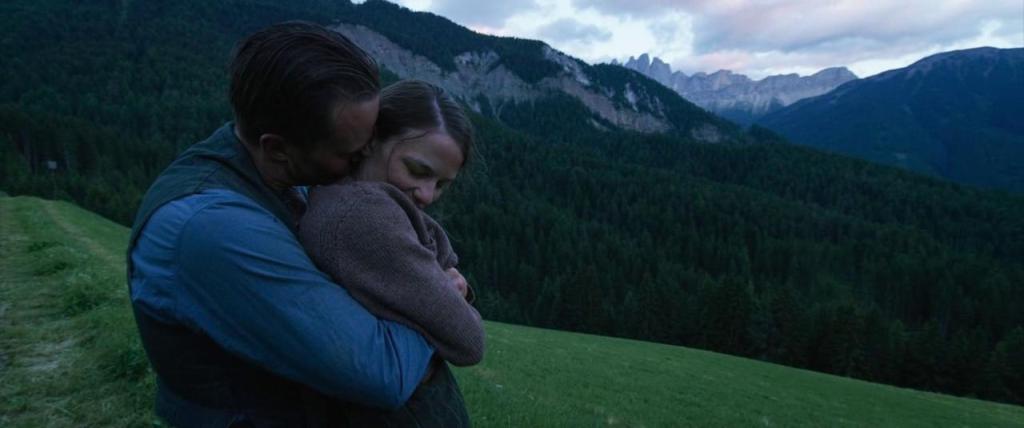
Franz and his family live in a small, agrarian community in Austria. Near the start of A Hidden Life, Malick presents us with a montage of joyful imagery that gives us an overview of their lives. We see them greet their neighbors in the streets, reminisce about the past over a warm meal, and swing scythes in their fields of grain. Their children chase chickens in the yard. Their neighbors dance together in merriment during a festival in their village. They smile deeply at one another. They are happy, or at least content, so far as we can tell.
Fields of vibrant green grass stretches as far as the eye can see around their home, all the way to the magnificent, grey, cragged Dolomites in the distance. The stunning scenery is a perfect match for their seemingly idyllic lives.
In both action and setting, their life feels like one that would be tragic to disrupt.
Heartfelt strings play on the soundtrack as Franz’s wife narrates, “It seemed no trouble could reach our valley.” For a moment, this feels true.
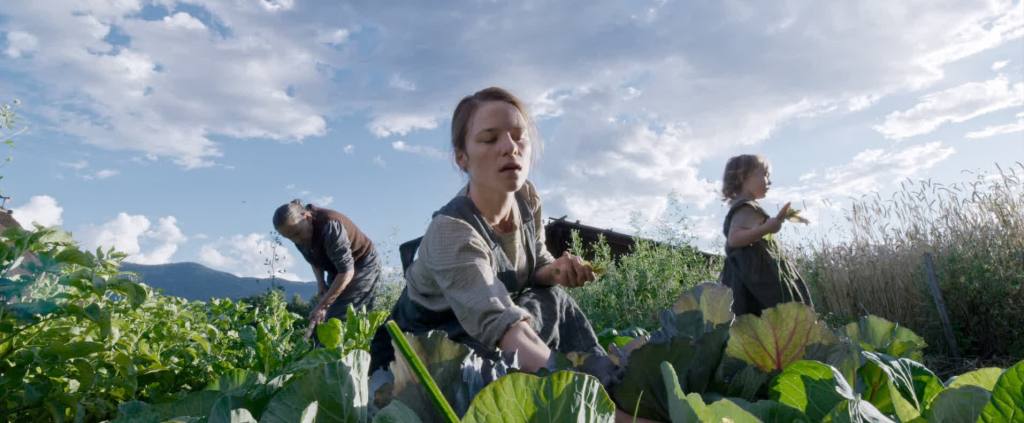
But trouble invariably comes. Malick ends this joyful montage with a shot of Franz’s wife, Fani, pausing her work to stare at the sky with trepidation while we hear a plane fly overhead. The shot stays with her — we do not see the sky from her point of view. The fear and uncertainty of the war is, for these characters, indirect — metaphorically akin to the sound of a military jet interrupting their daily labors, as opposed to the same jet bombing their village. As such, it’s appropriate for the camera to linger beside them and let the threat pass unseen by us.
Later, even when trouble comes to pass with more direct consequence, life continues to go on.
So many of the vignettes we see of Fani after Franz is arrested focus on her continuing the same day-to-day activities as before, only without him. She plays with their two young daughters and makes sure that they’re fed and go to bed on time. She drags a heavy basket into their fields to gather crops, and sheers one of their sheep. She unclasps dry laundry from cables outside, brushes a cow, and carries a long tray of baked bread away from the furnace and toward their home. The townspeople shun her for her husband’s disobedience — Malick shows them spitting toward her, or shooting her nasty glances, as she passes them in the streets — but she persists in her duties anyway. She still has children to take care of and a farm to uphold.
Malick’s extensive focus on Fani’s day-to-day life in her husband’s absence prompts and gives us space to ponder the moral ambiguity inherent in this situation. Yes, it is noble that Franz refuses to swear allegiance to the Nazi party. But does that nobility justify his daughters growing up without a father? His wife being outcast and made a widow?
In long, drawn out sequences with minimal dialogue, we are meant to contemplate questions such as this.
With one notable exception — when the camera takes the point of view of a collapsed Franz while the boot of a prison guard bears down on the lens — A Hidden Life is filmed in an observational style. Malick often seems to give his actors prompts, then let them improvise and riff off of those prompts, without being tied too closely to a script or specific blocking. The camera often floats in a wide, free-flowing manner, ready to reposition at any moment; scenarios are often naturally lit to allow the actors to move wherever they choose within the frame. Scenes are then spliced together from what Malick deems to be the most impactful moments of any given vignette, regardless of continuity.
That doesn’t mean that scenes feel disjointed. The lack of continuity between shots in sequences add a layer to the narrative that would otherwise be missing. In one scene, for example, the village’s drunken Mayor confronts Franz with a defense of the Führer: “He was not content to watch his nation go under. Before he came, it was all in a state of collapse.” Franz stands silently in front of him, neither wanting to agree with that sentiment nor cause drama. “You’re drunk,” he finally replies. Malick then cuts to a shot of Franz sitting at a table, holding a pint of beer in his hand. The Mayor continues to vent disjointedly as if time had not passed: “And I am not your friend. I am your Mayor! And now they tell us to spare these other races.” The camera then follows the Mayor from table to table outside as he meanders between groups of villagers on his racist tirade.
In the space of a single cut, Franz had to have ordered a pint, received it from a bartender, and sat down at a table beside his friends. We don’t see any of that action. Because the scene is edited so that it starts immediately with dialogue on the cut, we can assume that the Mayor’s tirade filled the space in which those actions occurred. Frequent jump cuts paired with the continuous conversation give us space to ponder exactly how much time had passed with the Mayor rambling about Hitler’s cause.
The Mayor’s racism and blind allegiance therefore come across as even more aggressive, imposed, and relentless in this scene than they would have in an more traditionally edited sequence.
In another scene, Franz visits the region’s Bishop to grapple with his moral dilemma aloud to a figure of presumed higher authority. Franz sits down in a chair, and the Bishop stands behind his desk, upon Franz’s arrival. Franz asks the Bishop an open-ended question; the Bishop does not reply.
Malick cuts, and the Bishop is now sitting. Franz speaks again: “If our leaders are not good… if they’re evil… what does one do?” Before the Bishop replies, Malick cuts away to a shot of Fani standing in the hallway outside of the Bishop’s office. Then, back in the office, the Bishop chooses his words carefully: “You have a duty to the Fatherland.” There is a long pause. The Bishop stands after another cut and opens a window. He tells Franz about his obligation to the State: “Let every man be subject to the powers over him.” Malick lets this sentiment play out in voiceover narration while he cuts away to a vignette of Fani strolling through the monastery gardens. How much time passed between those moments? In the edit, it is mere seconds. In the real time of the story, was it minutes? A half hour?
The jumps in space and time in this scene again make us ponder just how long Franz sat in that chair, trying to no avail to get the Bishop on his side. That the Bishop does not relent after all of that unspecified time makes Franz appear to be so much more isolated than a scene showing an unbroken conversation between him and the Bishop could ever make him seem.
In this way, A Hidden Life is efficient storytelling: it says more with its abrupt jump cuts than more straightforward, slowly paced edits ever would in the same amount of runtime.
In other ways, however, A Hidden Life rightly takes its time. Malick cuts away to shots of nature often to give us space to process our own thoughts and emotions while we absorb stunning scenery and stirring music. We often see Franz doing manual labor, contemplating silently, or strolling alone in a field. Characters speak slowly, minimally, and carefully — and they stare at each other for long periods of time before they do.
These moments — of which there are many — have a twofold effect: they enhance our understanding of the seriousness of the matter, and reinforce the strength of Franz’s resolve.
We know that his decision was not made lightly. We’ve seen him endlessly ponder it, we’ve seen the beauty that he is giving up because of it, and we have seen German officers scream in his face and loved ones gently plead him to renounce it.
In spite of it at, Franz remains stoic and resolute. In the end, it’s an ‘unhistoric act.’ But it’s a complex, moving one that warrants deep reflection.
 Story / Telling