“What else is life but being near you?”
When John Smith is captured by the Powhatan tribe, he finds himself smitten by the chief’s daughter, Pocahontas, yet unable to speak the tribe’s language. Word by word, he begins to learn — and teach them his own — in order to win her affection and negotiate on behalf of his kin.
Director Terrence Malick starts this sequence with a tracking shot following the pair — Pocahontas in the foreground, Smith in the background — as they slowly walk through the Powhatan village. They both face the camera. He gazes longingly at her. She turns her head in his direction, but does not fully turn to meet his gaze.
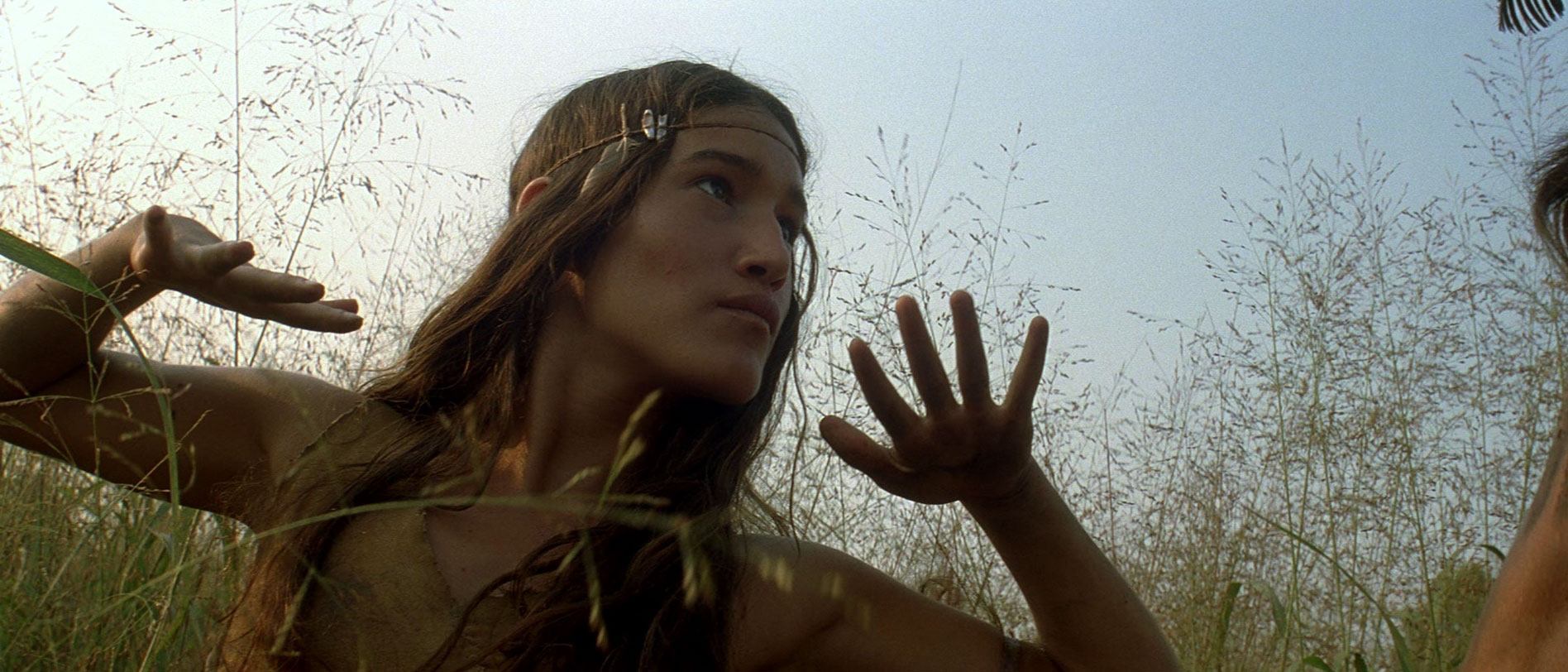
Then, Malick cuts to a medium over-the-shoulder shot on Pocahontas as she gestures her arms upward and sways. She says her word for the sky, then he says his. “Sky,” she repeats. She then makes another gesture and says another word. Malick cuts to the reverse over-the-shoulder shot, on Smith: “Sun,” he says, glancing skyward. “Sun,” she repeats. She gestures with her arms. They each learn the other’s word for “water.”
Malick makes a jump cut to show her swaying playfully with her arms reaching for the sky. She runs in circles around Smith saying the English word for “wind.” Smith smiles.
After a brief montage of other Powhatan tribe members sorting beads, the sequence resumes. Now, instead of ambient noise, the soundtrack is filled by soothing piano music and lilting strings; instead of medium shots, the scene is shot in close-ups. Pocahontas and Smith learn the words for “eyes” and “ear” and “lips,” while gesturing to each others’ features.
It’s a simple but poetic sequence. The style visually reinforces the thematic notion that communication is the key to intimacy and connection. As they learn to speak to one another, Pocahontas and Smith physically become closer, the shots get tighter, and the world around them blurs as they begin to focus more intentionally on one another.
Soon, he is no longer a stranger trailing after her from afar, longing to connect. He sits next to her while she lays on a swinging bed of wolf pelts, gesturing playfully at the sky. He connects with the men of her tribe, then runs and lays with her in fields of tall grass. They peacefully swim together in the river. There is no conflict.
“There is only this,” Smith tells us in voiceover narration. “All else is unreal.”

All of Malick’s films contain, to varying degrees, montages of the natural world: animals, plants, water — the earth, the sun, and the sky. They generally aren’t just there merely for the sake of aesthetics, though they certainly add beauty to his films. The montages of this kind in The Thin Red Line, for example, highlight the savagery and cruelty of nature: a wounded bird, a snake slithering through a field, a crocodile lurking in the river.
The montages in The New World, by contrast, highlight nature’s beauty: water rushes through rocks in a stream, a bird flies through the sky, sunbursts cut through the trees and flare up the camera’s lens. Grass sways in the wind.
Nature in this film is both beautiful and peaceful.
In this film about a conflict between peoples, the Powhatan tribe is on the side of beauty and peace, and their village is aesthetically integrated into the natural world around it as such. Its wigwams are interspersed between tall trees; its grounds are covered in grass. Their society has no firm borders — it extends into the nearby water and out into the surrounding fields alike.
The Powhatan are at one with nature. When Pocahontas experiences joy, she reaches for the sky; when she experiences despair, her hands clutch at the dirt below her.
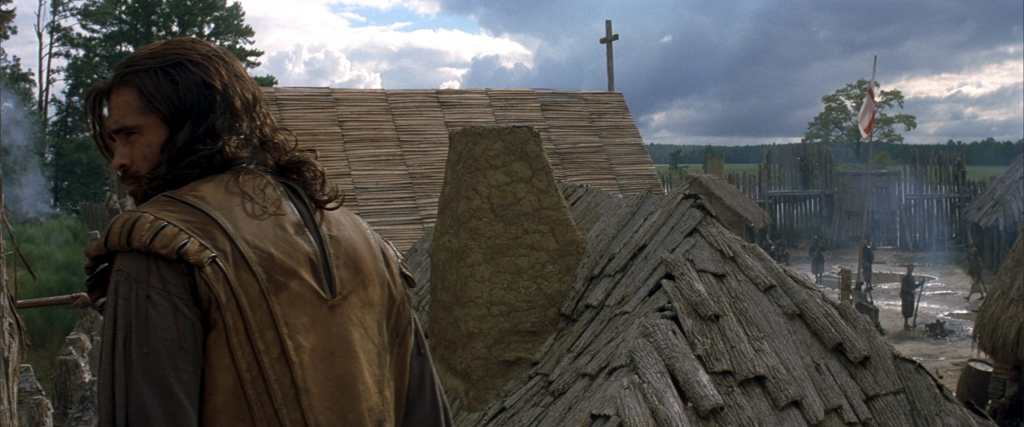
The colony in Jamestown, by contrast, is the aesthetic opposite: a village torn out of nature and secluded from it. The English settlement is surrounded by a wall constructed out of vertical logs, all of which have been indiscriminately sharpened to a point. The ground below their meticulously hewn huts is nothing but dirt and mud. Their weapons are made of metals; full-sized cannons sit in the middle of their village where mats filled with seeds and berries might be in the realm of the Powhatan.
Jamestown looks like it is at war with the natural world, not part of it.
Just before irreversible fighting breaks out between the colonizers and the native tribe, Malick lingers on wide shots of Pocahontas walking, crestfallen, on piles of logs in a grove of fallen trees. It’s the perfect symbol for the colonizers: a wealth of natural resources violently taken with nothing given back in return.
Before the English settlers arrive, the Powhatan swim naked in the nearby river, free from any fear of the world. After mere months of colonization, the fires of the settlers light up the natives’ wigwams and shroud fields of their crops in ash and smoke.
The dialogue in The New World is sparse. Sequences are more often than not comprised of vignettes as opposed to fully realized scenes. Malick assumes that we know the story, so instead focuses his film on these two aforementioned components of it: communication and nature.
His goal, it seems, is to explore the differences between these peoples insofar as they relate to the natural world around them, while examining the fear that arises from being unable to communicate, and the beauty that can come from trying.
In doing so, Malick crafts a wholly unique experience: an original, poetic take on a well-known tale.
In the end, Pocahontas finds herself in a new world of her own — London — betrothed to John Rolfe. There, she greets royalty, dresses in England’s finest, and Anglecizes her name. In many ways, she finds herself at the top of London society. But she is inherently out of place among the British, and ostracized by her own people back home.
In a particularly melancholic scene near the end of the film, Pocahontas finds herself torn between both worlds as she bids farewell to her uncle in a carefully manicured, regal garden. They stroll side-by-side between rows of trees. She asks him to tell her father, the chief of the Powhatan tribe, that she is still his daughter in spite of her mistakes, and wishes all honor to him. Her uncle does not reply. As he walks away, she stares ahead, and the camera retreats with her in the opposite direction. She does not look back.
The New World is, ultimately, about the clash of two cultures whose languages and worldviews do not mesh, and of the violence that ensues when communication between opposing factions is forsaken.
But it’s something else, too. Its lengthy, visually poetic sequences in the Powhatan village make an emotionally compelling case for us to live a simpler life — a life entangled with nature instead of at constant odds against it.
But in the story’s coda, Malick adds nuance to this case — and depth to his film. Dressed in luxurious and undoubtedly expensive attire, Rebecca (formerly Pocahontas) cartwheels through the lawn behind Rolfe’s manor, hides among the carefully manicured bushes, and splashes water upon herself in a pond with joy.
Regardless of the world in which she lives, she chooses to exist in harmony with the natural world and regard it with acceptance and awe.
Through its poetic examination of this worldview in both the Powhatan village and English communities, The New World posits that perhaps our societies would be better if we took the same approach.

 Story / Telling