
“A person may like pineapple today and something else tomorrow.”
Chungking Express connects two parallel but separate storylines via a central location: an urban food stand. It’s the perfect hub for the various narrative spokes: a place that is believably accessible to all of the characters and open late at night, when most of the action (and inaction) happens. The location itself is also neutral territory; it has little to do with the plot (so much as there is one) of either story, yet is an integral part of the setting of both.
Both stories in Chungking Express revolve around heartbroken police officers, Cop 223 and Cop 663. Writer / director Wong Kar Wai has symbolic fun with the characterizations of the women with whom they become involved as they bounce back from their heartbreak: Cop 223 becomes entangled with a big-time drug smuggler, and Cop 663 falls first for a flight attendant, then a food stand staff member named Faye. All of the women are personifications of relationship red flags: the lover whose values conflict with your own, the partner who doesn’t want to settle or stay in one place, and — in Faye — the potential love so anxious and terrified of vulnerability that she only visits the Cop’s apartment when he isn’t home.
Through all of these characterizations, as well as narration that describes the Cops’ own emotional quirks and baggage, Wong Kar Wai finds memorable, comedic ways to explore thematic ideas about relationships. The ideas themselves have been explored before in countless stories, but because of the personality and creativity imbued in the telling of this one, the execution feels both intentional and uniquely Wong Kar Wai’s own.
“We split up on April Fool’s Day,” Cop 223 muses in narration about his failed relationship with a woman named May. “So I decided to let the joke run for a month. Every day I buy a can of pineapple with a sell-by date of May 1. May loves pineapple, and May 1 is my birthday. If May hasn’t changed her mind by the time I’ve bought thirty cans, then our love will also expire.”
The quirk repeats until it becomes a motif. The camera lingers on close-ups of preserved pineapple cans as Cop 223 sifts through them in a convenience store, relentlessly searching for one with the right expiration date. He confronts an unamused store employee at the end of April when he realizes that all of the nearly-expired pineapple has been removed from the shelves: “You realize what goes into a can of pineapple? The fruit must be grown, harvested, sliced — and you just throw it away! How do you think the can feels about that?” When the Cop finally meets the drug smuggler at a bar, it’s made clear by his awkwardness that he has forgotten how to make small talk, so he leads with, “Do you… like pineapple?”
Through repetition, the motif generates a theme: “In May’s eyes, I’m no different from a can of pineapple.”
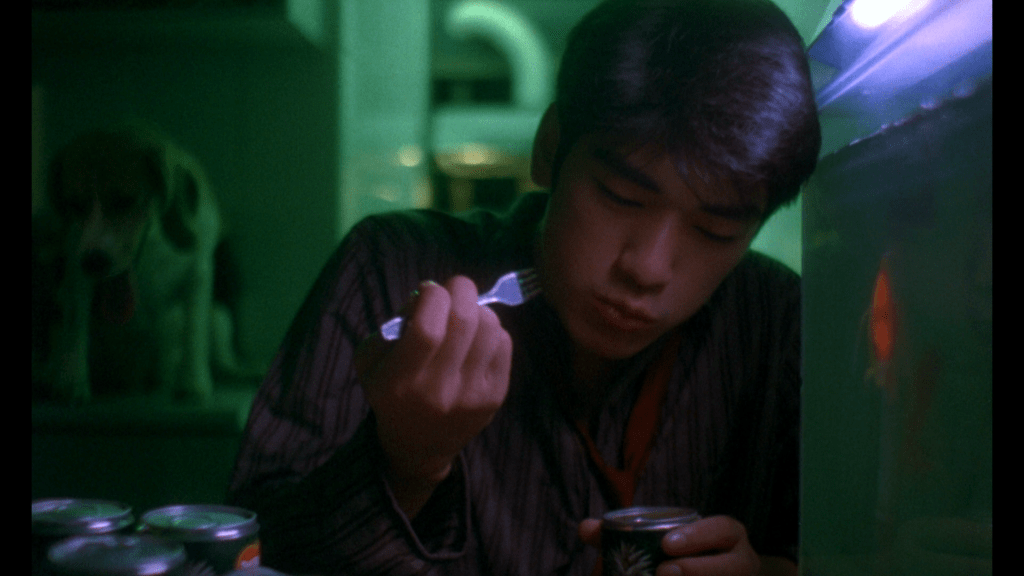
Neither Cop is conventionally aggressive, per se, but both act out traditional masculine values. Some are positive: Cop 663 carries heavy baskets for a woman he barely knows when he sees her struggling to drag them, and we watch Cop 223 dramatically rush through the streets of Hong Kong in handheld-camera-slow-shutter-speed-visual-chaos to subdue a criminal. Other traits are less positive and contribute to their personal turmoil. Cop 223, for example, remarks in amusing but melancholic voiceover narration about all that he does so that he never has to cry: “We’re all unlucky in love sometimes. When I am, I go jogging. The body loses water when you jog, so you have none left for tears.”
Cop 663 doesn’t fare much better in the emotional department, either. He projects his own emotional baggage on inanimate objects in his apartment instead of dealing with it himself. To his soap, he laments: “You’ve lost a lot of weight, you know. You used to be so chubby. Have more confidence in yourself.” To his wash cloth, he demands: “You have to stop crying, you know. Where’s your strength and absorbency? You’re so shabby these days.”
Wong Kar Wai’s stylistic approach to Chungking Express is very much that of the French New Wave, set in the neon-lit streets of Hong Kong. Handheld cameras observe stylized male and female characters interacting with one another in real locations. Scenes appear to be naturally lit, with any heightened visual stylization mostly arising out of the contrast of colors and shadows in the real environments themselves, as well as through dramatic shot compositions. Voiceover narration conveys the characters’ inner thoughts.
And, sequences are chopped up with jump cuts for dramatic effect. Early in the film, Cop 223 tries to find love via the 1994 equivalent of endlessly swiping on dating apps. Wong Kar Wai cuts between various shots of him making fruitless phone calls at a pay phone beside the food stand.
“Lulu? This is Qiwu. Want to come out for a drink? You’re in bed already? This early? You were asleep? Never mind. Bye. Chieko-san? Guess who? This is Qiwu. That’s right. Want to come out for a drink? Your husband? When did you get married? Five years! Has it been that long? You have two kids! You’re happy, that’s great! Okay, never mind. Is Kong Siu-wai there? This is He Qiwu. We were classmates in grade four. You don’t remember? Nothing, goodbye.”
The scene would be similarly amusing if Wong Kar Wai merely held on one unbroken shot of Cop 223 dialing, greeting, hanging up, and repeating the cycle over and over again. But the jump cuts break it up in an interesting way, giving the scene greater depth. Sometimes He Qiwu (Cop 223) stands, and sometimes he sits on the ground as he dials. Sometimes we see him in close-up, sometimes from afar. Because of his shifts in position and the variety of camera coverage, it’s plausible that we’re only seeing a fraction of the calls that he actually makes. This aesthetic approach adds a layer of sadness to the comedy, which in turn makes it more compelling — and more relevant to the film’s central question: why are we so bad at finding and holding on to love?

 Story / Telling