
“And when the sun went down, he ran again.”
Nearly every scene transition in Paris, Texas is marked by a slow, melancholic, lilting melody played on an acoustic slide guitar. Composer and guitarist Ry Cooder lets the notes of the score ring out; ambient sounds of nature fill gaps in the melody, but the tunes never fully resolve. Cooder recently stated in a BBC Radio 4 interview that he wrote the score in the key of E♭ — the same key of the sounds of the desert wind recorded for the film. Like the wind in the desert, the score gently breezes through the movie, pushing the momentum of the story forward while never indicating that the emotions of the characters caught in it will definitively settle or rest.
Travis, the protagonist of Paris, Texas, wanders into the story as if blown by the wind, and rarely speaks during the film’s first act. Instead, he spends lengthy sequences strolling through desert environments in the southwestern United States. Director Wim Wenders holds on to many wide shots of vistas — railroad tracks, open roads, prairies — in these sequences while Travis walks through the environments on a straight path from one side of the frame to the other, seemingly without thought. He may as well be a tumbleweed, aimlessly blowing forward in no purposeful direction by forces seemingly out of his control.
When we first see him in close-up, it becomes clear that Travis’ face has been scorched and dried by the desert sun. He looks dazed and morose, like any victim of his circumstances would look. But lest we mistake him merely as a poor, unfortunate soul, Wenders and team dress Travis in a suit, tie, and bright red baseball cap. His wardrobe contrasts dramatically with his circumstances: on the surface, he’s appears prim and proper — as if he were an upstanding member of society, at least before the desert sands got to him. In spite of that appearance, however, he is lost and alone and sorry for himself… a man blowing in the wind.
Cue the melancholic slide guitar.
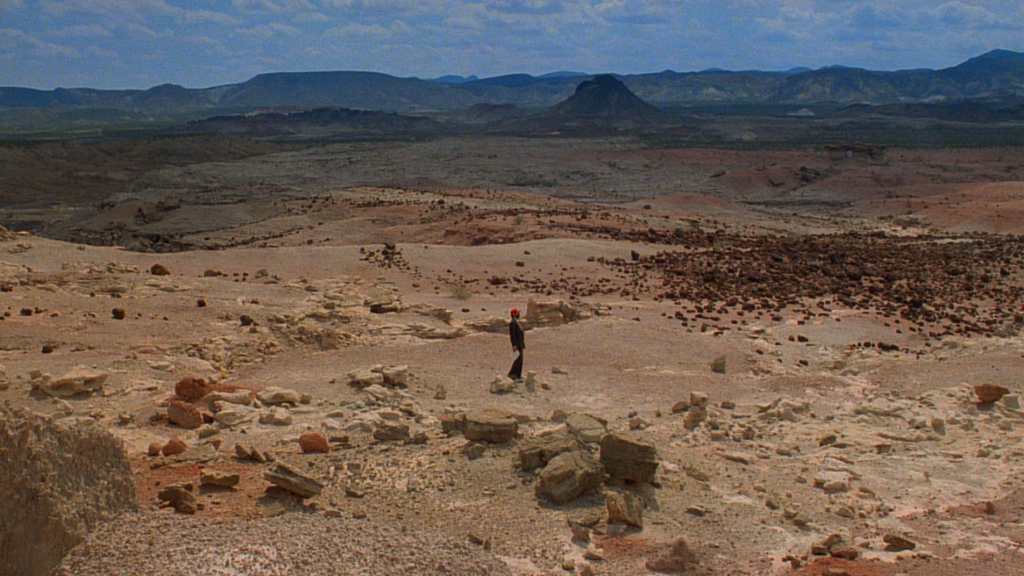
Late in the movie, we come to understand that Travis is deeply lost, emotionally and spiritually speaking. His introductory sojourn in the desert, then, takes on new meaning over time as a metaphorical representation of his conflicted inner world. As the film progresses from that sequence, other visual and dramatic clues reveal how he ended up so aimless, lost, and alone.
Much of the story of Paris, Texas — as much as there is one — focuses on Travis’ reunion with his son after four years of absence. But it is clear — by his silence and awkwardness around him in their first few scenes — that he has no idea how to communicate or express his emotions, even with his son.
Wenders and writer Sam Shepard insert a comedic scene shortly after Travis’ first interactions with Carson, his son, which pokes at the heart of what his character’s internal struggle is all about. The scene begins with Travis reading a magazine article about fatherhood, then bluntly asking his brother’s housemaid, “What does a father look like?” The housemaid then lets him try on new outfits so that he can outwardly portray the role of a rich “father” for his son.
The scene has a lighthearted tone, but it’s far from fluff — it’s an essential story beat that imparts necessary information to us about Travis’ emotional intelligence and personality.
After that scene, Travis tries to impress Carson with his outfit and his sense of humor by mirroring his kid’s behavior and acting silly in his extravagant attire while walking him home from school. But Wenders places father and son on opposite sides of the street instead of together; even when Travis tries to connect with someone, he keeps his distance. Wenders physically represents that idea by how he blocks his characters in this scene.
Travis’ inquisitiveness, vulnerability, and personality shine through to others brighter when there is separation between him and those with whom he wants to connect. When Travis is talking to his son on walkie talkies on the highway to Texas, for example, he sounds much more animated and curious; when he talks to his ex-wife on the phone in the club near the end of the film, he is honest and emotional in a way that we’ve never seen him be before. In both scenes, Wenders takes care to block Travis so that he is facing in the opposite direction of his loved one, with a physical glass window barrier between them. Travis can only open up when there is enough separation between him and those he loves so that he feels safe. He needs to be alone, but within earshot of the person whom he wants to hear him.
Shepard and Wenders sprinkle clues about Travis’ past throughout conversations in the script; of particular interest are dialogues that allude to Travis’ own parents’ shortcomings.
All of these dramatic clues and visual motifs paint a portrait of a man lost, guarded, and emotionally torn. By the end of the film, Travis’ seemingly shocking monologue about how he wound up divorced and in the desert in the first place feels somewhat inevitable upon close analysis. We aren’t surprised that a man so out of control of his own emotions — so guarded, so incapable of communication, yet so desperate for connection — would have made some of the decisions that he made.
But the film gives us no satisfying resolution. Like the melancholic melody of the acoustic slide guitar music, and the gust of the desert wind, Travis keeps sadly, steadily moving on.

 Story / Telling