
“You survived this long, I suppose, because of your ability to change sides — to serve any master.”
Mid-way through Tinker Tailor Soldier Spy, earnest spy Peter Guillam loses his cool when he discovers that presumed defector Ricki Tarr, whom he believed to be in Russia, is not only back in England, but the reason that Guillam was tasked with stealing documents from his own British Intelligence Service, known as the Circus. Upon seeing Tarr in a hotel suite, Guillam punches him in the face until he bleeds. Master spy George Smiley calmly orders Guillam to stop, then carries on the conversation emotionlessly, stating nothing but facts to clear Tarr’s name without ever raising his voice.
Immediately after this debacle, Guillam confronts Smiley outside: “Why didn’t you tell me that you had Tarr?” Smiley does not reply; he merely stares, letting Peter come to the conclusion on his own — “In case I never made it out of the Circus…”
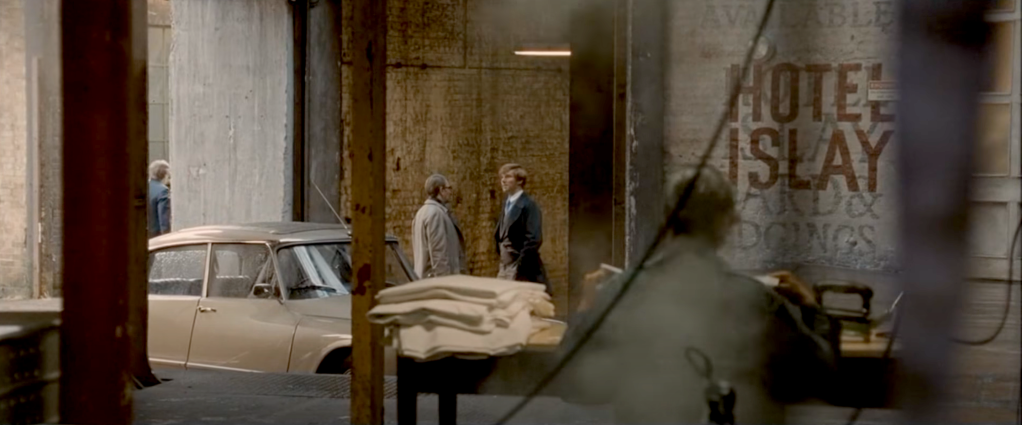
During this conversation, director Tomas Alfredson positions the two men halfway down in the center of the frame, far away from the lens. Between the camera and the characters, Alfredson places a parked car, vertical metal support beams covered in chipped paint, a woman folding laundry, wires, and billowing steam.
Their position in the center of the frame between two poles draws our eyes to them, but their lack of prominence in the shot makes them feel less like the subjects of the scene and more like background characters. In the frame, as in their lives, the spies are hidden in plain sight.
In Let the Right One In, Alfredson showed violence from afar in poetic, meticulously composed wide shots, in an effort to express brutality as a matter-of-fact, emotionless decision for his vampiric characters. In Tinker Tailor Soldier Spy, he takes the same approach for a similar reason. When Irina, a Soviet agent, discovers her husband disemboweled in a bathtub, Alfredson doesn’t cut to a close-up for dramatic effect. He holds his camera static, showing us the whole crime scene in one unbroken shot. Violence is a known risk of these characters’ professions — never a true surprise. Its aftermath is presented matter-of-factly, as such.
In vignettes that explore characters’ domestic matters and personalities, too, the shot compositions are often held wide, and the editing patterns show restraint. Spies live double lives by trade; most character moments that aren’t directly related to the investigative plot, therefore, are shot wide as a visual representation of detachment. We get a glimpse into their personal lives, but never the full detail. In this way, Alfredson’s technical filmmaking approach reflects the ethos and principles of the story’s main characters.
George Smiley is a deeply reserved man; he is careful with his words and emotions, even one-on-one with trusted colleagues. Though he is the film’s hero, he remains something of an enigma to most of the characters he meets. This is for good reason.
Near the middle of Tinker Tailor, Smiley reveals to Peter Guillam that he once came face-to-face with his KGB archnemesis, Karla, in the Delhi airport in 1955, but that he did not know who he was at the time. He only knew that it was his job to convince the Russian spy to defect to the West. “Things weren’t going well with Ann,” his wife, during those years, Smiley reveals, and because of this, Smiley unintentionally revealed personal information to Karla, who never said a word during their meeting. “Think of your wife,” whom Karla had never mentioned even having, Smiley pleaded to him, before giving the Russian a lighter engraved with the words “From Ann, with all my love.” From the personal information gathered from that simple exchange and lighter, Karla was able to devise a plan to throw Smiley off of the mole’s scent, prolonging Russian infiltration of the British Circus.
Lesson learned. And so, Alfredson often frames heavy, personally emotional scenes for his spies as things to be hidden. When Smiley reconnects with Ann at the film’s conclusion, Alfredson leaves his camera at the base of a stairwell; Smiley steadies himself on the railing for a moment, then descends into the kitchen, where we see him through a small doorway that takes up less than a quarter of the frame as he reaches his hand out to Ann.
Alfredson also uses the power of wide shots to force the audience to truly observe scenes, as spies do, instead of telling us what we should be focusing on at every single moment. This gives us the opportunity to deduce things about characters by watching them behave and interact as they are, without much editorial manipulation. Note the brilliant, single-shot scene, for example, in which Alfredson sets his camera in the back of a car that has Guillam and another spy in the front seats, Smiley in the back. A bee joins them on their journey, and buzzes about the cabin of the car. The two spies in the front swat at it, agitating the bee and revealing their own annoyance at the matter. Smiley, by contrast, slowly moves his head to watch the bee when it is his turn to contend with the insect, and as soon as the bee flies toward his own face, he calmly cracks his passenger window open, and the bee flies out. Alfredson never cuts in for close-ups, and there is no dialogue in the scene, but he lets us observe it in one unbroken wide shot that reveals something very important about Smiley in contrast with the other men of the Circus.
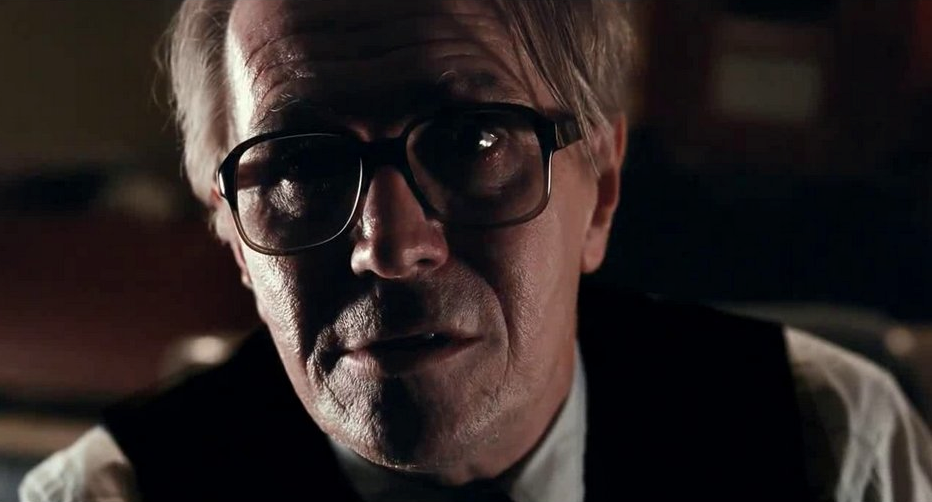
The standard use of this kind of filmmaking restraint makes close-ups, when they occur, much more powerful. Alfredson doesn’t cut to a close-up of Smiley when he is picking up a bottle of whisky for his friend in a convenience store; he cuts to a close-up when Smiley is confronting the Russian mole for his crimes, or internally reckoning with the deeply troubling question that he posed to Karla during that fateful meeting in Delhi: “We’re not so different, you and I. We’ve both spent our lives looking for the weakness in one another’s systems. Don’t you think it’s time to recognize there is as little worth on your side as there is on mine?”
The controlled choices that Alfredson and his team make regarding shot composition and editing patterns in Tinker Tailor Soldier Spy reveal as much about the characters as their dialogue does, perhaps more, if you sit back and truly observe.
 Story / Telling