
“I felt that I was alone, all of a sudden. Yet nothing had changed.”
Krzysztof Kieślowski opens The Double Life of Véronique with two short vignettes. In the first, a young girl hangs upside down in her mother’s arms, Christmas decorations blurred behind her; she points toward the night sky, as if reaching out for a particular star. In the second vignette, a mother holds a magnifying glass in front of her young daughter’s face as the girl stares wide-eyed in wonder at the veins on a leaf. The two vignettes are the same, in essence — mothers encourage their curious daughters to observe the natural world in each — but while one girl looks to the heavens, the other fixes her gaze on the earth.
Later, Kieślowski lingers on a profile close-up of an adult woman, Veronika, while she talks to her father late at night. Flickers of green light illuminate her face, then shroud it again in darkness, as she tells him that she has just experienced “a strange feeling.” Kieślowski cuts to a medium shot of Veronika as she explains that feeling: “like I’m not alone in the world.”
On frame right, in the window pane of a door, she is partially reflected — duplicated, if you will.
Shortly thereafter, on a train ride to Krakow, she holds a glass ball in front of her eye and stares through it out of the window; the passing homes reflect back to her upside down in the ball. In the train window, she, too, is reflected — mirrored by the glass.
Visual reflections abound throughout The Double Life of Véronique. Where there is one woman in a scene, there is often the hint of a duplicate.

Veronika has an identical French dopplegänger, Véronique. Véronique and Veronika only cross paths once in the film, in a crowded square in Krakow. Véronique snaps photos from inside of a tour bus; Veronika walks back to her aunt’s home carrying sheet music after an audition. It’s a dizzying sequence, in part because of how the camera spins around Veronika in one shot while the bus carrying Véronique rotates through the square in another — but also because Kieślowski dresses them in nearly identical wardrobe: a long dark coat atop a bright red sweater and red gloves.
They are not intended to be the same person, but visually, they are difficult to distinguish.
One speaks French and develops a career teaching music to children; the other speaks Polish and performs music until her death. Their interests are identical, but the lives inspired by those interests manifest in different ways — perhaps because, like the girls at the start of the film, one aims for the stars, while the other stays down to earth.
Veronika gets her big break as a professional singer after an impromptu audition in Krakow, then abruptly dies onstage during her breakthrough performance. We briefly witness Veronika’s funeral, then Kieślowski cuts back to Véronique in bed. A wave of sadness falls over Véronique, for reasons that she cannot explain.
Véronique then drives to her teacher’s home and quits her own music lessons indefinitely. He is flabbergasted by this rash decision. “You’re wasting your talent,” he exclaims. She halfheartedly agrees, but does not change her mind; she simply remains standing in his doorway, stoic and resolved, until he fully processes the news. She then closes the door.
Unbeknownst to Véronique, she soon thereafter teaches her students how to play the exact same song that Veronika died performing, a unique composition that was “discovered only recently.”
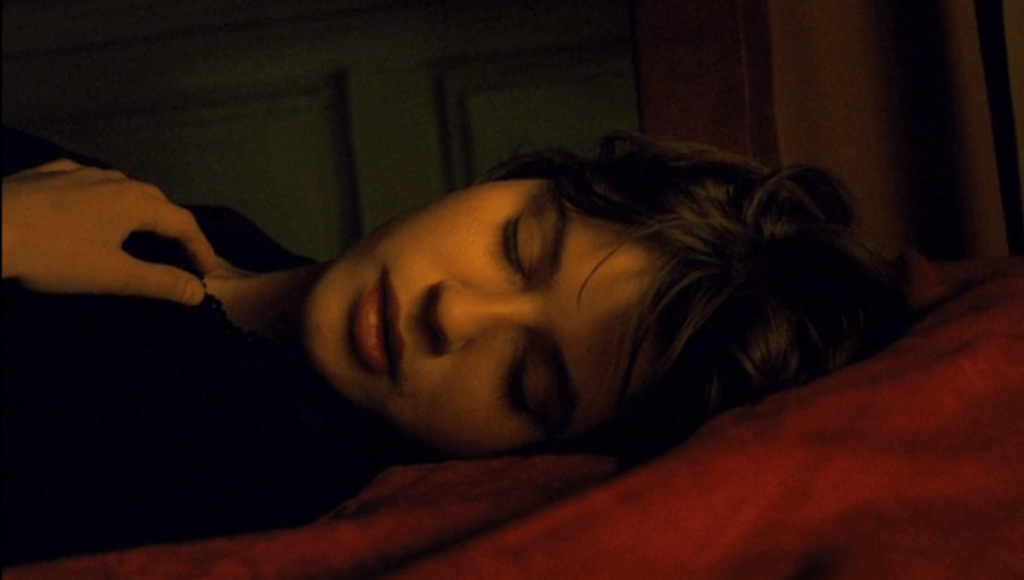
Kieślowski creates parallels between Véronique and Veronika throughout The Double Life of Véronique through both aesthetics — motifs of reflection and resemblance in their wardrobe, hair, and makeup — and plot — their professional interests, their relationships with their fathers, and similarities between their lovers.
But a neat explanation for the connection between these women is not identified. They are dopplegängers, to be sure, and they are emotionally connected in some inexplicable way, though they are separated by hundreds of miles. But even as we get to know them, their relationship, if any, remains a mystery.
Under-explaining this makes The Double Life of Véronique a more uniquely compelling film than it would have been otherwise. Kieślowski creates an evocative cinematic experience by presenting these women as reflections of each other and themselves, but never telling us what we’re supposed to see of them in the mirrors he provides.
 Story / Telling