
“I can’t waste any more time doing things I don’t want to do.”
The foreboding threat of death hangs over The Great Beauty from the start. In the film’s entrancing opening scene, an a cappella choir sings on the upper level of the Acqua Paola Fountain in Rome as a bus full of tourists arrives. Their haunting voices swell on the soundtrack as the camera lyrically glides past statues, over water, and toward each group — tourists and singers. A late middle-aged man, seemingly in good health, walks to the edge of a terrace to take photos of Rome from afar. The camera rotates around him as he snaps pictures and smiles. Suddenly, he holds a hand to his head and falls to the ground, dead. The choir continues to sadly sing as director Paolo Sorrentino tilts up from the 400-year-old fountain to reveal a panorama of the Eternal City’s skyline. The nameless man lies lifeless in the center of the frame.
Later, socialite Jep Gambardella — the protagonist of Sorrentino’s film — returns home and is greeted by a man standing outside of the door of his luxurious Roman apartment. “How can I help you?” Jep asks. “I’m Elise De Santis’ husband,” the man replies.
“Elise died. Yesterday.”
Jep’s brow furrows and his eyes widen with grief, shock, and despair. His eyes swell with tears. The two men cry together in solidarity. The man’s wife is dead, and she was the first woman whom Jep ever loved.
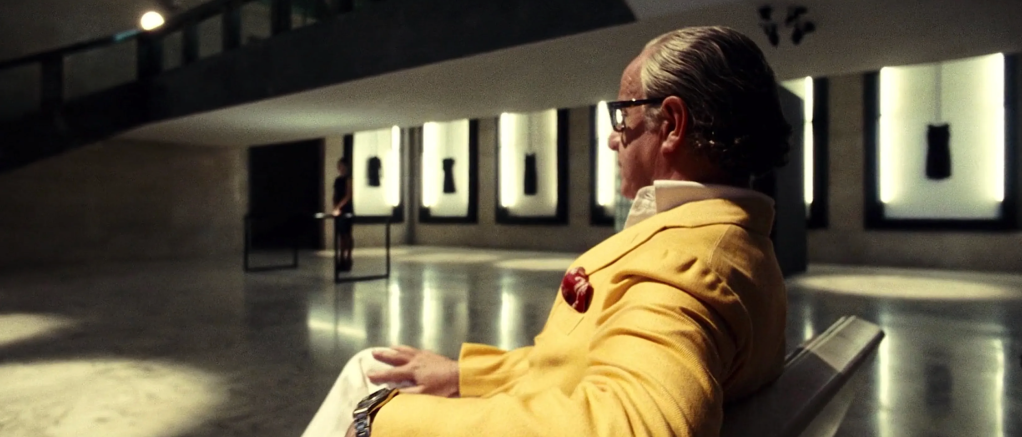
Still later, Jep sits on a marble bench, well-dressed in a yellow blazer and white slacks, explaining the proper funeral etiquette for a socialite to his girlfriend, Ramona, as he helps her pick out a proper dress for one. The funeral is for a young man who died by suicide, and at it, Jep goes through his usual performative motions. But as he assumes the role of pallbearer, he betrays his most fundamental rule — “one must never cry at a funeral” — and breaks down in inconsolable tears. His break from decorum surprises the crowd. Jep is not usually like this.
Not long after, Ramona abruptly dies, too. Sorrentino cuts through a montage of reactions that ends with Jep observing the disastrous wreckage of a massive cruise ship from the top of a cliff overlooking the sea. Life is chaotic and unpredictable, and tragedy can sometimes pile on all at once.
Near the end of the film, Jep strolls through Rome’s Villa Giulia with a middle-aged man who tells Jep that his father took a photograph of him every single day of his life. The man has displayed them all in this Villa as a means of artistic expression — and a celebration of life. Jep smiles joyfully as he strolls past rows and rows of photos plastered along the loggia of the Villa. But his smile gradually shifts to expressions of sentimentality, then tears, as he contemplates the progression of this man’s life, and the slow but steady march of time in his own.
“This is how it always ends: in death,” Jep muses in the film’s final voiceover narration. “But first, there was life, hidden beneath the blah, blah, blah.”
Near the start of the film, Jep declines a one-night stand with a beautiful woman, with his rationale, stated in voiceover narration, being: “The most important thing I discovered a few days after turning 65 is that I can’t waste any more time doing things I don’t want to do.”
Throughout The Great Beauty, Jep experiences a personal awakening, triggered by the onset of his 65th birthday and the jolt of several surprising deaths. He grows tired of aimless laziness and hedonism, and uses that tiredness, grief, and existential dread to re-discover his own passion and focus in life… which, for so long, had been hidden beneath the “blah, blah, blah.”
Sorrentino explores the “blah, blah, blah” that makes up so much of Jep’s life in many of the film’s other scenes. After the panoramic reveal of Rome with the dead tourist in the middle of the frame, Sorrentino cuts to a close-up of a woman screaming her lungs out at a swanky rooftop party. So the “blah, blah, blah” begins.
For the next nine minutes, Sorrentino cuts around the party to show off all of its extravagance and excess. Lusting men chase after women. Women bizarrely dance above the crowd. Throngs of people awkwardly flail and sway to the beat of electronic music that feels much too young for so many of them. Some people stand still in the middle of the crowd, stoned. Strippers perform in transparent, sealed-off boxes elevated above the dance floor. Sorrentino cuts to the inside of their booths so that we can hear what they hear while they dance: nothing at all. Eventually, we discover that the party is raging in celebration of Jep’s 65th birthday. When he appears, one thing becomes clear: the crowd adores him.
The party scene is intentionally long, to the point where it becomes somewhat exhausting to watch. That is the point.
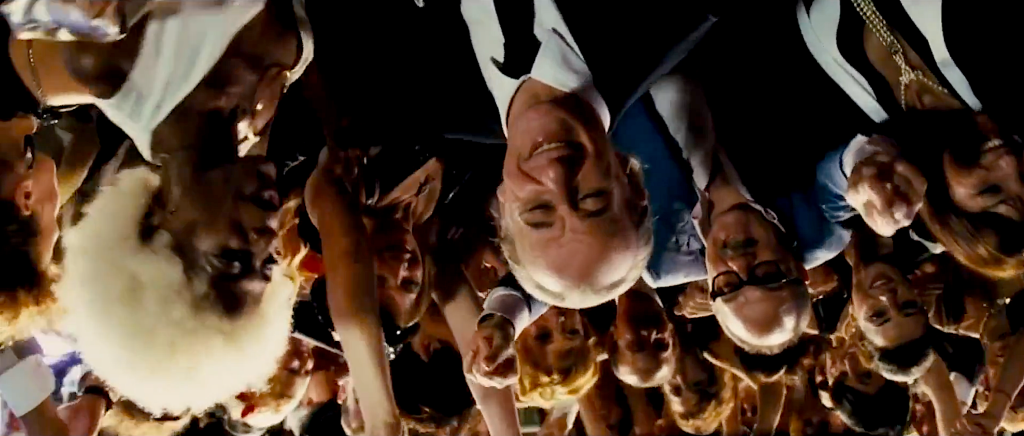
At one key moment in the midst of all of this dancing, the camera tilts upside down, and the heads of the dancers aim toward the bottom of the frame, with Jep in the middle of the shot.
It’s a brilliant visual metaphor — after this party, Jep’s life, for good and for bad, will be turned upside down.
The “blah, blah, blah” isn’t all partying, though.
In one scene, Jep sits in the grass watching a nude performance artist as she runs headlong into an ancient Roman aqueduct, cracking her head open. Unimpressed by these theatrics, he sits down to interview her, and doesn’t mince words: “All I’ve heard so far is unpublishable fluff.” Later, he laughs about it with his paper’s editor, a sassy dwarf named Dadina. The article, like the show, will be meaningless.
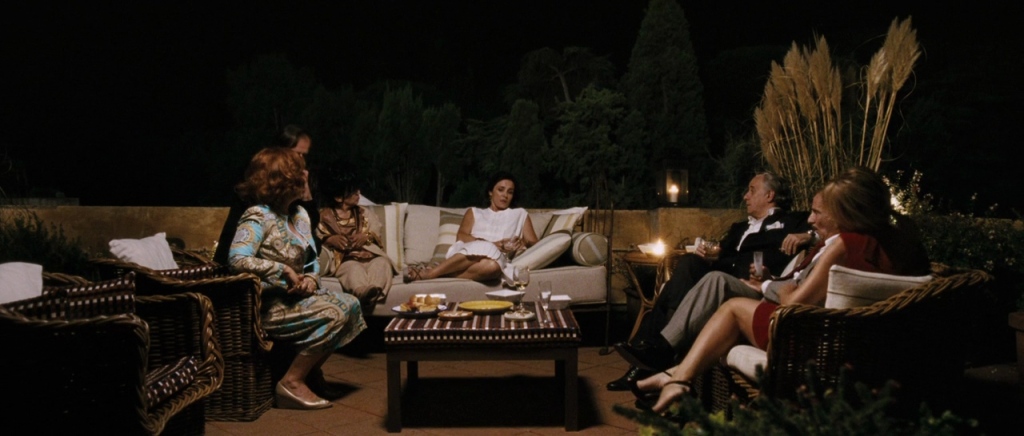
He strolls aimlessly through the streets of Rome, contemplating his life. He drinks on his balcony — which overlooks the Colosseum — and discusses self-proclaimed “inane nonsense” with his socialite friends. He casually shows up at a party, at which a pair of wealthy parents force their emotionally unstable daughter to splash paint upon a massive canvas against her will. She ends the night drenched in a veritable rainbow. The partygoers leave mightily impressed by her talents.
Jep often sneaks away from the crowds — to laugh with Dadina on his balcony while their peers dance in a conga line, or to peer at St. Peter’s Basilica through a tiny eyehole in a park at night.
“This is my life… and it’s nothing,” Jep tells us.
Sorrentino lets him wander, and in these scenes of wandering, we begin to understand him and his values. He, like the city he lives in, is full of contradictions. He strove to be “king of the socialites” from the age of 26, but abhors elitism and those who refuse to own their own “untruths.” He shies away from romantic commitment, but when he visits Elise’s widower and his new girlfriend at the end of the film, and they happily tell him that their night will only consist of a glass of red wine, TV, and bed, his response is to smile with a mix of envy and affection and say, “What lovely people you are!” He also weeps openly for the loss of a youthful love he never got a chance to develop and explore.
The Great Beauty is more than just a Jep Gambardella character study, however. The titular Great Beauty refers to life, but also to Rome. And Rome itself is a character that is studied, and photographed beautifully, throughout the film.
Rome is portrayed as a city of dichotomies.
We see many of the city’s most stunning monuments throughout the film — they are magnificent relics of a long-dead, storied past. We also witness parties next to these monuments attended by people who dance to electronic music wearing the most modern fashions.
We see beautiful classical art, and are exposed to phony and exploitative performance art that seems to make a mockery of the term.
A priest and nun dine in a fancy, expensive restaurant near the Vatican. A Cardinal ignores Jep’s inquiries about spiritual matters, but cannot stop talking about his recipe for Ligurian-style rabbit. In contrast, Jep finds himself at dinner near the end of the film with a true, bonafide saint.
Rome is a clash of the new and the old, the holy and the farce — a world center of fashion and art and religion and culture, and simultaneously, a city teeming with, as Jep would put it, “blah, blah, blah.”
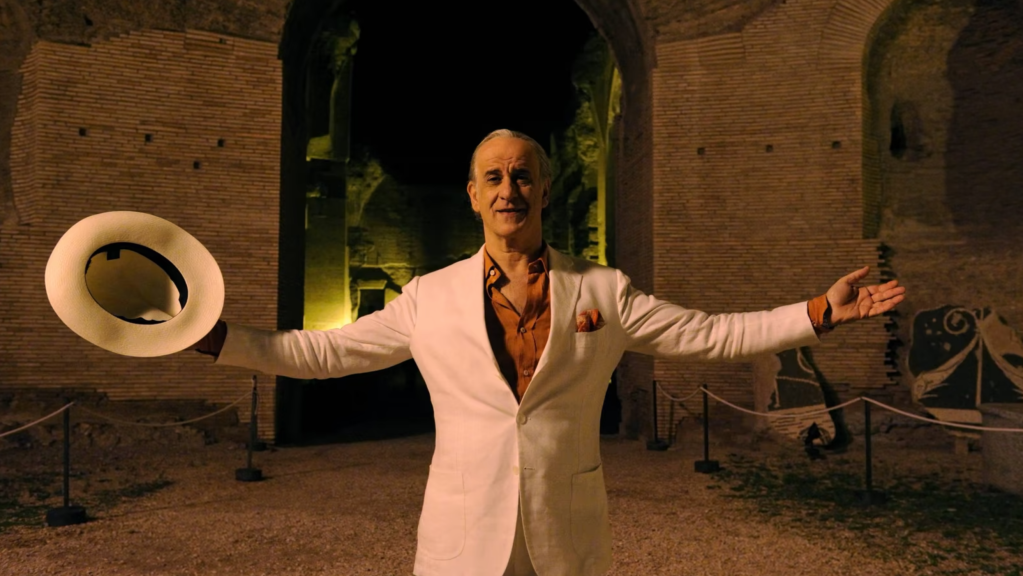
It is also a city full of magic and wonder. The Great Beauty addresses this, too. Late in the film, Jep enters the ruins of the Baths of Caracalla at night, and is unexpectedly, inexplicably greeted by a massive giraffe, and a magician who makes it abruptly disappear. It’s a marvelous trick.
Then, near the film’s conclusion, Jep walks out on to his own balcony at night, only to be greeted by a flock of flamingoes that have seemingly been summoned out of nowhere by the saint, Sister Maria.
“Did you know that I know the Christian names of all of these birds?” Sister Maria asks. Jep chooses to believe her.
Her next sentiment links the two stories woven throughout The Great Beauty together by speaking to both — Jep’s search for meaning and inspiration, and the unifying truths beneath the dichotomies of Rome.
“Do you know why I only eat roots?” she asks.
“Because roots are important.”
The flamingoes fly off into the night, above the ancient Colosseum, and Jep reflects on his own roots — and those he failed to plant.
 Story / Telling