
“I’m tired.” “Of her?” “It’s a little of everything.”
Nearly every time we see Umberto, he is dressed in a suit and tie. A well-kept fedora often adorns his aged head. The first time he tries to pawn something off for money, it’s not a worthless trinket, but a gold-plated pocket watch. He says that he owns two. Umberto is old, but dignified; his appearance does not betray the fact that he is harshly impoverished. He calmly walks his dog, Flike, on a leash through the streets of Rome; Flike does not look particularly ragged, either.
After Umberto tries to sell his watch, he pauses on a Roman sidewalk, facing the street on frame left as he fumbles through his pockets. Behind him, on frame right, four agile young men wearing paint-stained trousers climb down scaffolding to reward themselves with a lunch they presumably purchased, or were provided by an employer. Umberto, by contrast, eats his and Flike’s next meal at a nearby soup kitchen.
Director Vittorio de Sica and screenwriter Cesare Zavattini communicate from the start of the film that Umberto is living off of a government pension. They don’t communicate what he did for work before, however — nor why he quit, or even why he currently lives alone. This feels right. By keeping Umberto’s past unclear, they remove all chance of the audience victim-blaming or rationalizing his plight. All that matters is that we know that he worked for an honest living, retired at an old age, and lives modestly — but neither savings nor a pension can keep up with his ever-increasing living expenses, and no one cares much if he ends up on the streets.
De Sica and his team dress Umberto’s primary antagonist — his landlady — in gaudy outfits and flashy jewelry. In her first scene, she vindictively tells Umberto that she’s kicking him out at the end of the month, but still wants his overdue back rent. Meanwhile, she rents out his apartment to amorous couples for 1,000 lire an hour when he’s away from home.
There is an ant infestation in the apartment, and the landlady’s teenage housemaid tries to solve it by drowning the bugs with water haphazardly sprayed from the faucet of their communal kitchen sink.
The money that the landlady demands from others clearly isn’t going anywhere but in her own pockets.
Her appearance and actions reflect her selfish nature.

After spraying the ants with water, the teenage girl reveals to Umberto that she is pregnant. “My God,” he says, a flicker of empathetic fear flashing across his face. “Does she know?” he says, referring to his uptight landlady. “God forbid,” she replies, implying that she’d quickly be out of a job if that were the case. Umberto hangs his head in despair while she lights a newspaper on fire to try to smoke out the ants. Her expression remains blank and resigned throughout the conversation. She doesn’t even bother to look at the wall while she’s fanning it with smoke, ash, and flames.
I was struck, while watching Umberto D. again, by how much the key setting of Umberto’s apartment evokes poverty, and how much his landlady, by contrast, embodies not necessarily opulence, but exploitation. Wallpaper flakes off of Umberto’s bedroom walls, and the blinds in his windows look as though they’d never stay up unless they were strapped in place with makeshift ropes. The parlor down the hall that the landlady socializes is in much better shape.
There is a scene about a third of the way through the film in which the young housemaid lights a fire on the stove by flicking a match against the dirty, sloppily-painted wall behind her. The paint in that area of the wall has been completely removed in several streaks — no one has bothered to hide the match strokes with clean paint. De Sica then cuts to a shot outside, where he dollies toward the broken doors of the kitchen balcony, past hanging laundry, and settles on a close-up of the housemaid joylessly staring out of the dirty windows toward the back alley. He cuts to her point-of-view shot; we see dozens of similar balconies and a cat walking across a tin roof. She wordlessly meanders back into the kitchen after a beat, and begins to fill a kettle with water. She glances up at the ceiling, and — judging by the angry look on her face and her flick of the water spout — she sees ants. De Sica lingers on a close-up of her for a moment as tears well in her eyes. But he doesn’t dwell on this, nor make the scene sentimental. Instead, she sits down and begins to grind coffee. Her hopelessness is not drama, but fact, and she must do what she has to to survive.
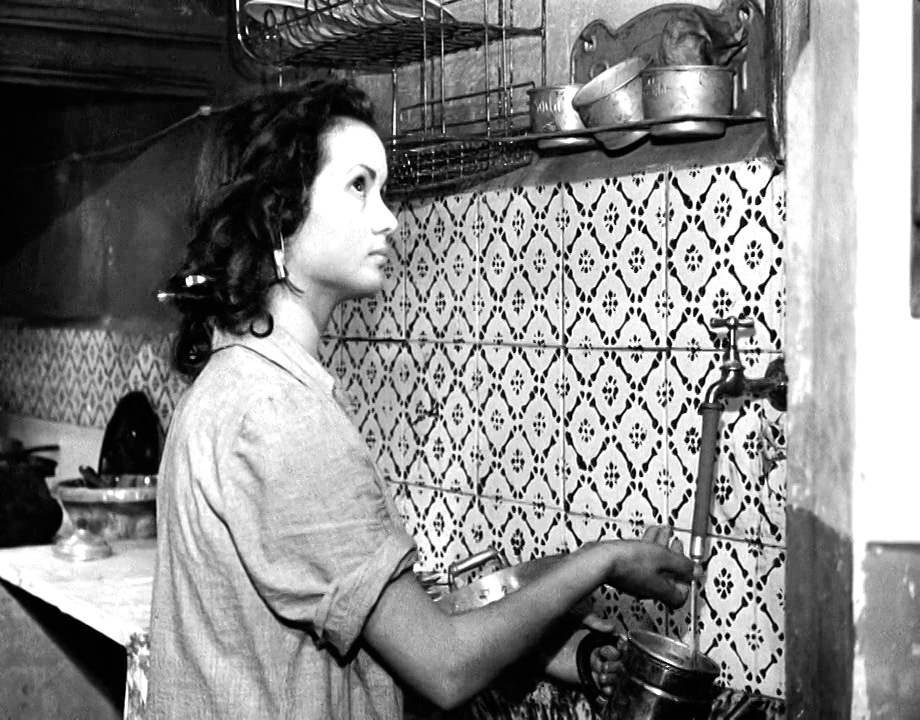
Umberto D. is powerful because the story doesn’t focus as much on its characters’ suffering as it does on their dogged attempts to cling on to dignity in the face of poverty and despair. The maid cries to herself about her misfortune in life for only a brief moment, then gets back to work; as soon as she hears a knock at the door, she wipes away her tears and dutifully greets her guests.
Umberto tries to get money honestly by selling his belongings, rather than beg in the streets like so many other men of his lot. His pride prevents him from making money any other way. In one poignant scene, Umberto finds himself at serious risk of eviction and subsequent homelessness and ends up standing outside of the Pantheon with Flike. He extends his hand horizontally into the air in front of him as if to beg — but his eyes stay fixed at the ground. It is clear that he is deeply ashamed. A man tries to give him money, but Umberto quickly shifts his hand position to pretend that he wasn’t begging, and the man walks away.
De Sica then cuts to a wide shot of the piazza as Umberto places his fedora upside-down in Flike’s mouth. Flike stands on his hind legs, hat in mouth, performing while Umberto hides behind one of the columns of the Pantheon. Flike looks back at him, confused, but stays obediently still, doing his trick. Someone that Umberto knows approaches the Pantheon. Umberto rushes out from behind the column. He doesn’t want anyone to know that he’s down on his luck — he can’t even bear to let his dog suffer the indignity of begging for cash.

The supporting characters in Umberto D. are all essential. The housemaid serves an important role as a foil for Umberto. Her story makes this not just a film about the poverty as experienced by an old man, but about the lack of adequate social safety nets for anyone disadvantaged — even his polar opposite: a young, single mother.
The men who kindly refuse to provide Umberto with financial aid ultimately contribute to a theme similar, albeit gentler, to that which the landlady provides: in this capitalist system, everyone must look out for themselves. Some are better at it than others.
And then, of course, there’s Flike, who ends up being the most important character of all.
Flike’s role in the film is sentimental, to a degree, but he also gives Umberto his salvation. Umberto’s love for Flike raises the stakes — knowing that he has a dependent creature to take care of makes every eviction notice colder, and knowing that his dog is Umberto’s only source of joy makes every half-hearted attempt to give Flike up so that the dog can have a better life that much sadder. Flike is at the center of the film’s most emotional scenes. And, ultimately, Flike gives Umberto comfort and purpose — enough to push him forward, even in his darkest moments.
 Story / Telling