
“I’ve been cursed since the day I was born.”
It’s clear from the start of Bicycle Thieves that Antonio Ricci, the protagonist, is poor. In the film’s opening scene, a crowd of men gather outside of an employment office nestled within an apartment complex on the outskirts of Rome. An employment officer calls Ricci’s name, but he is not present among the crowd. A nameless friend runs to fetch him.
We first see Antonio sitting in an adjacent dirt field, dressed in an ill-fitting suit. That he is in the dirt, away from the crowd, is a subtle, informative piece of character development: he’s been down on his luck for so long that he doesn’t bother getting his hopes up.
When the employment officer tells him that he has been selected for a job, his face lights up with pure, hopeful joy.
We first see Antonio’s wife, Maria, in the next scene as she fills a bucket of water at a communal water pump. A tracking shot frames her — and the other housewives at the pump — through the gaps of a barbed wire fence. When Antonio arrives at the pump, he vents about how he can’t take the job that he’s been offered because he no longer has his bicycle. Maria carries two heavy buckets of water away from the well as he speaks; he’s so wrapped up in his own despair that he doesn’t even think to help lighten her own load until they reach their apartment building.
He finally grabs one of the buckets right before they walk up the building’s staircase, but when they enter their apartment, Antonio’s helpfulness wavers. He leans against a wall in the hallway, lost in thought, bucket in hand, while Maria carries hers into their kitchen. Vittorio De Sica frames Maria in focus in the foreground of a shot that looks back into the hallway through the kitchen doorframe; Antonio leans in the background, out of focus. Maria walks back down the hallway and takes the other bucket out of his hands without saying a word.
De Sica then cuts to a wide shot of their bedroom in which Antonio sits down on their bed. Wires that look like nooses hang from the ceiling on frame left. Photos of a man and woman hang above the bed, a massive hole in the wall between them. He sulks in this bleak setting.
But it doesn’t last long. Maria rushes into the room and frantically rips the sheets off of their bed, much to his bewilderment.
“What are you doing?” he asks.
“We can sleep without sheets,” she replies.
The blocking of these scenes and the interplay between Maria, Antonio, and the buckets of water tell us more about their individual personalities and the dynamic of their relationship than their words do.
De Sica cuts from a shot of her dumping water on top of the sheets to a shot of a large, white linen bag passing through a pawn shop window. Maria haggles with the clerk, and they use the money they receive to buy Antonio’s recently-pawned bicycle back so that he can work.
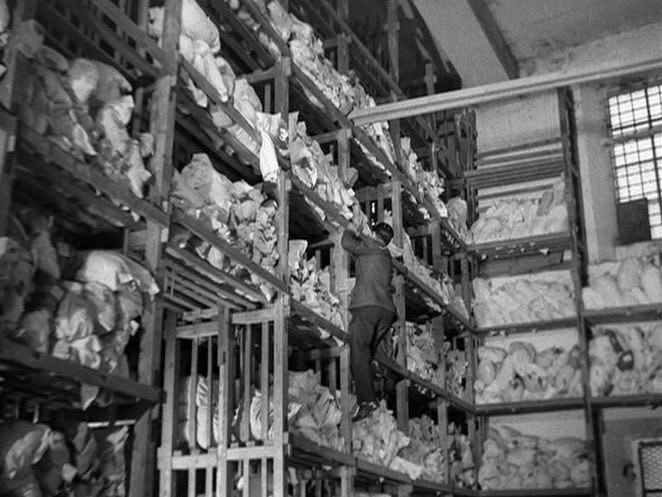
While Antonio waits for a clerk to retrieve his bicycle from this same shop, he watches an assistant carry their bundle of sheets up a massive, multi-tiered, floor-to-ceiling shelving unit filled with similar bundles. The camera slowly tilts up until the man finds an opening near the top and thrusts the Ricci family sheets in with the rest.
De Sica doesn’t draw attention to this action by cutting into a close-up of the bundle, or even a particularly expressive reaction shot on Antonio’s face. The music doesn’t swell to artificially heighten the emotion. The shot alone is profound enough, as it begs a poignant question: how many couples must be sleeping without sheets just to put food on the table for their families?
Here, and in several other moments throughout the film, De Sica reminds us in a simple, elegant way that poverty is a societal issue experienced not just by the main characters of Bicycle Thieves, but by many nameless people whose stories we will never hear.
In doing this, he makes his main character a specific example of a larger societal issue, instead of the sole focal point of an isolated story, without ever making us feel like we’re being preached to.
Antonio Ricci takes a job pasting posters on walls around Rome, which he describes to his wife in an early scene as a “good city job.” His earnestness reveals just how much this employment means to him. He’s grateful, willing to work hard, and wants nothing more than to provide for his family.
De Sica spends time before the film’s inciting incident — the first bicycle theft — to build empathy for Antonio and his family by building scenes around small moments like this, which reveal Antonio’s hopes, fears, family life, and flaws in natural, touching ways. In one such scene, Antonio shows off his uniform and workplace to Maria in a street in Rome. “Come look,” he says. “Everyone has his own locker. See how big it is?” He lifts his wife up so that she can peer inside of the office window. Someone inside closes the shutters, wiping the smile off of her face — but not his. His earnestness endears him to us.
Another early scene, by contrast, reveals Antonio’s fatal flaw in a way that makes the inciting incident feel inevitable. Antonio, wondering what’s taking his wife so long at a soothsayer’s appointment, walks into a building to find her, abandoning his bicycle in an alley.
De Sica frames Antonio from the top of the staircase; we see the wheel of the bicycle through the building’s front door. “Hey, kid,” he says to a young boy playing in the street. “Could you watch the bike for a minute?” Antonio turns around and carelessly ascends the stairs before the boy can fully answer.
That Antonio would abandon his bicycle in the streets knowing what would happen if he lost it reveals other characteristics that are less flattering than endearing, but integral to the plot: recklessness and naïveté.
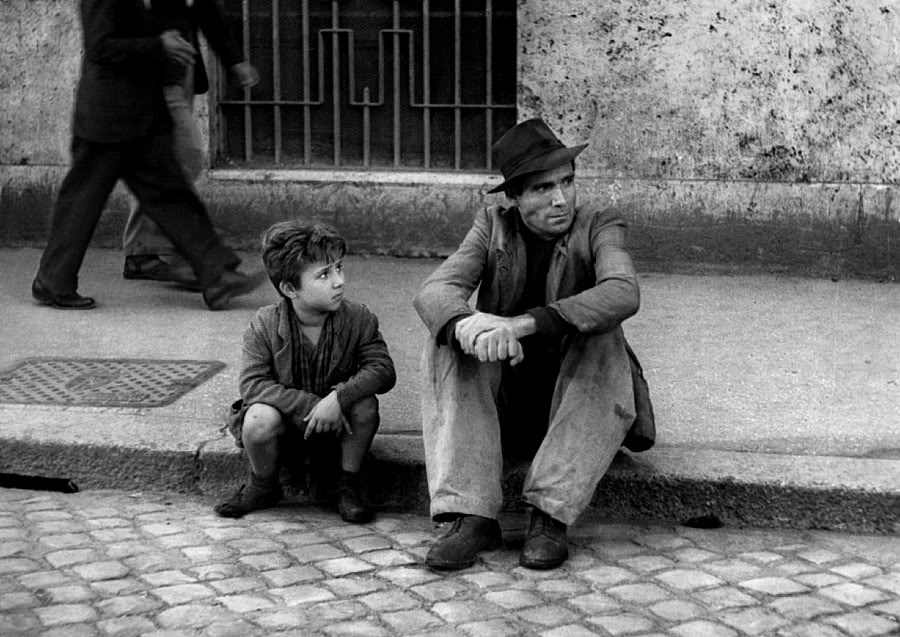
The emotional core of Bicycle Thieves centers on the relationship between Antonio and his son, Bruno.
On the morning of Antonio’s first day on the job, De Sica stages a scene in which father and son get ready while wearing matching outfits. Antonio hands Bruno an egg sandwich wrapped in parchment. Then, they each stuff their own sandwich into the breast pocket of their shirt in sync, smiles on their faces. Small actions, aided by props, again tell us about the nature of an important character relationship.
Bruno is portrayed in this scene as a bright, earnest boy who idolizes his father.
The ending of the film — the fallout from the second bicycle theft — is far more emotionally devastating than it would have been had Bruno’s love for his father not been so clearly established in early scenes such as this.
Throughout Bicycle Thieves, Bruno joins his father on quests to find the man who stole Antonio’s bicycle. None of them go particularly well. In one scene, De Sica intercuts between their own unique experiences of a search for bicycle parts street market. De Sica frames a shot in this market of an older man peddling a bell to Bruno, who repeatedly refuses the man by shaking his head ‘no’; it’s clear by Bruno’s body language that he is uncomfortable — but his father is nowhere in sight. De Sica then cuts to a shot of Antonio leading a police officer through a crowd in that same market, oblivious to the whereabouts of his son, but convinced that someone in that market must be his bicycle’s thief.
In other scenes, Bruno is more actively put in harm’s way because of Antonio’s unintentional neglect; in one particularly harrowing scene, Bruno and Antonio ride through the streets of Rome in a large truck driven by a reckless driver. Torrential rain obscures their view, and Bruno looks terrified as the driver nearly runs over a man in the street. In another scene, Antonio loses track of his son and then hears screams from afar; he slowly learns, to his horror, that a boy has been found in the river nearby. Thankfully, it is not Bruno — but it could’ve been.
In the film’s final sequence, we see Bruno crying, confused, and scared of the mob around him. Most of this scene is framed from the adult perspective, and in those shots, what is happening to Antonio is always clear, even when it is troubling. But when the camera drops down to Bruno’s eyeline, the scene becomes chaotic and confusing, as we cannot see the faces of the adults or assess their surroundings.
This shift in perspective adds dimension to an already meaningful scene. Without Bruno’s point of view, the final sequence is a reflection on the sad desperation that poverty creates — but with it, the scene (and the film) also becomes a reflection on intergenerational trauma.

The film’s best scene takes place in a restaurant, which Antonio takes Bruno to after the aforementioned scene by the river. Antonio intends for it to be a celebration and chance to bond with his son. For the most part, it is; Antonio’s face lights up as he orders mozzarella sandwiches and wine for them, and the atmosphere is lively. Bruno seems to be having fun. But then De Sica cuts to a shot of a well-off family eating heaping plates of food beside them; the bored son of that family trades glances over his shoulder with Bruno, which makes him self-conscious. Antonio makes an off-hand comment about how much money they’d have to make to eat like them; Bruno pauses before taking another bite of his sandwich, looking for reassurance that it truly is okay to do so. Little more is said about it, but the glances and mannerisms reveal that Bruno has already been subconsciously trained to feel guilty about spending money.
It’s a brilliantly simple, effective scene that deepens the film’s exploration of the intergenerational trauma caused by poverty in a compelling way.
This scene — like the pawn shop scene before it, or the finale taking place next to a professional bicycle race — also subtly and seamlessly points out the inequalities that exist between our main characters and much of the rest of their society, without ever pulling us away from the main plot.

The plot of Bicycle Thieves is methodically structured. Many events happen twice: police interventions, bicycle thefts, soothsayer appointments, run-ins with angry mobs, and misguided decisions by Antonio that cause Bruno to break down in tears.
Each of the second occurrences of these events change our understanding of the first. When the police officer joins Antonio in the street market, for example, we hold out hope that the law could help him, even if they won’t make much of an active effort to do so; when another officer intervenes in the first mob fight and that investigation comes up short, the sidebar conversation that he has with Antonio puts that idealism to rest. The same is true of the soothsayer appointments — and all of Antonio’s run-ins with religious institutions.
Comparing each recurrence of these scene “types” to their previous iterations elucidates themes, and the repetition of these scene “types” gives us the satisfaction of drawing all of these parallels for ourselves, without us ever being left confused by an overly complex plot or expositional dialogue.
De Sica doesn’t have to overtly tell us that the only difference between a victim and a perpetrator of petty crimes is how desperate they become. Parallel scenes show it.
 Story / Telling
This has been my favorite movie for about 25 years, ever since I first saw it, for its sweet sad loving account of poverty and pride and familial love.
LikeLiked by 1 person