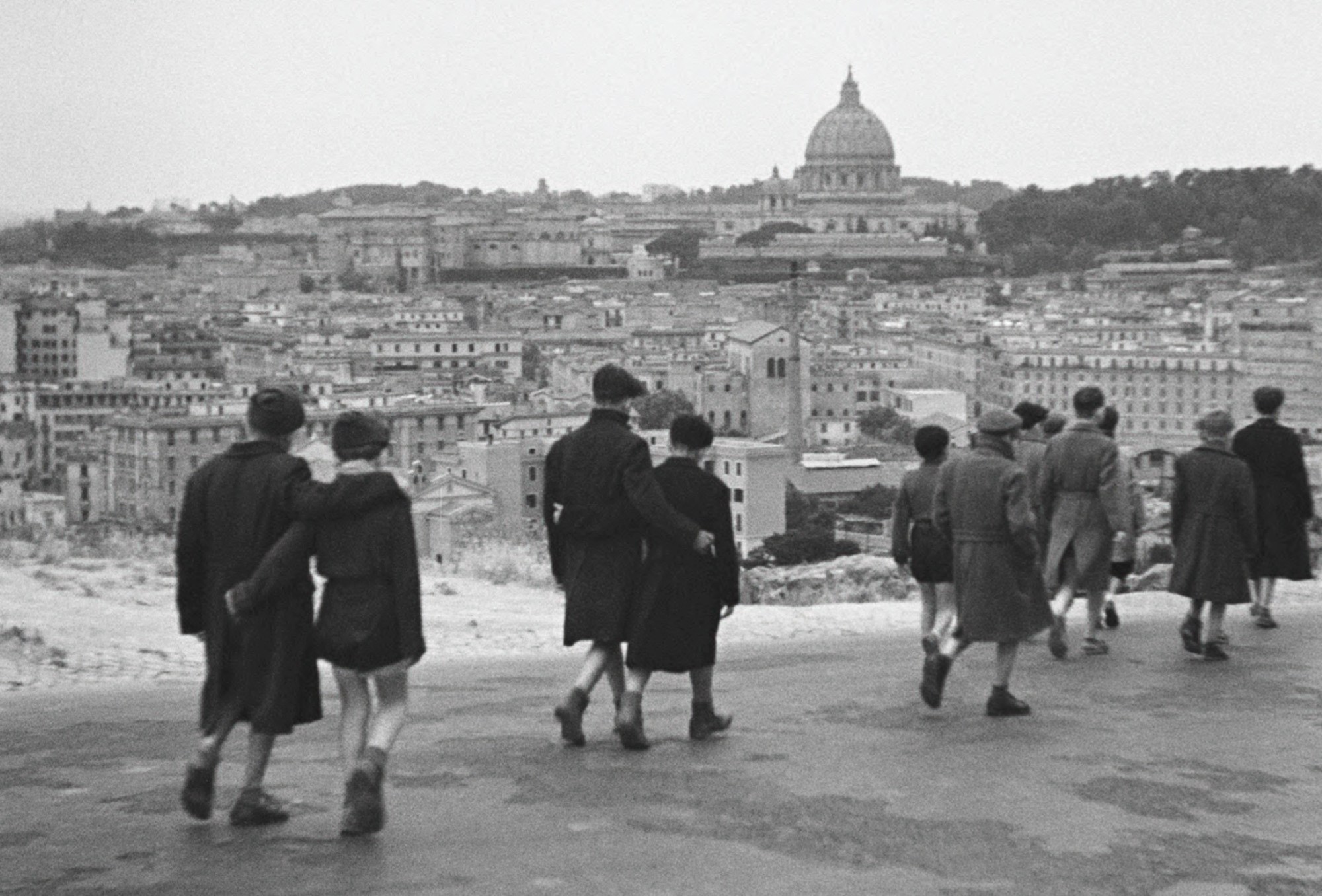
“It’s not hard to die a good death. What’s hard is to live a good life.”
We don’t see the Italian Resistance fighter Giorgio being tortured much toward the end of the film, but we hear his muffled cries. As soon as the screaming begins, the German SS officer in charge of the interrogation strolls to the back door of his office. Director Roberto Rossellini frames this exit with another prisoner, the Italian priest Don Pietro, in focus in the foreground, and the German officer Bergmann in the background, out of focus. The priest fixes his gaze of shock and pain toward his fellow Italian. The German officer, in contrast, leaves the room, shutting the door behind him.
Bergmann strolls casually into a parlor, pours himself a drink, asks his fellow SS officers who is winning their card game, and lights a cigarette on a candelabra that sits atop a grand piano, on which another German plays a beautiful melody. “Strenuous evening?” a drunk Nazi asks him. “Not really,” Bergmann replies.
The drunk Nazi begins to question whether the Germans really are a master race and if their cause is truly just. “I forbid you to continue!” Bergmann spits. The piano stops playing. The peaceful atmosphere is ruined. Bergmann seems to be far more distressed by this than the torture that is still happening in the adjacent room… perhaps, because it forces him to reflect on the reality of the orders he has given.
“We stormed a bakery this morning,” Pina tells Giorgio near the beginning of the film, while casually making her child’s bed. “Some know why they’re doing it,” she flippantly continues, “but most just grab all the bread they can. This morning someone filched some shoes and a scale.” “I’d like to know who filched my stockings!” another woman yells, from another room. Pina rolls her eyes. It’s an amusing deflection that speaks to the same theme as the “rebels” stealing bread for themselves and their families: it is a noble aim to fight for a cause you believe in, but people will almost always consider their own needs first.
Father Don Pietro aids Resistance fighters and risks his life daily. But we first meet him kicking a soccer ball around a courtyard with a group of raucous young boys, feigning exasperation when a play goes awry. Later, he enters a shop to secretly meet with other Resistance members. While he waits for his contact to escort him downstairs, he sees two statues facing each other in the shop — one of a modestly cloaked Christian saint, and another of a beautiful, naked woman. Rossellini lingers for a few seconds on a shot of Pietro from behind the statues as he angles them away from one another, so that the Saint statue isn’t tempted to betray his presumed vows. It’s both a comedic aside and one of many humanizing moments featuring the priest.
Rome, Open City is about the Italian resistance to Nazi occupation during World War II, and there are a few scenes of torture and cruel violence that are exactly as you’d expect in such a film. But most of the movie’s run time is comprised of more subdued exchanges and small, human moments like those listed above. Whether they’re a German SS officer or an Italian rebel, the characters in the film spend most of their time trying to live normally within their extraordinarily bleak circumstances. The characters’ actions convey a kind of cognitive dissonance — they might believe passionately in their respective sides’ goals, and will aid them if they must, but they’d much rather spend time with comrades in a parlor, or run errands and eat lots of bread, than fight their good fight.
Because of this, the scenes in which the war ambushes their peace feel even more heartbreaking and jarring than they would if the entire film centered on each side planning their side’s respective bombings and assassinations.
Don Pietro talking a boy with a bomb and a machine gun off of the edge of a bomb-ravaged rooftop, or the subsequent scene of Pina defying SS orders to chase after a captured Francesco, which has devastating consequences, remind us starkly that a war is happening in Rome between two violent factions. The humor, warmth, and scenes of human connection in between clearly show us all that that war interrupts.
The Resistance fighters try to fight against the occupying forces, but they also just want to live their lives as though they didn’t have to try so hard. That they often ignore the war around them to focus on other things indicates that they wish that they weren’t thrust into the devastating circumstances that they are in, and that they would just go away.
“Everyone foolishly thought it would be over quickly, and that we’d only see it on newsreels,” Pina’s fiancé, Francesco reflects back to her in one scene, worrying about the future beside her in a stairwell.
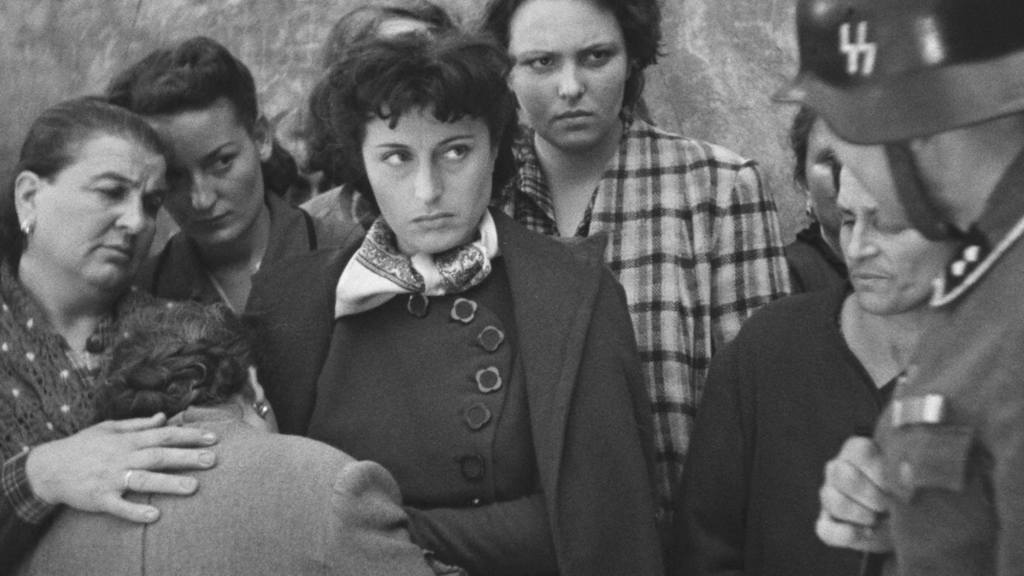
In the end, before the film’s tragic conclusion, Don Pietro is asked if he is scared of death. “It’s not hard to die a good death,” he replies. “What’s hard is to live a good life.”
What Rome, Open City explores so effectively is how, through actions big and small, the citizens of occupied Rome try to live a good life in the constant shadow of death.
 Story / Telling