
“Today, everything amazes me.”
Agnès Varda’s Cléo from 5 to 7 is about a singer, Cléo, distracting herself while in existential despair from 5 until approximately 7 PM one afternoon in Paris while she waits for the results of a cancer screening. She is certain, based off of intuition and a tarot card reading, that the outcome of her illness will be dire.
The plot of the film — so much as there is one — unfolds in real time (Cléo from 5 to 6:30 would be a more apt title for this 90-minute movie). Superimposed titles appear at the bottom of the screen at the start of each scene indicating the time of day, the number of minutes that the scene will be, and the name of the person Cléo focuses on during that timeframe. Often, that person is Cléo. Sometimes, it is not: Bob, a composer and pianist, for 7 minutes; Raoul, a projectionist, for 4; a general “some others” in a café for 7.
More than a dozen times throughout the film, we see these subtitles. They make us acutely aware of how much time has passed, how Cléo’s distracted focus is shifting throughout the afternoon, and how much longer we need to wait before the medical news is shared with her.
It’s a remarkably simple, yet suspenseful, formal device that helps give structure to Cléo’s wandering narrative.
Rarely do films make us so hyper-aware of time. Typically, we are meant to become immersed in the story so that we forget about the minutes that are elapsing. Here, Varda’s intent is the opposite — like Cléo, we want to know the outcome of the test results, so we’re constantly “watching the clock” with her, distracting ourselves in 4 minute doses here, 7 minute doses there…
Tick. Tick. Tick. We hear a clock steadily ticking in the opening scene, as Cléo chooses her tarot cards and has her past, present, and future analyzed. Varda continues the ticking audio on the soundtrack even after Cléo exits the room; Cléo’s heels tap against the marble stairs in perfect rhythm, second by second. Diegetic sounds throughout the film subtly bring back this aural motif… tick. tick. tick.
The passage of time is an ever-present framework of Cléo from 5 to 7. The constant reminders of time as it passes reflect Cléo’s internal anxiety while she waits impatiently for the call that will decide her fate.

The entire formal structure of the film is designed to get us inside of Cléo’s head.
In an early scene, Cléo’s friend takes her to a café, where Cléo breaks down in tears immediately upon sitting down in the booth. As Cléo tries to pull herself together, her friend starts a conversation with a server. Cléo pretends to listen, but becomes increasingly distracted while stirring her coffee. Varda cuts to a splitscreen layout of two different angles of the café, in which we see a couple on the right two-thirds of the screen and Cléo on the left third. We hear the couple’s conversation overlap with Cléo’s friend’s conversation; Cléo tries to pay attention to both — and neither — as her attention shifts between her thoughts, her coffee mug, and the bustling restaurant around her.
Pacing varies from scene to scene. Time passes slowly and Varda’s camera glides and observes in fairly long shots as Cléo tries to (unsuccessfully) distract herself by shopping for hats. The pace of the edit — and intimacy of the shots — changes when Cléo is distracted by people who are close to her. Romantic orchestral music swells when her lover briefly visits her — then abruptly ends when he leaves. Never is the pace faster than when her friends and professional collaborators come to visit her apartment to play a song together; never is it slower than when Cléo is being driven around in taxis, lost in thought, staring at the buildings and streets of Paris pass her by.
Close confidants bring her comfort and make her feel at ease; time spent in her head stretches out time. The pace of the edit reflects this.
Cléo feels anxious about her fate throughout the entirety of Cléo from 5 to 7, but the film is clearly delineated into two halves: the first, in which she cannot get out of her head, overwhelmed by stress — and a second, in which she decides to go out and make the most of her time while she waits. In the first half, she wears a white dress; in the second half, she wears a sleek, black dress: an evening gown, in the color of mourning. The wardrobe shift indicates a shift in mentality for Cléo, and a distinct change in behavior.
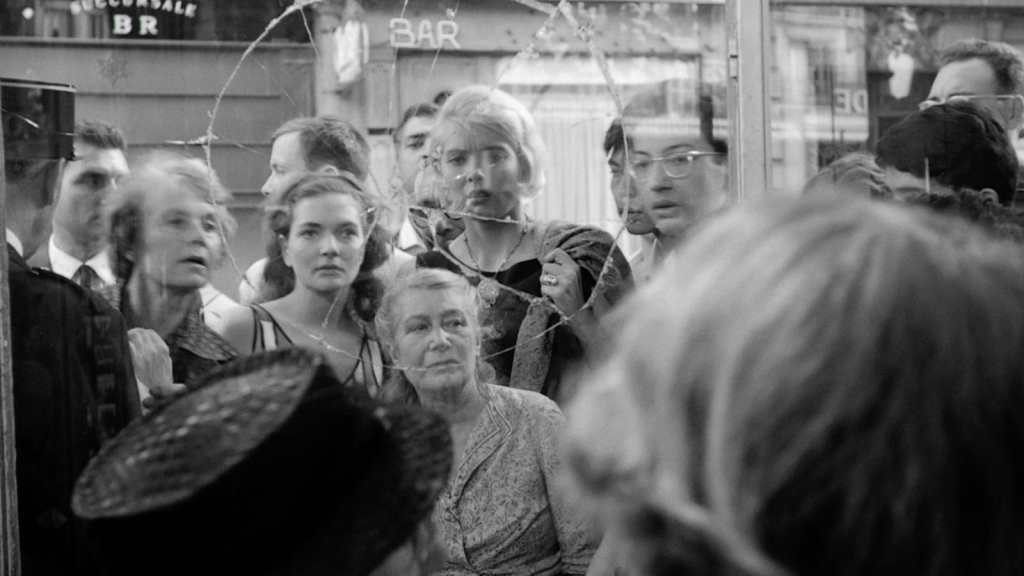
Cléo from 5 to 7 tells the loose story of a woman reflecting on her life and its fate. Varda frequently shows Cléo and her surroundings in literal reflections, through mirrors and storefront windows in the environments she wanders through, to visualize this. We see Cléo’s reflection fragmented often, broken up in odd angles facing mirrors, as such — and in a few shots, we see her face distorted and broken in shattered glass.
In the visuals, pace, performance, and structure of Cléo from 5 to 7, Varda reflects Cléo’s mindset — and guides us along with her throughout her stressful, poignant, and ultimately uplifting waiting game.
 Story / Telling