
“Along these stone paths and amidst these statues, where you were already losing your way in the still night, alone with me.”
Alain Resnais seems intent to hypnotize us from the start of Last Year at Marienbad. For several minutes, his camera glides and dollies through the nearly empty corridors of an extravagant estate. All the while, narration fades in and out, droning on and on repeatedly about the marble, pillars, pictures, darkness, alcoves, chandeliers, and rows of doorways “along these corridors and through these rooms in this building that belongs to the past, this huge, luxurious, baroque, and dismal hotel.” The narration repeats several times, until the descriptive words start to lose all meaning. Unsettling musical tones from an organ on the score establish a measured pace and haunting mood.
After a few minutes of montage to set the scene, Resnais shows us a scene from a play, which resembles the events of the movie’s later plot — as much as there is one — and shows us the source of the droning narration: the main actor in the play. Resnais then cuts to vignettes of the well-dressed audience members mingling after the show. In each vignette, we see groups of people speaking words that the movements of their mouths do not entirely match up with. We see them freeze their motion throughout the frame mid-sentence… then start to move again after a brief pause. We watch a beautiful, blonde-haired woman in a black dress and pearls standing alone in the theatre turn around and abruptly, on a match cut of her turn, end up standing alone in the hotel lobby. Only the background seems to change. Her movement is seamless.
The unsettling organ music plays again on the soundtrack while Resnais cuts together a montage of beautifully-composed vignettes of these well-to-do people making insufferably meaningless small talk with one another while walking up stairs and wandering through corridors. The tonal clash between the music and imagery is comical; the music escalates in intensity to the point where it would feel appropriate in a horror movie, yet the images that we see are merely of men in tuxedos and women in dresses talking to each other about things they know nothing about.
The tonal shifts seemingly indicate that the film is meant to be viewed as satire; the experimental misdirections with time and space and repetition convince us that nothing that we see or hear can be taken at face value. Even though the opening sequences of Last Year at Marienbad seems to be radically unconventional and disorienting, there is clear purpose to all of this aesthetic chaos: it tells us exactly how we are meant to process the winding narrative that follows.
That’s not to say that the movie is confusing, however. The plot itself is exceptionally simple: a man (call him X) in this luxurious hotel desires another man’s (call him M) wife? girlfriend? (call her A). X tries to convince A that they met and had an affair the year before — at Marienbad, or Frederiksbad, or maybe at Karlstadt; he can’t recall.
The “plot” of Last Year at Marienbad unfolds according to his obviously unreliable narration, and the film’s aesthetic approach reflects that: the interior design of A’s hotel room changes entirely several times throughout the film, as does the layout of the grounds — in some scenes there is a hedge maze outside of the hotel, in others a large pool of water, and in still others, neither. A doesn’t really believe a word that X says, yet even though she verbally resists his advances, she remains intrigued by his ever-changing story and aggressive determination. So are we.
“I’ve waited a long time for you,” X tells her on an ornate stairwell, in a scene that takes place in reality (to our best guess, at least). “In your dreams?” she asks him, an amused smile crossing her face. She doesn’t believe him and is moderately annoyed by his presence… but she is also dryly entertained. And so are we, and so the film carries on.
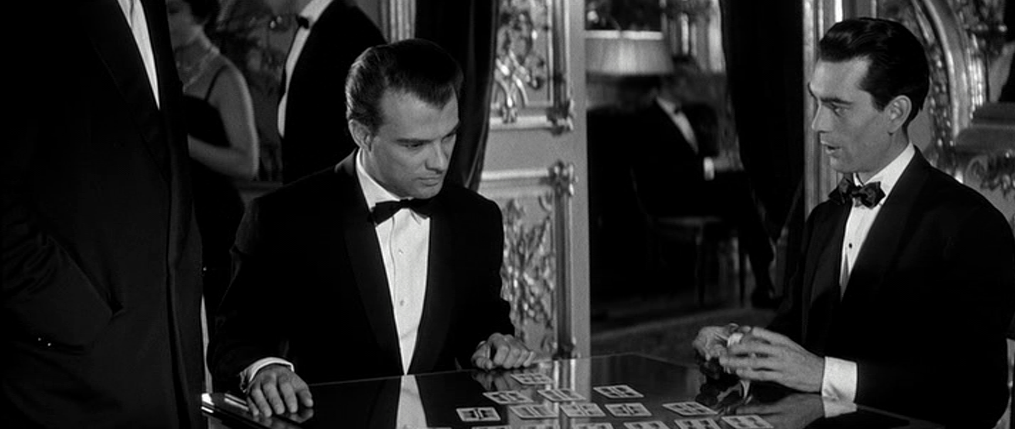
X’s pursuit of A lacks passion; his alleged memories of her involve them strolling together through gardens, talking about nothing more meaningful than statues, or sometimes not talking about anything at all. Their affair — if it even is one — is a bored and self-destructive game, played by bored people with nice, boring lives.
A is merely a prize to be won for X in an ongoing game with M, whom he profoundly dislikes. Resnais uses an actual game played between them to represent their continued conflict, the repetition of which helps give the film — and their warring dynamic — structure. We see X and M together for the first time playing this game, in which a pyramid of cards (or match sticks, or dominos, or whatever else is available to them later on) are laid out on a table, and each player can take as many cards (or match sticks, etc.) as he wants, as long as they are all in the same row, until there are none left. M always wins. X, much to his frustration, always loses.
This game becomes a motif, with X repeatedly engaging in a game he can never win but refuses to lose.
This motif culminates with a brief scene in which A, in one of her many ornate bedrooms, stares at a pyramid of photographs laid out in the game’s pattern. All are photographs of her, taken by X… last year? That day? At Marienbad? At Frederiksbad? It is impossible to say. No one takes any of the photographs in this scene (they simply disappear), but X tries to take her away.
Repetition of visual motifs keep us oriented amidst the free-flowing, ever-changing narrative, while foreshadowing major events that otherwise would feel like they came out of nowhere. Take, for example, the recurring motif of the buttoned-up men at the indoor shooting range turning toward their targets and firing off a pistol shot for sport. This low-brow, violent hobby in the underbelly of polite society is an amusing part of the satire of Last Year at Marienbad. But these scenes serve a dual purpose: they also foreshadow (and justify) the (real? imagined?) violent outburst that happens in A’s room near the end of the film.
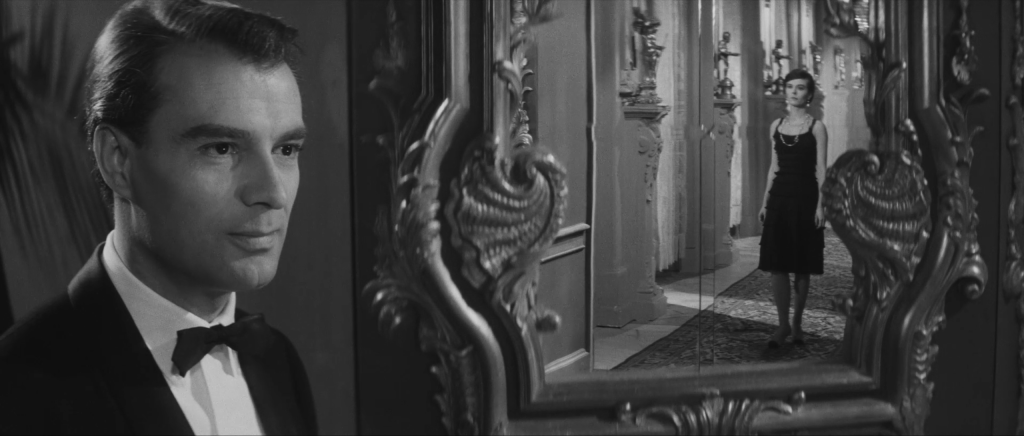
Last Year at Marienbad is a stunningly beautiful, surreal cinematic experience. Stark wide shots and a frequently mobile, smoothly-gliding camera reveal ornate details within the expansive, ostentatious estate. Glistening lights shine on pearls and other women’s jewelry, highlighting their expensive taste. Intriguing, beguiling vignettes unnaturally stage beautiful people together in beautiful places. We see characters reflected in — and fragmented by — mirrors, further causing us to question what our eyes are seeing.
Resnais whimsical plays with time and space and fearless breaks standard technique and form throughout this film, even whipping the camera around to face A after tracking a shot from inside to outside without adjusting the exposure to compensate for it, leaving our main female character dramatically overexposed. What is meant as style and what has deeper meaning in these instances feels irrelevant, given the impossibility of understanding what the characters want due to their unreliable narration. Perhaps this overexposed shot visually represents A’s inner turmoil, or perhaps it is just another aesthetic trick to make us question the film’s representation of reality.
Either way, the cinematography and production design of Last Year at Marienbad are absolutely gorgeous, fitting for the high society characters and location(s) that the film is all about.
And yet, amidst all of this stunning and alluring imagery, Resnais takes care to intercut sequences with many shots of empty corridors and settings and people devoid of joy, however beautiful they are, to reiterate — to the unsettling tune of an organ — his satirical, scathing opinion of these people and the games that they play.
 Story / Telling