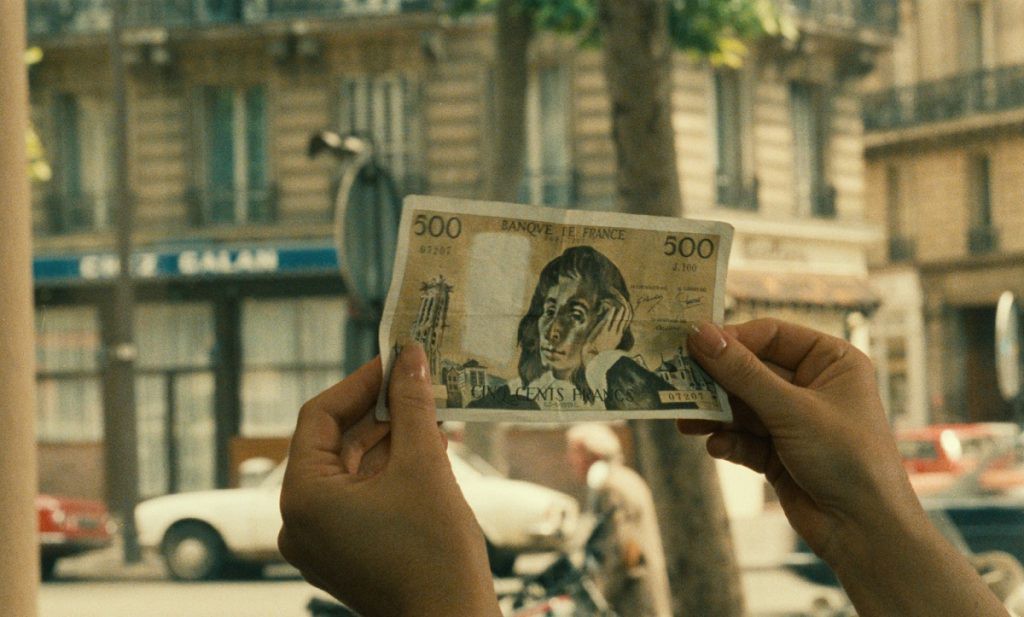
“Where’s the money?”
The French New Wave (1958 – late 1960s), which director Robert Bresson was both a forefather of and participant in, eschewed traditional cinematic continuity decisions in order to pare stories down to their essence. This approach to cinema revealed itself in a few ways, most boldly and obviously in the use of jump cuts, in which segments of shots were removed entirely from the film if they didn’t serve a purpose. This could be as subtle as an abrupt scene transition, or as overt as seeing a character switch from one side of the screen to the other, in the same shot, suddenly and without explanation.
The French New Wave officially ended in the late 1960s, but its most successful auteurs — Godard, Varda, Truffaut, and others — continued working for decades after, constantly refining their vision and approach to cinema. Bresson, whose directorial debut was released 15 years before the official start of the “Nouvelle Vague,” ended his career roughly 15 years after its official end with L’Argent (“Money”) in 1983.
By that point, revolutionary New Wave techniques had become codified into the universal language of cinema. Bresson executed them effortlessly; L’Argent is a clear testament to that. His largely untrained actors serve as models for action and dialogue that makes intellectual statements on social themes. And, by playing with cinematic conventions of continuity and time, the intellectual rumination that they represent never feels plodding — as soon as scenes get started, Bresson moves on to their end result, then on to the next scene, and the next, until his protagonist makes his last important decision. And when that final narrative beat happens, Bresson doesn’t linger; he quickly cuts to black.
L’Argent is masterfully economical cinematic storytelling — the lessons of the French New Wave, matured.
Bresson focuses his camera as often on actions as he does on faces, if not more — if a scene centers around an action, then Bresson wants us to see that action and nothing else. We are first introduced to Yvon, a blue collar worker who becomes the film’s main character, in a medium shot from behind him as he fills up a fuel tank and scribbles an invoice on a notepad. Bresson then cuts to a shot of Yvon’s hand opening the front door of a store. We see Yvon’s face clearly for the first time only when he needs to interact with another character.
Sequences in L’Argent are structured out of scenes highlighting causes and effects, with little shown in between. We see a close up shot of a collection of pills, then a point of view shot of Yvon being carried away on a stretcher. We see Yvon’s feet shifting between the gas pedal and clutch of his car, then see a wide shot of that car colliding with another — then, as soon as the cars settle after impact, Bresson cuts to a shot of Yvon’s wife sitting on a bench in what appears to be a courthouse, saying to someone off camera, “If he was hurt, he’d be in a hospital.” We quickly fill in the blanks as to what happened between the car crash and that statement.
Efficient, cause-and-effect storytelling like this — especially when scenes are shot with the focus on actions instead of faces — runs the risk of confusing the audience. But Bresson uses props and repetition to keep us oriented. Take Yvon’s brown bag, for example, which we first see in his introductory scene, then later in his apartment. When Yvon is imprisoned for the first time, Bresson lingers on a wide shot of a police van and a staircase leading up to the jail; the police unload a pile of bags before the prisoners exit the vehicle. The brown bag among this luggage heap indicates Yvon’s fate before it is formally revealed to us. When all of the prisoners have climbed the steps, Bresson cuts to a shoulder-height medium shot of bodies walking single file through a prison gate inside; we don’t see the prisoners’ faces, but the brown bag hanging at one man’s side confirms that Yvon is among them. A guard whose face we never see slams the prison gate shut and locks it. The prisoners and guards walk out of sight in the distance, and Bresson cuts away to a new scene.
That same two-shot sequence is later repeated when a new character is imprisoned and Yvon returns from the hospital. Bresson reveals the new prisoner’s fate in much the same way, then simply pans over to the right to reveal an ambulance parking next to the police van, bringing Yvon back to jail after a brief stint in the hospital. It’s not the most realistic scenario — or the most realistic timing, at least — but it’s clear and efficient, and is believable in the context of the film’s droll, darkly comic undertone.
Time is compressed even more in the film’s chaotic final sequence, during which Yvon devolves into a life of crime. We see Yvon enter a hotel room, then see the aftermath of a murder. Yvon sees an old woman in the streets in one shot, then in the next follows her through Paris, then in the next follows her through the countryside, then in the next, he’s inside her home, and she knows exactly what he has done.
The final murder isn’t shown at all. Bresson lingers on a shot of a lamp as an ax is raised, then swung once; blood splatters on the wall, a light goes out, and Bresson cuts to a shot of the murder weapon being tossed into a pond.
Cause and effect. Methodical, efficient storytelling.

The plot of L’Argent becomes increasingly alienating, chaotic, and difficult to buy into in the second half of the film… if it is taken seriously at face value. It’s arguably easy to miss, due to its lack of overt comedy, but L’Argent is a satire to its core. When we view the film as a satire, the chaotic ending makes a lot more “sense” as the perfect absurd climax to L’Argent‘s social statement.
The comedic, satirical undertones are established from the beginning of L’Argent. The film opens with a dryly comedic scene in which a spoiled teenage boy, Norbert, demands a monthly allowance from his rich father… then asks for more after he receives it, so that he can pay back a friend he owes money to at school. The father refuses, and Norbert leaves in a huff — “My friend’s parents give them a lot more.” He immediately complains to his mother. “I can’t help you today,” she replies, while looking into her empty purse.
Norbert turns to a friend for extra money… and the friend gives him a perfectly counterfeit 500 franc bill. The boys put on their jackets and exit the room to spend it. Before the door closes, Bresson cuts to a shot outside of a shop in the streets of Paris; the boys roll up to the sidewalk on their motorbikes, park them, and enter the store. Norbert’s friend drolly convinces the cashier that the counterfeit bill is real. “No question about it.”
“Besides, your father gave it to you,” he says, turning slowly to Norbert. “No, he didn’t.” “Sure he did.” The cashier doesn’t question them again.
The real droll humor, though, comes later, as the ripple effects of this single action unfold. Bresson intercuts the increasingly dire plight of Yvon with scenes of Norbert knowingly getting away with the same crime without so much as a slap on the wrist, and scenes of a middle-class white kid blackmailing the corrupt adults he works for to get away with his own petty crimes for entirely too long without consequence.
Expertly stitched together with the economical cause-and-effect storytelling devices outlined above, these plot threads make a social statement about how criminal actions affect the rich versus the poor in capitalist societies. Entertainment value aside, that Bresson chooses to focus on the absurdity of this more than the sadness of it oddly makes L’Argent an even more damning social statement.
 Story / Telling