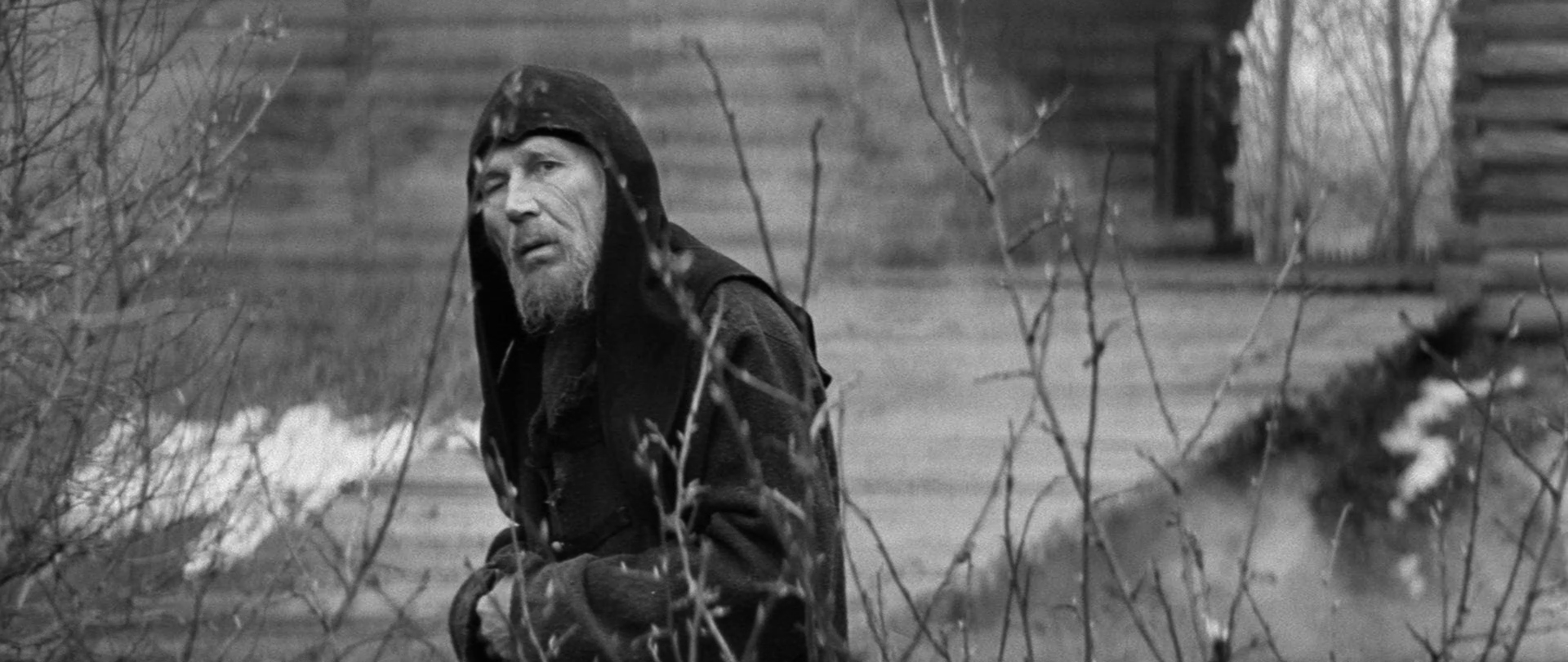
“You can grasp the essence of everything if you name it correctly.”
The second of Andrei Rublev‘s primary eight chapters centers around a chance meeting between two religious icon painters, neither of whom is the titular character: the monk Kirill, who is one Rublev’s apprentices, and a master painter, Theophanes the Greek, who propositions Kirill to leave Rublev and work for him instead.
The chapter begins with a tracking shot following Kirill, in profile, through a crowded town square. A man is aggressively pulled toward a public torture device in the background of the shot, out of focus. The prisoner screams, “I am not guilty!” It doesn’t matter. Kirill largely disregards this display of public cruelty. He exits the frame, his gaze fixed ahead, while we are left to watch the wrongly convicted criminal, his spectators, and his executioners.
The scene cuts to the dark interior of an ornate church. Kirill, shrouded in a black robe that makes him appear almost entirely in silhouette, slowly strolls into the light to observe the beautiful architecture and icon paintings around him. The church appears to be empty. “Is any living soul in here?” Kirill asks, staring directly at the camera.
The next shot dollies out from behind a pillar to reveal Theophanes lying flat on a bench, eyes wide open, an empty easel and a pot filled with brushes in front of him.
The two men talk about Andrei Rublev, and Kirill compliments the beauty of Theophanes’ paintings in comparison to Rublev’s. Director Andrei Tarkovsky focuses this scene not on the art, but on Kirill’s expression of admiration and awe — and only shows us a small portion of the admired painting until it is revealed at the end of the scene.
We occasionally hear the cries and moans of the crowd watching the prisoner’s execution outside. Theophanes yells at them off camera, begging them to stop their cruelty.
Only after he tells them off do we see Theophanes’ painting of Jesus’ face in full.
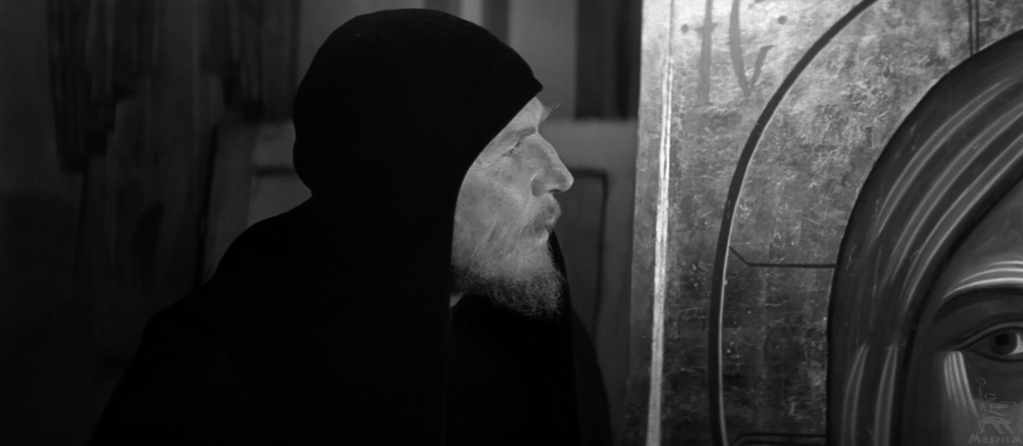
The choices that Tarkovsky makes in this scene — not showing the painting while the characters talk about it, Kirill physically walking from darkness into light while leaving the cruelty outside to experience the beauty of Theophanes’ art, the chaos happening outside of the church mostly being muted on the soundtrack while the Kirill and Theophanes examine the art — place the focus of the scene on the experience of art and aesthetic beauty, as opposed to on the physical artwork itself.
This scene is indicative of the storytelling approach that Tarkovsky then takes throughout the rest of Andrei Rublev. The film is a three-and-a-half hour biopic about 15th-century icon painter Andrei Rublev, but we never see Rublev paint, and he is absent in many of the film’s scenes. We never see his finished art, either — until the stirring, roughly seven-minute-long epilogue that ends the movie.
Instead of focusing on the individual painter, his process, and his perspective, Tarkovsky structures his narrative around a macro view of the world in which his protagonist lives. Each of the primary eight chapters that make up Andrei Rublev is an examination of 15th century Russia more than anything — and they collectively paint a portrait of a harsh, cruel world.
In the first sequence, more than a dozen unwashed peasants huddle inside of a small wooden cabin, entertained by a jester’s song and dance routine.
The jester is then unexpectedly beaten and arrested by soldiers for reasons left mostly unexplained. We watch the soldiers through the cabin doorframe as they throw the jester against a tree and place him, unconscious, on the back of a horse. By placing the shot within the cabin, we are removed from the action, forcing us to dispassionately observe the scene.
This sequence ends with a beautiful, panoramic shot of a lake. Rublev, Kirill, and another monk walk single file in the foreground on one side of the water, each minding their own business, while the soldiers’ horses cross on the other side of the lake, in the background of the shot. As the monks exit the frame, Tarkovsky’s camera lingers on the scenery; the soldiers continue to casually march along in the distance as heavy rain begins to pour from the sky.
Russian peasants — and the monks, including Rublev, among them — are portrayed as powerless against the state. Tarkovsky gives us a moment to reflect on this theme, while taking in this view of the tumultuous rain.
Subsequent sequences in Andrei Rublev explore a variety of other themes that all paint a similarly grim portrait of 15th century life —
Theophanes discusses the angst of being an artist to Rublev: “They praise you today and villify you tomorrow. The next day, they’ll forget why they praised you. They’ll forget you and me — everything.”
Rublev finds himself a prisoner at a pagan festival, a “witch’s sabbath,” which is then raided by soldiers; women are arrested for being heretics, and Rublev is shocked by the sins of both sides.
Andrei later takes a vow of silence after killing a man in defense of a woman during a violent raid; in another scene, artisans are ambushed and their eyes gouged out by troops on a Grand Duke’s orders, merely because Andrei’s artisans made the Duke’s brother’s mansion more beautiful than his own.
War, in general, ravages the Russian countryside.
And, nature itself threatens death to the peasants as well. The last hour of Andrei Rublev tells the story of a young bell maker commissioned to create a magnificent bell for a Prince. We learn early in this scene that the young boy’s entire family succumbed to the bubonic plague and died — and we later learn that, in spite of the boy taking the job knowing that if the bell did not toll that he would be executed, many of the family secrets of bell casting went to the grave with them.
The stark visuals in each of these sequences reflect the harshness of the times portrayed, too. Tarkovsky’s beautifully composed frames are remarkably tactile. The walls of interior spaces are often heavily textured. Vacant spaces in exterior scenes are filled with atmospheric elements. Monks gather in the yard of their monastery in the dead of winter; we see their breath in the cold air. Fog and smoke ripple across fields. Rain pours down on characters.
A cow runs through a village square during a raid, back on fire. A horse falls, as if in slow motion, down a set of stairs.
“It’s sinful to splash milk,” Rublev tells a young girl as they play together in a church. Later, after Rublev’s men are massacred by the Duke’s soldiers, Tarkovsky lingers on a shot of milk pouring into a stream out of a dead man’s pouch.
Together, these images and the narratives they support portray 15th century Russia as a cruel, unjust, harsh society — and the people living in it as powerless against the circumstances of their suffering.
Rublev frequently rejects his calling as an artist because of this; for a long time, he cannot bear to create anything in a world so full of darkness.
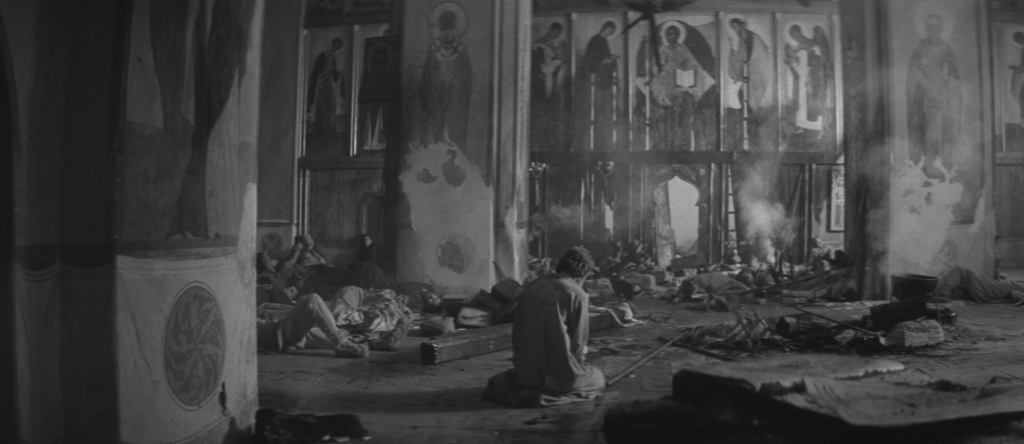
By structuring Andrei Rublev with sequences focused on external circumstances and events, and by often ignoring his main character outright, Tarkovsky crafts not so much a biopic about Rublev but a film that uses the artist as a centering force to make a universal statement about the role of art in society.
Tarkovsky is less interested in Andrei Rublev himself, it seems, than he is on the meaning of Rublev’s art — and all art — lasting the toils of time.
That’s why it’s brilliant, even while being exceptionally bold, that the lengthy final chapter of the film has almost nothing to do with Rublev or icon paintings at all. We see the aforementioned young bell maker become a nearly obsessive tyrant while crafting the Prince’s bell. We spend time with him in mud and rain and fire. Rublev appears in the scene during the bell’s unveiling, but for a long time, the film’s storyline focuses on a different artisan altogether.
At the end of the sequence, the bell tolls loudly, and the gathered peasants cheer.
But the young bell maker falls into a fit of despair, as the bell is not as good as one that his father would have made.
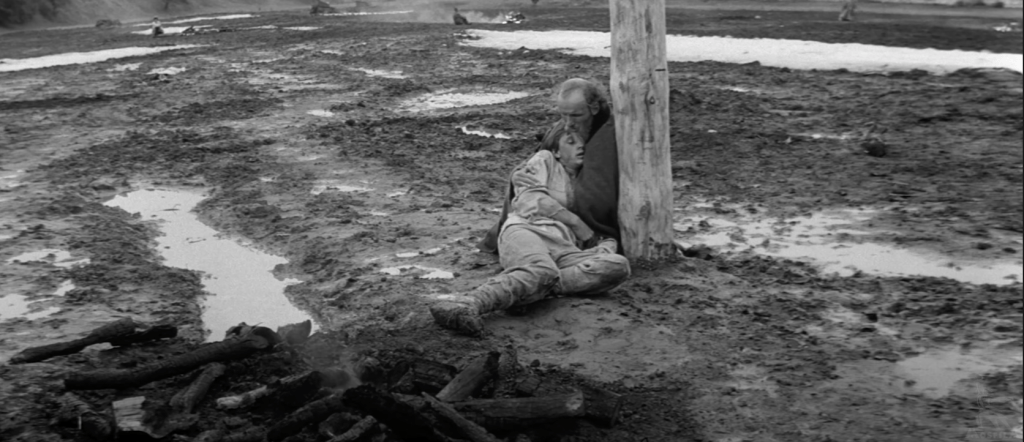
Rublev, having previously renounced art and taken a vow of silence, consoles the bell maker in his arms. Rublev reassures him: “It turned out very well. Let’s go together, you and I. You’ll cast bells. I’ll paint icons. You’ve brought them such joy, and you’re crying.”
Then, after we’ve spent nearly three hours watching black and white images — and many long, tactile, poetic sequences of suffering — Tarkovsky crossfades into a nearly seven-minute-long, full-color montage of detail shots of the real Andrei Rublev’s icon paintings, accompanied by somber, beautiful music sung by a choir.
It’s a transcendent moment that elucidates the meaning and impact of Andrei Rublev’s life’s work — and of art in general — more clearly than any traditional biopic could:
In a world full of suffering, this man painted beautiful things; centuries after he died, the suffering has largely been forgotten… but the beauty remains.
 Story / Telling