“I wouldn’t worry so much if I thought you were worrying enough.”
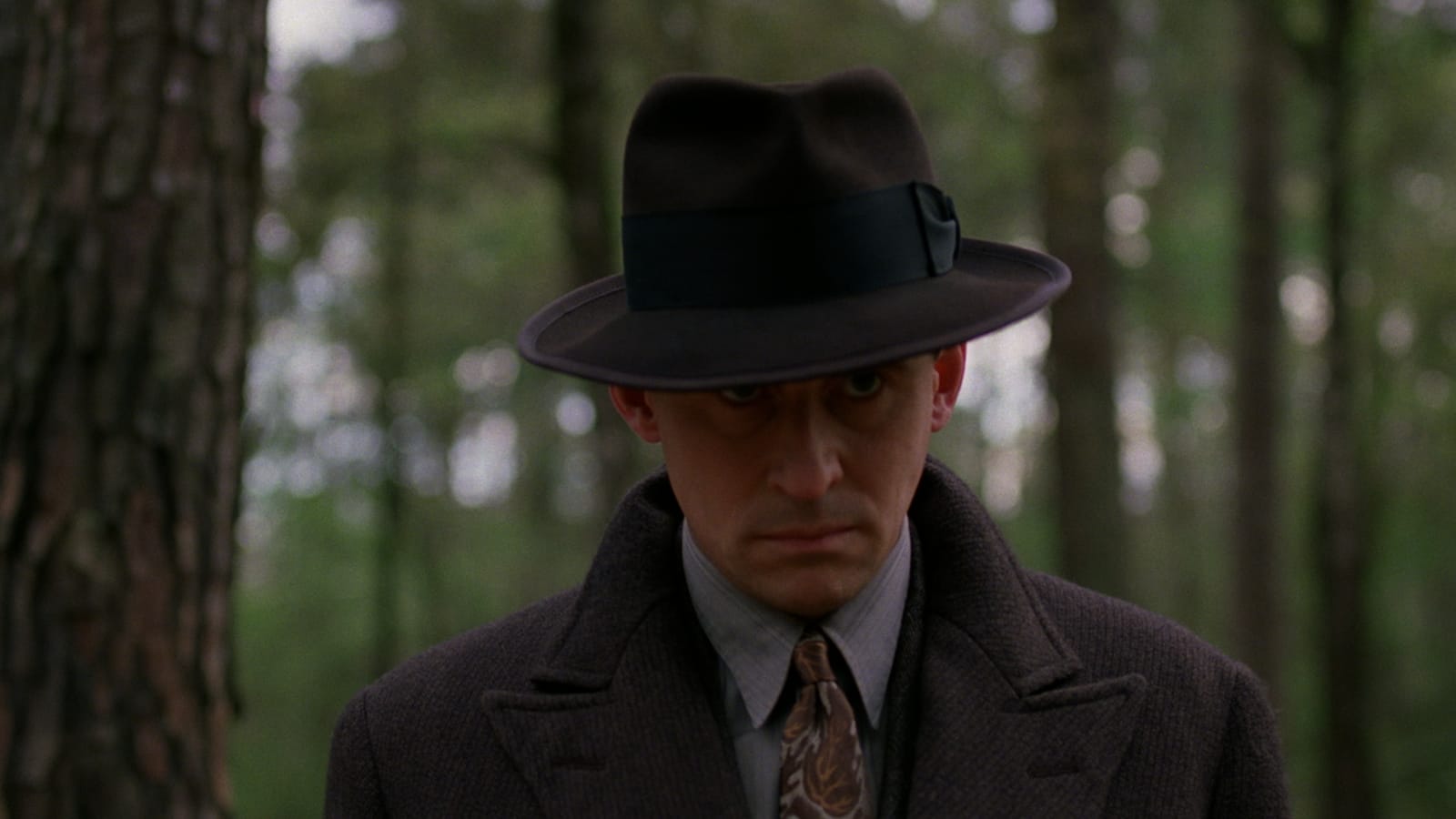
Much of Miller’s Crossing takes place in dimly lit apartments, nightclubs, warehouses, and offices in which characters’ faces are often half-shrouded in shadow. Violent events occur mostly at night. When characters confront each other, they do so in as private of quarters as possible (with one notable exception) — and often by surprise, as when Bernie repeatedly breaks into Tom’s apartment at night to wait for him in the dark as a power move.
Characters talk fast, and their dialogue is dense with information. The city police are corrupt, mob bosses fight for power against one another, and a stoic gangster (Tom) acts as a double agent, playing both sides of a turf war with somewhat ambiguous motives. Meanwhile, a femme fatale stirs up drama and connects competing factions.
Miller’s Crossing is, on the surface, a gangster movie — but the Coen Brothers make their take on that genre unique through genre-blending. The stylized dialogue, high contrast imagery, and femme fatale are straight out of film noir; the criminality, double crossings, and hyper-masculinity are all native to the gangster genre (with, of course, some cross-over). Shadows accentuate criminal secrecy; romantic entanglements between several gangsters and the femme fatale heighten the dramatic impact of characters’ betrayals.
And, throughout the film, the words that come out of characters’ mouths speak to themes in a way that might seem inorganic in a grittier, “realistic” gangster movie — but feel aligned with the way in which characters speak in classic noir.
“Tell Leo he’s not God on the throne — he’s just a cheap political boss with more hair tonic than brains.”

The fast-paced, dense, stylized dialogue serves a dual role — on one hand, it makes the plot feel more labyrinthine than it is. Characters talk around their concerns, often in inflated metaphors, heightening the drama and adding a layer of mystery to the story. This is mostly done, it seems, for entertainment.
On the other hand, it allows characters to overtly frame conversations with themes without the conversations feeling inorganic. While some of the dialogue indeed creates mystery, this focus on theme in the dialogue, in contrast, gives the plot structure. The dense dialogue tells us what the Coen Brothers want us to take away from the story, right from one of the very first lines:
“I’m talkin’ about friendship. I’m talkin’ about character. I’m talkin’ about–hell, Leo, I ain’t embarrassed to use the word–I’m talkin’ about ethics.”
Meditations on ethics are common in the gangster genre; in The Godfather, for example, Don Vito Corleone rejects the Tattaglia family’s offer to get in on the drug trade because it’s a “dirty business,” and the ripple effects of this decision drive the plot forward to its inevitable conclusion. “Ethics” are the primary point of focus for the characters in Miller’s Crossing, and drive most of the characters’ key decisions as well.
Opening the film with a monologue on ethics gives us a thematic framework that is essential to understanding this point. “Ethics” determine unethical actions; characters live or die based on the perceived ethics of their own behavior. “Ethics” cause Tom to lie to, kill, and double cross his friends. They also cause him to lie for, protect, and save them.
All of the characters’ decisions generally ladder back up to this murky concept of “ethics,” which imbues the story with its own distinct thematic logic. Mob boss Leo has Tom’s back completely, even when they fight — until Tom crosses a line with Verna, the femme fatale that Leo loves. Tom’s deviation from a brotherly code of ethics spoils their relationship, which then drives Tom to make decisions that go against his former loyalties.
Genre-blending and thematic rumination aren’t the only things that make the Coens’ gangster picture unique. Their distinct sense of humor is as much at play here as it usually is in their films, albeit more subtly than usual. But it’s not here just as humor for humor’s sake. There’s a funny scene in which Tom is about to be beaten up by a rival mob boss’ strongman, but the strongman clearly doesn’t want to be there, let alone trade punches with Tom, an old friend. They each politely wait for the other to take off their jackets before trading barbs, creating a false sense of security — then, before the other man is ready, Tom whacks him in the face with a chair. Tom’s opponent holds his hand to his face, shocked and betrayed. He sulks, then races out of the warehouse to find backup instead of punching back. Instead of running away, Tom patiently waits for the inevitable.
It’s a funny scene, one that ladders curiously back up to a rumination on ethics. But it also sheds light on another theme: that of obligation — another code which locks these men into absurd behaviors and toxic patterns that ultimately unravel their lives.
The Coen Brothers blend humor, noir, and gangster tropes together with information-heavy, metaphor-laden dialogue not only to craft an entertaining take on a tried-and-true story… but to clarify that story’s themes for viewers as well.
I’d be remiss if I didn’t reiterate the importance of the film’s settings — one of which gives Miller’s Crossing its name — as well. Leo’s ostentatious office and ornate mansion home contrast sharply with Tom’s sparsely furnished, rundown apartment; between this disparity and Tom’s pursuit of Verna, the femme fatale, it becomes clear that underneath all of the conversations about “ethics,” there are jealous, selfish motivations that drive these characters’ actions.
And just as those dimly lit apartments, nightclubs, warehouses, and offices hide characters’ double-crossings, the most important location in the movie — the titular one — reveals them.
Miller’s Crossing itself is a bright, almost stoic location. Here, characters face judgment that dictates whether they live or die. All of their fears and follies are brought out into the open (literally). And here, characters who are cool, calm, and collected in the dark fall apart in the light.
The Coen brothers alternate between intimate close-ups in this forest and point of view shots looking up at the tops of the trees in Miller’s Crossing. Carter Burwell’s melancholic, lilting, almost romantic score in this location stirs emotion and generates reflection.
The scenes in Miller’s Crossing are all extended, elongated pauses in the narrative that make us dwell on the cold, harsh reality of these “ethical” characters’ world. Out of the shadows, the anxiety and pain of this way of life becomes the jolting point of focus.
The setting becomes an important enough framework to the story that it ultimately feels quite fitting as the movie’s title.
Ending Miller’s Crossing in this sacred, disturbing place — with Tom standing alone without any remaining allies — drives home the sad theme that whatever ethics the characters think they live by are made moot by their obligations, and how there can be no ethics in a life driven by selfishness and crime.

 Story / Telling
One thought on “Miller’s Crossing (1990)”