
“Keep him busy and don’t let him know he’s the hit of the show.”
A sequence early in Charlie Chaplin’s The Circus features his Tramp character in a familiar predicament: chased by police for a crime that he didn’t mean to commit. He seeks refuge mid-chase in a mirror maze to try to escape from them.
The police, the Tramp, and the well-off man whose wallet the Tramp inadvertently stole all run through — and get lost in — the mirror maze. Chaplin and the rest of the group visually repeat indefinitely within the frame through a set of infinity mirrors, and run into the glass a few times during their attempts to escape it as well.
It’s a fun visual gag, but more than that, too: whether intentional or not, the hall of mirrors is a fitting visual metaphor to include at the top of The Circus, as this is one of Chaplin’s most self-reflective films.
In The Circus, Chaplin pays homage to the vaudevillian talent that inspired his own career while also looking at his own craft (and industry) directly in the mirror. It’s an artistic work about the work, proof that the self — its talents and opinions — can be its own creative inspiration.
The Tramp is as downtrodden and impoverished as ever in The Circus; because of his general misfortune, he doesn’t recognize that he has talents — he merely exists to survive (by sneakily eating a snack out of a baby’s hand, among other things).

When he runs into the circus tent for the first time in the middle of a show, then, it is with no awareness of his own silliness and vaudevillian gift that he runs, trips, falls, and stumbles his way to uproarious applause from the otherwise disinterested crowd. When the Tramp exits the tent — and finally loses his police pursuers — clowns try to take his place as the center of attention, but the crowd doesn’t want to see anyone else. They cheer, “Bring on the funny man!”
Chaplin cuts to a title card that says, “The Funny Man,” then shows the Tramp asleep outside, hunched up inside of a wheelbarrow.
It would seem like the Tramp’s natural talent would be enough to lift him out of his circumstances, but he’s too busy trying to survive to notice — when does he have time to hone his comedic skills when he has to sneak after a hen so that he can pluck an egg for breakfast?
Eventually, the Circus’ Ringmaster recognizes the Tramp’s talent as an opportunity to save his dying circus, but instead of striking a fair deal, he exploits him — an all too common narrative in the entertainment industry: “keep him busy, and don’t let him know he’s the hit of the show,” he tells his Property Manager.
The Ringmaster is the movie’s primary antagonist. He’s a nasty man, and the film’s greatest and most dated fault is that he doesn’t get the comeuppance that he deserves for his cruelty. It is resonant social commentary, though, that the Tramp doesn’t do anything about the Ringmaster’s cruelty to the woman the Tramp is smitten with until he recognizes his own value in the existing power dynamic… and that his actions won’t put him in an unfavorable spot. “If you strike that girl, I’ll quit!” he finally summons the courage to say. The Ringmaster changes his ways not out of some higher moral virtue, but because it would affect his bottom line.
This insidious power dynamic is something that we’re still grappling with nearly a hundred years later, and though the tone of this plot point is a far cry from the lighthearted nature of most of the film’s scenes, the scenes between the Ringmaster, his daughter, and the Tramp illuminate one of the boldest and most insightful statements Chaplin has to say about his field.
Much of the rest of the film seems to be Chaplin’s own admission that comedic talent — and what audiences respond to — is impossible to pinpoint or force; when the Ringmaster makes the Tramp try out for the circus (after his first successful appearance wins over the crowd), he tells him to “go ahead and be funny.” The Tramp awkwardly dances, to which the frustrated Ringmaster bluntly and angrily replies, “That’s awful!”
The Tramp isn’t funny when he tries to be, only when he’s given the opportunity and circumstance to authentically be. And, when he tries to be something that he’s not — like when he tries to become a tightrope walker to impress a girl — he ends up making the crowd unhappy, and feeling like (while being attacked by) a performing monkey.
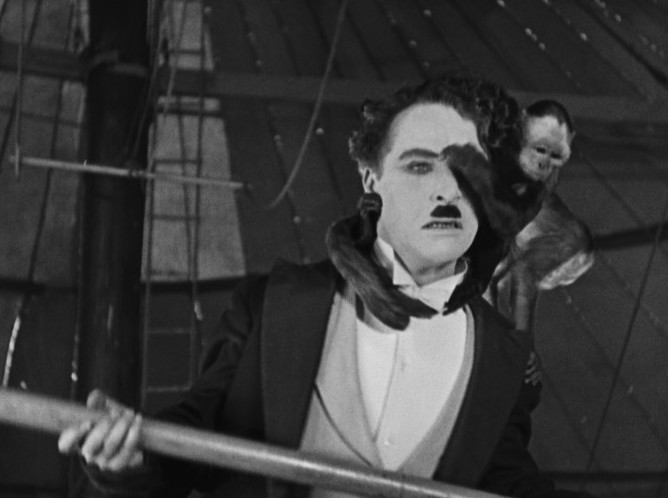
Lavish sets and an impressive menagerie of animals make The Circus visually whimsical and entertaining at face value, but Chaplin’s self-reflection and social commentary, melancholically buried beneath the comedy and joy, is what elevates the film beyond being just a story of the Tramp performing for a girl and some food at the circus.
 Story / Telling