“Fair is foul and foul is fair.”
The Tragedy of Macbeth begins with the voices of three witches conversing in hushed tones over a black screen — “When shall we three meet again, in thunder, lightning, or in rain?” “When the hurlyburly’s done; when the battle’s lost and won.” From the film’s opening moment, the focus is on Shakespeare’s words; this remains consistent throughout to the finish of Joel Coen’s adaptation. Though the film cuts from black to a striking cinematic image — blinding white fog that parts to reveal three black crows circling in the sky — it quickly settles into a back-and-forth of medium shots of actors reciting the Bard’s lines directly to camera.
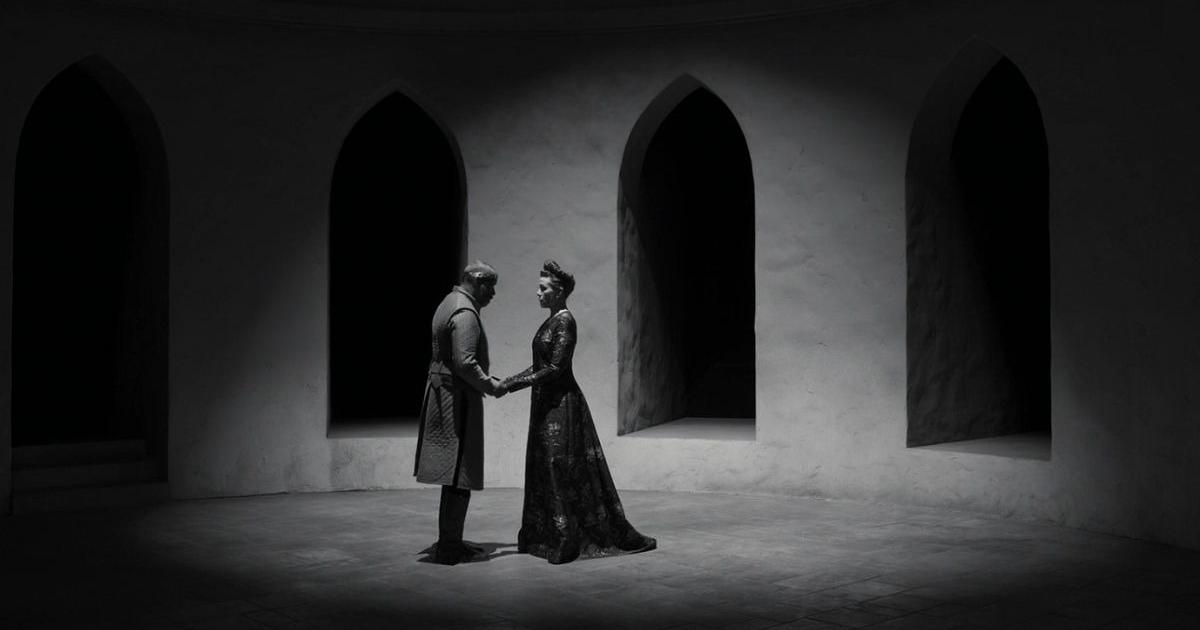
Joel Coen boxes in his characters within black-and-white, 3:4 frames; the film is visually stunning, but plays out predominantly on simple, surreally artificial-looking sets. Joel sticks to the original text quite closely for most of the film, and doesn’t stray his characters beyond the realm of Shakespeare’s narrative. Not once, for example, does he venture out to the villages of Scotland to show how Macbeth’s rule hurts the commoners — besides, of course, scenes that spotlight Macbeth’s assassination attempts on his enemies and their families.
Because of this, The Tragedy of Macbeth often feels more like a filmed play than a traditional cinematic adaptation. Instead of watching from afar as we would in the theatre, however, we often hear the poetry while staring directly into the faces of the characters that speak it. It’s not a flashy trick, or even something that would be lauded as particularly cinematic, but this reminds us that one of the most powerful communication tools that separates the movies from all other forms of drama is the unblinking close-up. The theatre doesn’t allow you to stare into the desperate eyes of Macbeth as he wrestles with guilt, or see, in high definition, the grey hairs lining his aging beard, or the wrinkles that time crafted on his forehead. Intense close-ups add depth to his character without words; you get the sense that he is aging, and desperately wants to make a lasting mark before his brief candle runs out.
The most impactful moments in The Tragedy of Macbeth, however, are the ones that utilize the flashier techniques of the cinema to generate unease in the viewer. When Macbeth and Banquo first confront the witches, for example, we see and hear all three supernatural beings in the body of one. She speaks a prophecy to them in close-up through her chapped lips — but then, when she finishes the prophecy with an, “all hail,” the edit cuts to a wide shot of her standing between a fog-shrouded pool of water and the ripped flags and dead bodies of a bloody, finished battle. The other two witches crossfade in on either side of her, as if appearing from the fog itself.
They turn and disappear from sight as Macbeth mumbles quietly that “what seemed corporal melted, as breath on to the wind.” He stares after them in silence for a beat, and then, loud cawing erupts on to the soundtrack as crows rush him out of the fog. We’re jolted by the intense shift in audio cues.
Clever reveals and intentional sound design make the theatrical cinematic.
Lighting plays a key role in how we experience the story here. Luminance and shadow wash over characters to both reveal and hide them within scenes. No better example is there in the film besides the scene leading up to the murder of Duncan; we track alongside Macbeth as he walks down a long corridor, passing in and out of swaths of light as he monologues a speech to convince himself of the inevitability and purpose of what he is about to do.
The contrast between light and darkness on him visualizes his inner conflict; the overly loud footsteps on the soundtrack indicate his fear of being caught; the slow camera movement of the shots that track him and show us his point of view as he edges closer to Duncan’s bedroom door heighten the tension and suspense of his words. Then, as Macbeth concludes, “hear it not, Duncan, for it is a knell that summons thee to heaven, or to hell,” bells chime loudly on the soundtrack, the bedroom door opens, and the scene dips to a fullscreen black abyss before fading in for us to witness the intensely quiet and violent murder.
As Macbeth emotionally unravels in the aftermath of his crime, we see a water droplet fall from the edge of a table in extreme close-up; it hits the ground with a thundering, unnatural drum. Many sounds in the aftermath of this murder are heightened; drips of water remind Macbeth of the drips of Duncan’s blood, and the loud audio throughout torments him.
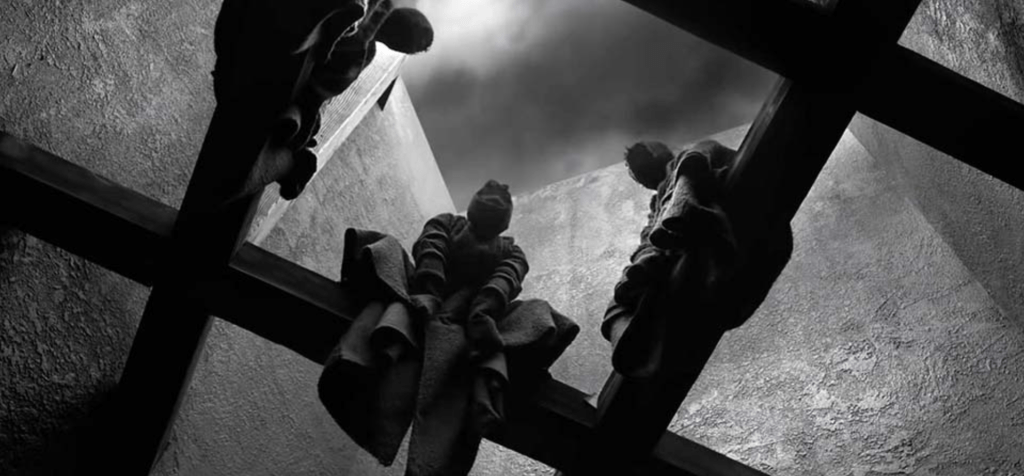
When these sound design and cinematography choices are at their most exaggerated, The Tragedy of Macbeth feels most overtly like a movie as opposed to a filmed version of the play. Though compelling throughout, the film is best when it boldly plays to the unique strengths of its medium… when images and sound overtake the senses, like in the scene in which the witches stare at Macbeth from above and fill the room with a false and unnatural pool of water from which Macbeth hears dark prophecies from a disembodied head. Light and sound and close-up fury are among film’s most powerful tools; translating a play to screen without expanding the story or adapting the play demands that those tools are utilized powerfully if the film is to feel cinematic.
The Tragedy of Macbeth strictly adheres to text and performance; in this way, it never quite leaves the realm of the theatrical. But its cinematic qualities often create a feast for the senses in a way that only movies can. This tension is indicative of the unique strengths of each of the dramatic mediums, which Joel Coen’s film tries to intriguing extent to blend.
 Story / Telling