“A man’s made by patience and the odds against him.”
Lingering gestures.
By the time we see Phil Burbank sit down at a table for dinner with his cowhands and brother, George, near the beginning of The Power of the Dog, we already get the sense that he’s an unpleasant man. He calls his brother “fatso” and has a brash temperament with a short fuse.
It’s not odd to us, then, that he would make a flippant comment about the handmade paper flowers decorating the dining table — “I wonder what little lady made these.” What is odd, however, is how much time he spends admiring them before he does. He twirls them in the palm of his hand, sniffs them as if they were real, and swirls the paper petals delicately with his finger, which we see in a narrowly focused macro close-up.
When the scrawny, awkward boy named Peter Gordon proudly tells Phil that he made the flowers himself, Phil makes sarcastic jabs at the boy, then mocks his mannerisms and slight lisp, much to the amusement of Phil’s cowhands.
And yet, in spite of this cruelty, Phil still holds the flowers closely, a tiny glint in his eye. This lingering gesture plays at odds with the words coming out of his mouth.
Until, that is, he counters his instincts, assumes his projected masculine persona, and casually lights one of the paper flowers on fire.
This prop — how it is handled by the character and visually presented by the camera — communicates a tension between Phil’s internal and external self. This will become one of the key themes of the story, and the source of much of its conflict.
Fleeting moments.
In the scene before this, a pensive, finger-picked guitar riff plays on the soundtrack as we watch a herd of cattle cross wide, yellow plains in a zig-zag formation. Phil and his cowhands cross the screen on horseback in the foreground of the shot that follows, keeping their cows in line. In the background of that shot, a dead cow sits in the center of frame, its legs up in the air; craggy rock formations and looming mountains close the background in behind the animal’s corpse.
“There’s a dead cow. Keep our cattle away,” Phil says to his men. “What happened?” a cowhand asks, looking out at the sorry sight.
“Anthrax. Don’t touch,” Phil replies.
The scene moves on; this fleeting moment passes into the next. But the music, shot composition, and directness of the dialogue are all stark and dramatic enough that this otherwise seemingly irrelevant moment sticks in the back of our minds. It’s fleeting, but not forgettable, and it provides important context for what happens later.
Repetition.
“Bronco Henry.” The name is repeated over and over again until we start to think of him not as a man but as a mythological figure. Phil’s near constant reminders about him at the start of the film ensure that we never forget about Bronco Henry and how good he was to his men. The cowhands drink shots of whisky in Bronco Henry’s honor in a bar; Phil, suppressing emotion (betrayed by a lump in his throat), refers to him as “the wolf who raised us” before downing his own shot. The phrasing of this comment communicates the depth of Phil’s respect to the man in a hyper-masculine way.
Bronco Henry, to Phil, is the embodiment of what it means to be a man. Phil even keeps a plaque honoring him in his shed.
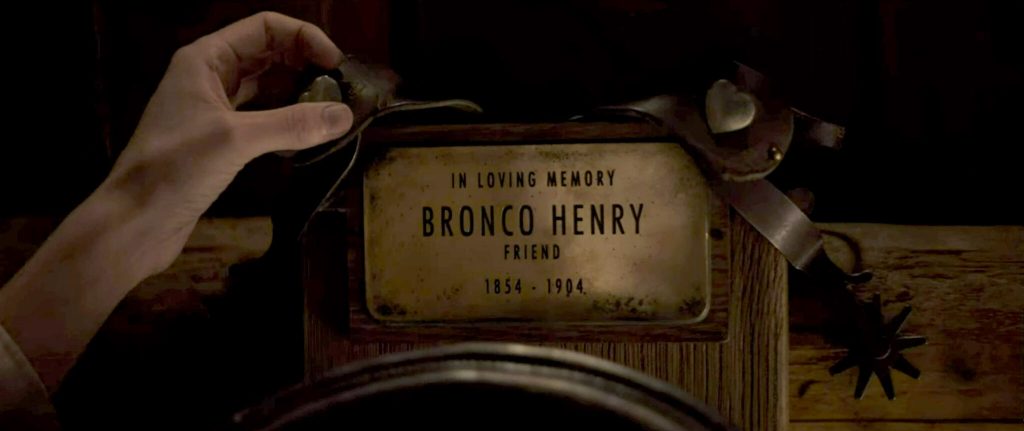
Given Phil’s rough exterior, rejection of femininity, and how deeply he idolizes this man who “raised” him, we imagine Bronco Henry to be a traditionally masculine figure for much of the film.
The truth, however, differs from this projected image — just as the truth about Phil differs from his own projected image. More than an hour into The Power of the Dog, we see Phil, shirtless, eyes closed, lying in a secluded patch of grass by a river. We watch in close-up as he sensually rubs a cloth handkerchief over his face. A warm murmur of strings swell on the soundtrack as he pulls the monogram at the handkerchief’s edge into view: BH. As Phil indulges in private fantasies, Peter finds a stash of nude male model magazines in a tree nearby. A familiar name adorns the top of the first booklet that we see.
Phil then peacefully, quietly bathes in the river, thinking that he is alone. Then, he sees Peter watching him from afar.
Being seen in this vulnerable moment elicits brief panic in Phil’s eyes, but the vulnerability does not last; his masculine persona overtakes him, and he chases after the young man, enraged.
It’s a key moment that reveals the disparity between how Phil acts in private moments versus how he behaves around others. This internal conflict between these two sides of him, and the toxicity that it creates, is the film’s central thematic focal point.
Inner worlds versus projected personas.
Most of the other characters are guilty of this as well, to some degree — their personas shift depending on whether they feel like they can be vulnerable, or whether they feel like they have to be perceived as others assume them to be.
Peter, for example, presents himself as scrawny, awkward, and weak in the company of others. But in private, he commits cruel acts like killing and dissecting animals under his care. Though his final actions in the film feel out of character for his projected persona, they align well with the Peter whom we get to know in his private moments.
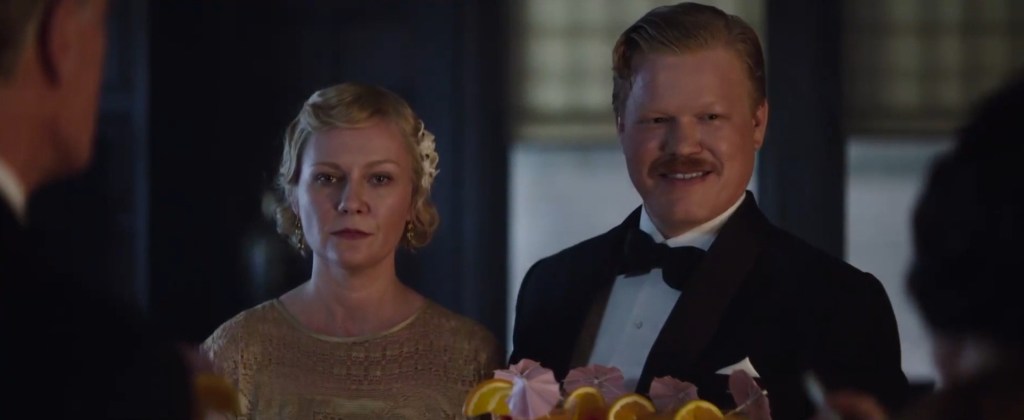
In an early scene, Rose plays a pianola in her restaurant well, finding joy in the music. But later, when George forces her to play in his manor for distinguished guests, the pressure of the occasion gives her so much anxiety that she is unable to play a single note. Fear of what others will think of her — and how they will react if she fails — prevents her from being able to be her full self around others. These scenes take something that brings Rose joy in private and weaponizes it against her when she’s in public.
In contrast, playing the banjo brings Phil joy in private moments as well — we see him strumming a tune calmly in bed at night in an early scene. But instead of spreading happiness and joy with his skillset, or allowing it to be weaponized against him, he directly weaponizes his talents against others. The notes of his banjo perfectly finish the tune that Rose fails to play on her piano, as the camera frames her powerlessly from Phil’s point of view as he stares down at her from the top of the manor stairwell. He weaponizes a private joy in order to make her feel small.
It’s winter in Montana when Rose is embarrassed in front of George’s imposing guests. A dusting of snow blankets the ground outside, and the environment is not just its usual harsh self, but cold as well, reflecting the cold treatment that she is given by others.
George is sweet and kind to Rose in private. Shortly after they become husband and wife, George dances with her and tells her, tears in his eyes, that is it so nice to not be alone. His vulnerability, kindness, and compassion in this scene starkly contrasts his coldness around her when she is humiliated in the aforementioned scene featuring mixed company.
The pressure of being who other people think they should be changes and distorts them. Rose and George serve as foils for Phil not only because their behaviors often contrast his own, but because many of the same things that make him a monster affect their behavior — and most other characters’ behavior — in detrimental ways as well.
The disparity between all of these characters’ projected personas and private vulnerabilities elucidates and deepens our understanding of Phil, his actions, and the film’s themes.
And then there’s the style.
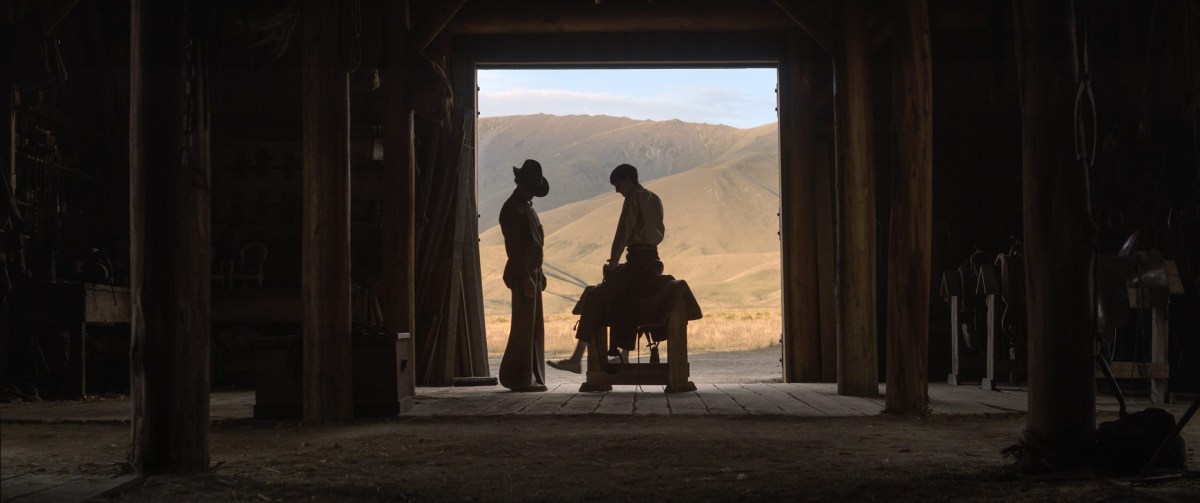
Several actions throughout The Power of the Dog are framed within ‘frames,’ with the camera composing vignettes through barn doors and manor windows. These framings narrow our perspective within scenes, creating a visual motif that evokes a feeling that we are not always getting the whole picture — only a controlled view.
We see close-ups of violent acts performed by men, including the castration of a cow. We linger on the rage in men’s eyes in close-up as well. The camera does not blink from the callous actions that make these men feel large.
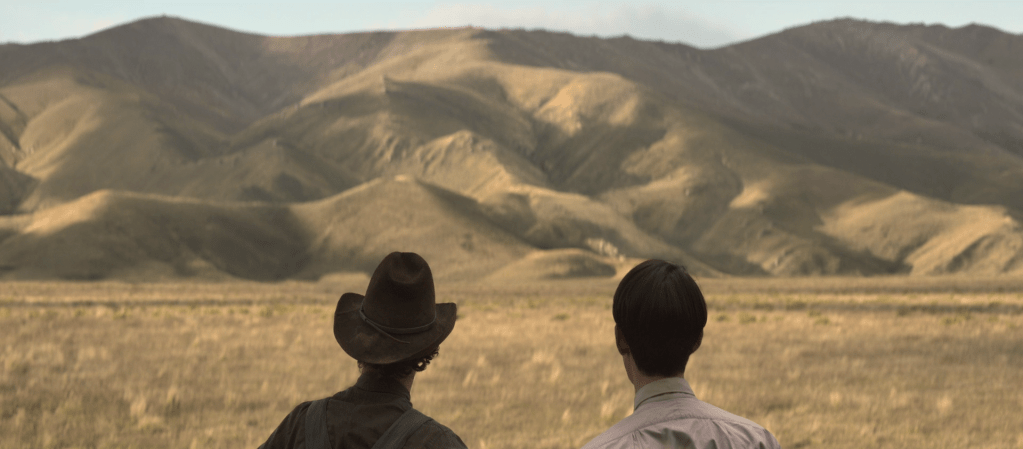
In much of the rest of the film, however, beautiful brown and yellow vistas overtake the frame while men appear small within them… a reminder that in spite of all efforts to portray themselves as unflinchingly strong, nature dwarfs all men.
 Story / Telling