
“I don’t want any belongings, any memories.”
After her husband and daughter’s deaths, Julie begins to systematically wipe away all memory of them by pushing everyone and everything in her life away.
We hear on a news broadcast while she is in the hospital that her husband, Patrice, was an acclaimed composer; shortly after Julie returns home from the hospital, she stands beside a piano and begins to play a melancholic melody from one of Patrice’s most anticipated, unfinished scores. The camera focuses on the individual musical notes on the sheet of score as she plays them, and pans our field of view across the blue-light-bathed sheet of paper to the right note by note as the music progresses.
As she slowly plays, she self-sabotages her own experience of the music; her free hand pushes the lid prop of the grand piano to the side ever so slightly until the lid crashes down on top of the piano. Many notes ring out in discord, and Patrice’s melody remains unfinished. As the cacophony dies down, we see her in close-up, emotionally distressed; she heaves a heavy sigh.
She then examines rolls of unfinished score sheets with a friend in a different space; the camera lingers on the wide sheets of paper long enough for us to examine all of Patrice’s handwritten musical notes, the handwritten comments, and the scratched-out changes and alterations on these documents.
The selection of composer for Patrice’s former job is perfect in the context of the film’s story — the work that he leaves behind is something that we can both look at and hear, and it evokes the notion that this life, taken too soon, had unfinished beauty to give to the world that will never be given.
The friend in this scene tells Julie that she loves what Patrice wrote for the chorus of this song; as the friend points to the notes on the paper, we hear a choir chant the tune on the soundtrack. After just a few notes, Julie rolls up the score and carries it outside. The choir continues to sing as she tosses the roll into the back of a garbage truck. She watches with a blank expression as the roll is destroyed with all of the other discarded trash. We see the grinding gears of the garbage truck smash the roll of paper in close-up, and as the paper becomes destroyed, the audio of the chanting choir becomes distorted, slowing down until we hear not beauty but surreal and unnatural vocal tones.
The edit then cuts back to a shot of Julie; half of her face is shrouded in shadow and the other half in light. She doesn’t emote. She merely watches, withdrawn and cold.
It’s a short sequence, but it encapsulates all of the primary storytelling devices that Krzysztof Kieślowski uses throughout Three Colors: Blue to paint a compelling portrait of grief on top of a bare-bones narrative: subdued performances where characters hold back more emotion than they show, props that have metaphorical meaning for both the characters and the audience conveying ideas without words, and experimentation with form for visceral dramatic effect.
There is sadness and anger in Julie’s eyes throughout the film, but she rarely overtly cries or breaks down completely; in spite of losing everything, she bottles up her emotions in an effort to carry on with life. Instead of her character’s grief feeling performative, as it would in a flashier character study, we witness realistic suppression punctuated by moments of intense emotional instability — the erratic contrast of her cold, matter-of-fact exit from the arms of a potential long-term lover followed by her grinding her knuckles against a stone wall on the foggy countryside road outside and wincing at pain as she effectively self-flagellates communicates more clearly than her character breaking down in tears ever could.
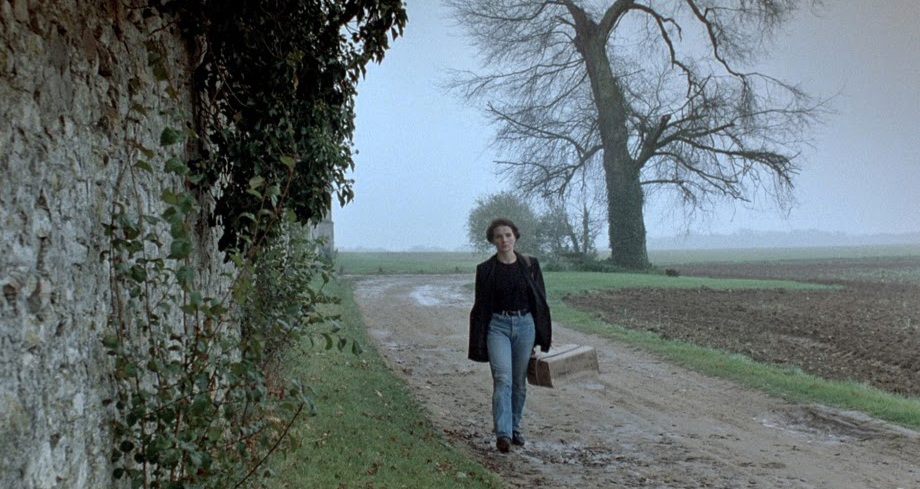
Julie tries to distance herself from the life that was taken from her, but even as she rids herself of most of her possessions, mementos of the past evoke haunting reminders of what she lost. The sheets of unfinished score remind her of her husband. A candy wrapper — silver on the inside, bright blue on the outside — brings back memories of her daughter.
Julie moves into a new Parisian apartment in order to start her life over; however, the first thing that she does when she arrives there is hang a chandelier taken from her old home. The chandelier obscures her face in tight close-ups, then casts flickering blue light upon her as she fights back tears.
The intermittent musical callbacks to Patrice’s score, alongside these props, directly evoke memories of the past for her. Some she tries to get rid of, and others she clings on to, for similar reasons.
The most interesting prop in Three Colors: Blue develops new meaning each time we see it. The cross necklace first evokes a happy memory for Julie, as she fondly remembers her husband’s sense of humor; then, the same type of necklace evokes pain and changes her perception of her husband when she sees it on the neck of his pregnant mistress. Finally, the ripple effects of the tragedy that consume her are felt when we see the boy who witnessed the accident wake up in the middle of the night wearing the necklace. This one prop evokes the notion that grief spreads, morphs, and changes perception of past relationships and events over time, and impacts more people than any one of us can at first imagine.
Less personal props featured throughout the film are also used to provide us with insights into Julie’s state of mind. Julie sits alone in a coffee shop and hears a homeless man across the street playing music on a recorder that sounds eerily similar to one of Patrice’s compositions; as we listen, an abstract overhead insert shot of her coffee mug holds onscreen for an extended period of time. Time escapes a singularly-focused depressed mind; in this moment, it’s as if we — and she — have given in entirely to what the aural stimulation evokes as we stare at the steam billowing out of the mug and the light passing over her café table. Later, she greets that same homeless man in the street; as he lays his head on his recorder’s protective case, he tells her, “You gotta always hold on to something.”
This statement — and the prop that accompanies it — is evocative; the sparseness of the plot meshed with the level of attention given to these kinds of seemingly small moments make us wonder: what loss did this man experience? Was it similar to hers? How would her life have played out after the accident if she was in the same emotional and mental state, but didn’t have familial wealth?
Kieślowski ponders this but doesn’t linger on it; the beats of this story are less like plot points and more like the individual notes of the score so carefully regarded near the start. Together, they add up to a melancholic melody.
Performance, props, and locations — the gritty streets of Paris, the empty apartment, the lavish but cold mansion — are all effective tools in Blue; they deepen a loose story and give it emotional weight. But Kieślowski pushes his storytelling further by playing with form itself as well.
Several moments in the story shatter Julie’s inner world — for example, when she meets her husband’s mistress, and learns of her pregnancy with his child. In those moments, Kieślowski dramatically fades to black, pausing the film to allow time for us (and her) to process the news… before fading back in to the same scene, which then continues on. It’s an odd — but effective — break from stylistic convention, in which a fade to black almost always marks the end of a scene.
In another scene, Julie finally allows herself to connect with the man who loves her. Kieślowski pulls a similar trick here, but instead of fading out, he pulls the scene completely out of focus. Instead of dipping to black, the image turns into an abstract array of colorful orbs. Julie’s future after this scene, like after those that dip to black, is uncertain because of her interaction with another character in this meaningful moment, but unlike the earlier scenes that dip to black, the possibilities here seem to be colorful and bright.
Other experiments with form in Blue are even more visually arresting. The unsettling play with composition, light, sound, and footage speed during the opening driving scenes make the crash feel both inevitable and expected, and more viscerally upsetting than it would be if it were handled more traditionally as a surprise. The ensuing shot in the hospital where incredibly shallow focus directs our gaze to a single feather while a nurse works in the unclear background places our gaze as if we are seeing through the dazed and unfocused mind of Julie. We catch glimpses of characters in other moments as seen — quite literally — through others’ eyes; in those moments, they are distorted within others’ pupils. Perception is never exactly a reflection of reality.
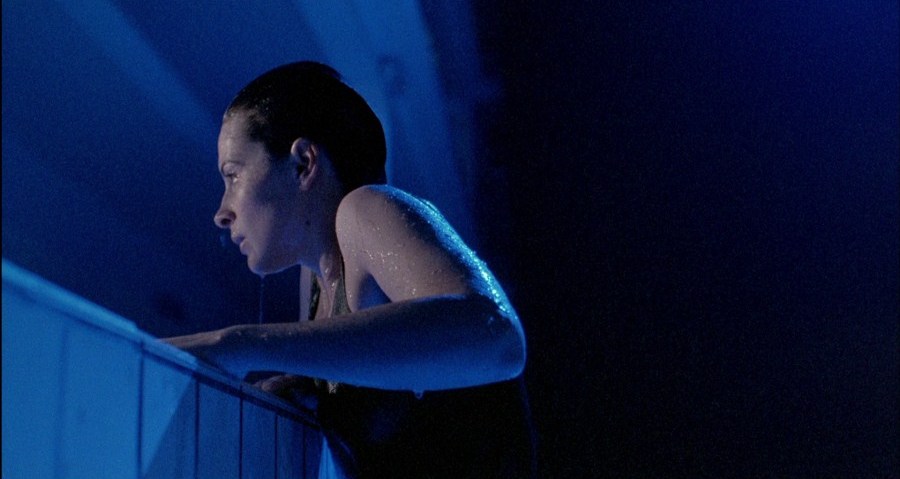
There is also a play in Blue, most obviously, with color, which helps to aesthetically tie all of this together. The color blue is scattered throughout the film’s environments: in the chandelier and candy wrapper and the folder that holds Patrice’s compositions; in the light that reflects on Julie’s face through several different windows, and in the water that washes over her as she repeatedly swims in a pool. In the case of this latter motif, the color directly evokes the notable term drowning in grief. At every turn of Julie’s story, over and over, that same color appears onscreen, both subtle and direct… blue, the hue of sadness.
 Story / Telling