
“I don’t like the idea that I’m not in control of my life.”
Neo’s arc in The Matrix is an archetypal hero’s journey. His character’s actions follow the steps outlined by Joseph Campbell and repeated throughout the history of modern human storytelling beat by beat. Neo’s call to adventure is to “follow the white rabbit,” and even after becoming intrigued by his first meeting with Trinity at the nightclub, he refuses the call to deviate from his ordinary life until he has an official meeting with a mentor, Morpheus, who presents him with a “crossing the threshold” moment so overt that the famous blue pill / red pill discussion starts with, “After this, there is no turning back.” Once Neo has been freed from the delusional world of the Matrix, he contends with enemies and allies, faces an inner ordeal of self-doubt, chooses a higher cause, initially fails at the hands of an enemy, and then is, in the end, resurrected to achieve his full potential and leave the story a changed man.
It’s not a knock on the Wachowskis to point out that The Matrix so closely follows the hero’s journey template. It’s a famous guide for a reason – it’s dramatic, compelling, and offers storytellers a reliable journey through which their heroes can face internal and external conflicts, fail, and then rise again… which makes the audience root for the hero far more than we would if they faced inner and outer conflict with ease or without as many interesting, dynamic complications.
If anything, The Matrix stands out as an excellent example of how to tell a standard hero’s journey at blockbuster scale well, and how to make a templated narrative unique by using a compelling combination of stylistic flourish, captivating aesthetic design, and interesting thematic ideas.
To use a dessert metaphor: style and big ideas are the beautiful icing and decor that make the delicious – but traditional – Matrix cake special.
The Matrix was released at the end of the dot-com bubble, as computers were becoming increasingly necessary in both businesses and in the home and the digital future felt uncertain due to societal panic around “Y2K.” Artificial Intelligence was not yet prominent in consumer products, but it – along with all of the other new digital advancements – was beginning to move out of the realm of science fiction and into the “real world.” The Wachowskis struck a chord with audiences by making their hero’s journey in The Matrix confront these pressing societal anxieties of their time. Through that journey, they posited what the future could look like once the difference between the digital and the real became indiscernible.
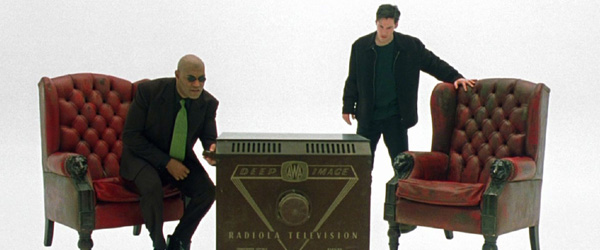
The Matrix poses the question “what if everything around us was a computer-generated illusion?” – what if we were all living inside of a machine simulation? As we – and Neo – begin to wrap our heads around this idea, the Wachowskis visually strip back the story’s environment to its bare bones by placing Morpheus and Neo in a blank canvas – a white void called “the construct.”
The filmmakers introduce simple set dressing elements as the scene progresses, then drop those same set dressing elements and characters into a simulation of the ‘scorched earth’ world that Morpheus speaks about. This on-demand changing of a blank slate environment, with new elements added methodically as the scene progresses, takes a complicated idea and makes it easily digestible for the audience. What this unique stylized approach communicates – even more clearly than Morpheus’ words – is that every component of the world as we know it is whatever the person or entity in charge of this reality wants it to be.
The Matrix is often lauded for its flashy fight scenes more than anything, and rightly so – not only do the action-packed shoot-outs and chase sequences look cool, but they’re smartly done: as Neo (and other characters) become more and more attuned to the notion that “there is no spoon,” the more they are capable of defying the laws of physics. Powers do not just become second nature to Neo at their full potential after being directly programmed into his head – he has to work to overcome his own mental roadblocks before he is able to evade (and later, outright stop) bullets, or leap across the chasm between skyscrapers. The trick shots in The Matrix become more dynamic as Neo’s character evolves; stylistic flourishes become bolder as the story progresses.
It’s these kinds of elegant visual choices that keep us oriented. We’re never confused as to where we are even as the story alternates between digital and physical realities, because we’re provided with visual cues to distinguish between them, like the metal outlets affixed to the characters’ arms and backs and heads in the real world and the sunglasses and black trench coats that they wear inside of the Matrix.
It is often the case that heady, action-oriented science fiction films become convoluted, as they over-explain intellectual concepts in extended expository sequences. But The Matrix is refreshingly unencumbered by that typical flaw because the filmmakers registered that elegant visualizations of complicated concepts not only are more clearly interpreted by the audience than anything that is overly complex… but that it can look cool to strip things down to a state of elegant simplicity, too. The white void of the construct is one obvious example; another is the black cat – seen shaking twice – that represents the “glitch” of déjà-vu within the Matrix.

By conveying concepts in a simple, clear, and visual manner, the Wachowskis give us space to ponder the questions that they are posing without ever confusing us. By adhering to a tried-and-true narrative structure, their science-fiction story retains a recognizable mythic quality to it that feels powerfully traditional even as it addresses modern ideas. And, by creating unique visuals that were, at the time, quite groundbreaking, they crafted a movie that is a feast for the senses – a true audiovisual experience.
 Story / Telling