“Nothing is what it seems.”
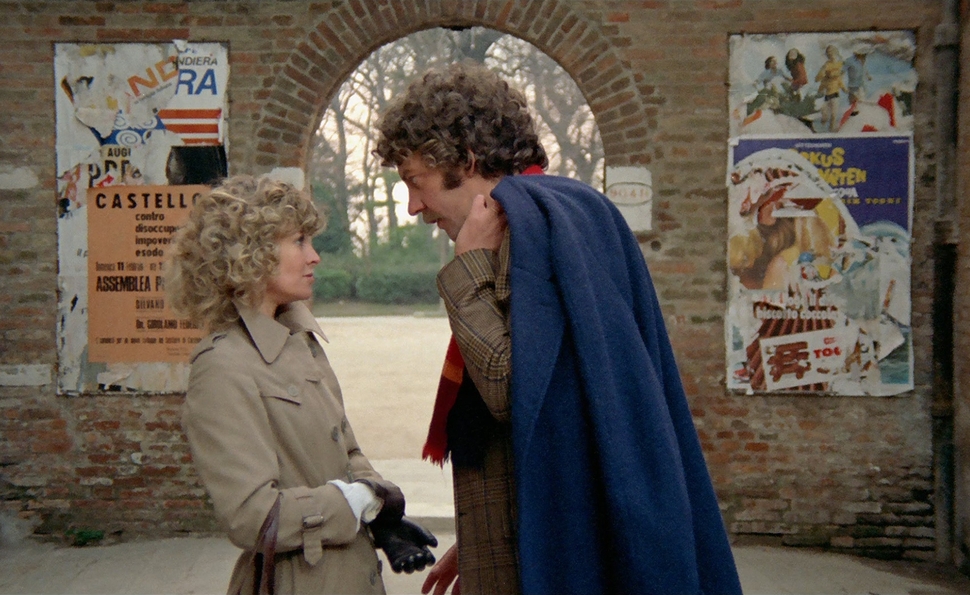
After the accidental death by drowning of their young daughter, John and Laura Baxter travel to Venice, Italy to heal, leaving their surviving son behind in a boarding school in England. John has been contracted to restore an old church which, like much of the city of Venice and John and Laura’s relationship, is crumbling down and in dire need of repair.
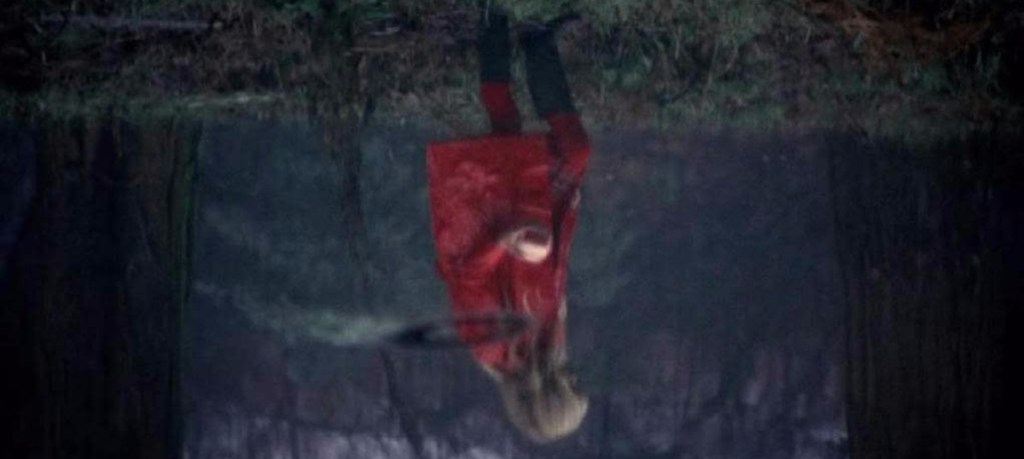
The setting is evocative; the cracked walls and dark alleyways of Venice at night contribute heavily to the film’s unsettling mood, and the waterways themselves create physical barriers that the characters — especially John — struggle to overcome. In one scene, John sees what appears to be his wife riding on a boat in the canals, but she is supposed to be in England at the time; the water prevents him from getting to her, which causes him to panic. In other scenes, an elusive person — short and shrouded in a red, hooded cloak that reminds John of the outfit worn by his daughter when she drowned — runs through the shadowy alleys; John catches glimpses of her from the opposite side of canals, but must either find a nearby bridge or climb across docked boats in order to get to her side. By the time he does, he almost always is too late.
The city is a perfect metaphor for what is going on with John and Laura as they grapple with their grief; the water, symbolic of their loss, surrounds them on all sides. They try to flow with it and live their lives on top of it as well as they can, but they never actually grapple with what to do with it when times are tough, besides clumsily stumble over or around it.
John’s vocation, meanwhile, mirrors his own internal grieving process; he stubbornly dedicates his life to fixing something beautiful and broken, but wants it to solely be done on his own terms, and might be driving himself into the ground over a lost cause. He throws himself fully into his work, trying to control what he feels like he can control, instead of being there for his wife or son’s more elusive emotional needs.
John’s work at the church also provides organic opportunities for Laura’s beliefs and values to be questioned and clarified for us; for example, the bishop whom John is collaborating with on the renovations asks Laura if she is religious, and she denies having any personal spiritual beliefs — but then, in contrast to this, believes the blind psychic wholeheartedly when she tells her that Christine, their daughter, is communicating with them from the beyond.
The film’s setting and main character’s profession ladder directly up to and support the film’s themes.
Don’t Look Now is a supernatural horror film, at least in part; there are unsettling scenes featuring the blind psychic and her sister, a harrowing sequence in the church when a wooden board smashes into the scaffolding inches from John’s head and nearly sends him tumbling to the ground, and, of course, the film’s climactic chase through the foggy alleyways of Venice at night, which ends with tragic violence.
That climactic sequence is brutal and, from the standpoint of the plot, feels somewhat out of place upon first viewing. But thematically, it resonates; throughout the film, we learn about a serial killer who has been drowning women in the canals — which obviously brings up dark memories and painful emotions for John.
Instead of accepting his daughter’s death fully and talking about it, he rationally accepts it but keeps his emotions closed off; because of this, John cannot move on and instead becomes fixated on “fixing” it in whatever way he can, including chasing after any reminder of Christine. This ultimately prevents him from living — metaphorically, and otherwise.
But even though the supernatural and serial killer narratives both play a prominent role in the plot of Don’t Look Now and merge at its climax, they are not the primary focus of the film — they are merely additive features that add metaphysical and metaphorical drama to a simple story. At its core, Don’t Look Now is a domestic drama about a couple who are deeply in love, grappling with their grief, and trying to connect to move on with their lives — but who are unable to shake the weight of the tragedy that is tearing them apart.

Director Nicholas Roeg makes bold stylistic choices that viscerally tell the story of their grief and inability to effectively confront it. Some are obvious and brutal, like the way in which time slows down while John pulls Christine’s body from the pond and the edit repeats that moment over and over again before they move to the shore, then cross-cuts the tragedy with an image of a frame of film that, because it was splattered with water, smears red dye into a streak that looks an awful lot like a splatter of blood.
Some are obvious and poetic, like the beautiful scene in which John and Laura finally try to reconnect one night in Venice and the edit cross-cuts between intimate shots of them intertwined in their hotel and vignettes of them both getting ready for a romantic dinner date, set to poignant classical music.
Still other choices are subtler, like how we watch a conversation during which Laura brings up the fact that John had said that he would never let Christine play alone by that pond, and he thanks her for the memories through gritted teeth outside in broad daylight from afar in a single wide shot, so we miss their true expressions, just as they miss each others’ emotional cues.
Or, how Roeg frames the scene of Laura meeting the psychic in the bathroom for the first time — Laura first faces the mirrors, and when Christine is mentioned, she breaks down in tears — but instead of staring at her own grief and facing her emotions, she turns away from the mirror to instead find comfort in a blind psychic’s premonition.
She then collapses to the ground immediately after, falling in slow motion until she smashes against the restaurant table, sending dishes and dinner rolls tumbling down upon her as she faints… perhaps a metaphor for the consequences of suppressing your emotions?
The scene that precedes that moment is a masterfully subtle portrayal of missed connection; on the surface, both John and Laura are polite and interested in one another as they sit down for a meal together, but they rarely make eye contact. John’s eyes wander the restaurant, but Laura does not pick up on his distraction and continues to speak as if he was actively listening. Not only do their eyes rarely cross paths, but the sound of clattering plates and other conversations around them are mixed higher than they normally would be on the audio track — it’s difficult for them to connect with one another when the world around them feels so chaotic and loud. John diverts his gaze back to her, and she continues to converse. They try.
The stylistic choices throughout the film — from the subtle acting gestures and blocking decisions, to the unconventional but thoroughly effective editing patterns of key sequences like those mentioned above — add layers of depth and meaning that lift Don’t Look Now above many of its contemporaries in both the supernatural horror and domestic drama genres, and make it a deeply compelling, unsettling, and oddly moving cinematic experience.
 Story / Telling