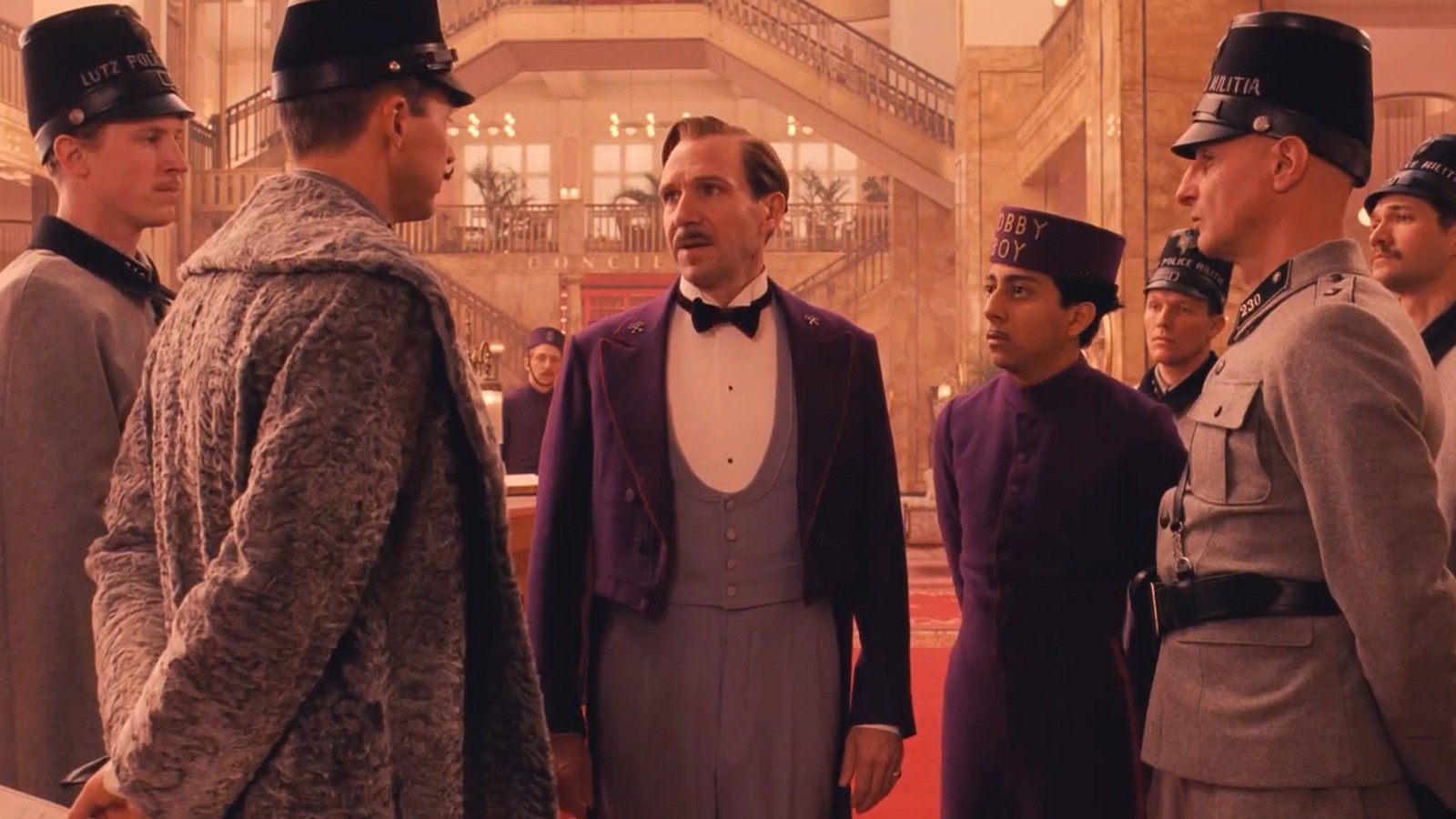
“We were happy here, for a little while.”
When we first see the titular Grand Budapest Hotel, it’s clearly a miniature, with no lighting or camera tricks used to hide that fact. In its first onscreen appearance, the hotel looks like a bright, pink, ostentatious dollhouse, and is set against a hand-painted backdrop of pine trees that are frosted over with pink and purple hues of paint. The cinematic frame that this whimsical setting is composed in is set at an aspect ratio of 4:3 — a sharp visual contrast to the widescreen frame that enclosed the scenes that came before it.
The story of The Grand Budapest Hotel is told through voiceover narration — first, from the point of view of the character of an Author — and the shift from the widescreen format of his ‘present’ world to the boxed-in, square look of his retelling of the ‘past’ serves as a visual reminder that the story that we are watching unfolds through a very particular, singular point of view that metaphorically and visually leaves out the edges in favor of an idealized narrative, derived from memory.
The Grand Budapest itself is described by the Author as “a picturesque, elaborate, and once widely-celebrated establishment” when we see it for the first time in this square frame. But then, as the Author moves on to say, “I expect some of you will know it,” the frame size shifts back to widescreen, and we see the Grand Budapest as it exists in modern times — which causes us to question if it ever really was what we saw it to be. The general shapes of the architecture remain the same, but the pink paint has been replaced by sheer brown stone; all ornamentation has been removed, and the pink and purple hues have been replaced by sparse orange signs and windowsills covered in dirt. The foliage behind the ‘modern-day’ images of the Grand Budapest is vibrant still but natural in its coloration — orange, yellow, and red leaves cover the tree branches; autumnal colors replace the fantastical pinks and purples of old.
The hotel still looks like a miniature with a painted backdrop behind it, but the image feels less fantastical, more realistic. The shift from one frame size to another adds to this perception; it represents the unspoken notion that what we saw before was an idyllic representation of the past, and this new and far less attractive image is — both literally and metaphorically — the “full picture.”
The Grand Budapest Hotel is a film that is, at least in part, thematically about perspective, memory, and the ways in which we create and protect our own idyllic worlds within the chaos that surrounds them, to control what we can control in a vicious, cruel universe. The shifts in frame size and color palette are among the many stylistic choices that draw attention to those themes. The film is absolutely beautiful, but the aesthetics do more than dazzle; form serves essential storytelling functions. When things are going well for Zero and M. Gustave, they’re inside of the bright and ornate Grand Budapest; when things are not going well, they’re most often outside in the blistering cold, running or skiing their way out of trouble in snowy towns — or inside of environments with darker aesthetics — like Madame D.’s manor or the prison that M. Gustave finds himself in — that are inhospitable. When the recollection of this period in time becomes too sad for the older Zero to bear repeating in narration, the scene is filtered in black-and-white entirely.
One of the other aesthetic pleasures of The Grand Budapest Hotel, besides this playing around with color and frame size and the obvious charms of the costumes and the score, is that almost every setting is filled with small, delightful details. You notice some — like the sign for Dental Clinic Appointments hanging on the front of the Reception desk, and the abundance of dead animal trophies and hunting rifles that litter Madame D.’s manor’s sitting room — that clearly exist for the sake of eccentricity and humor, and others — like the painting of Boy With Apple hanging conspicuously behind the concierge desk in the film’s opening scenes — that add thematic depth to the film if you pay attention, but do not draw too much attention to themselves outright. Boy With Apple causes chaos, death, and strife throughout all of the narrated flashback scenes; the value of the painting and its willing to M. Gustave by Madame D. sparks a battle with Madame D.’s children that reminds Zero, the Lobby Boy, that “men’s greed spreads like poison in the bloodstream.” But though characters die for it in the past, just a few decade later, it hangs completely ignored by all behind the desk of a hotel largely stripped of its former glory. What was once so important is now extraneous.
Only Zero cares about it still; note the older Zero, near the end of the film, without drawing attention to his action, rights the painting mid-conversation with the Author when he notices that it is askew.
“There’s really no point in doing anything in life because it’s all over in the blink of an eye,” M. Gustave tells Zero as they take a train ride across the cold and wintry countryside to visit the estate of Madame D. to mourn her death. Yet, everything that they subsequently do is done with such fervor, such attuned attention to detail, and — when it comes to the fight over Boy With Apple — such panic and pain.
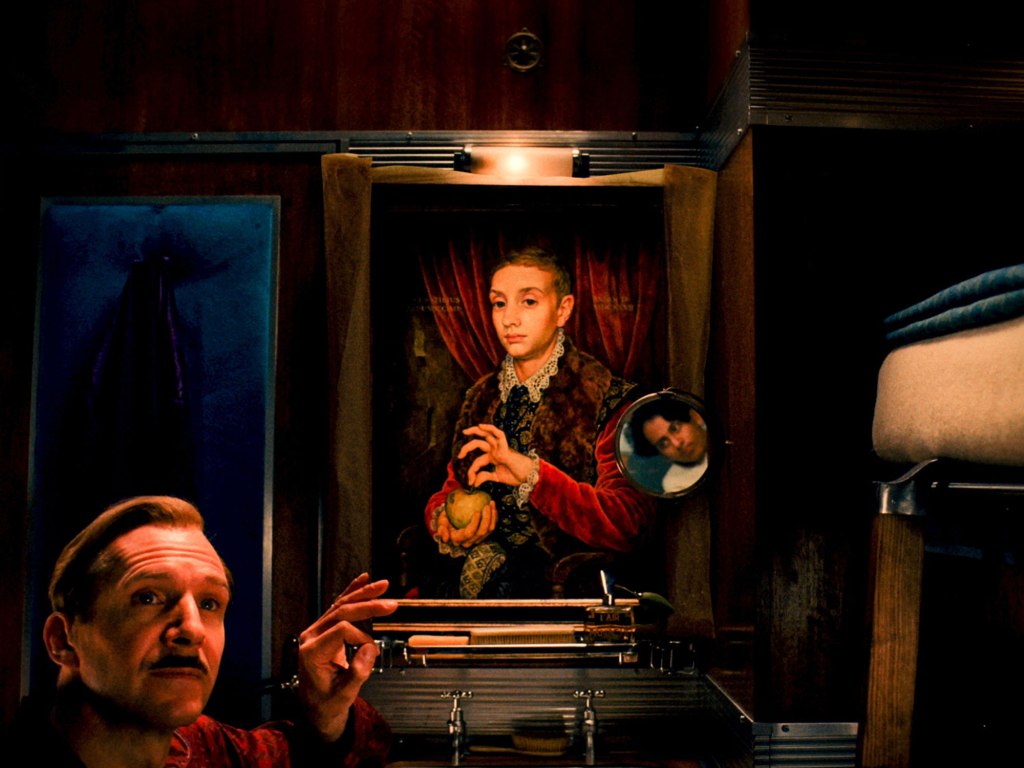
This duality is part of what makes M. Gustave one of Wes Anderson’s best and most interesting characters; he has a meticulous attention to detail, dry wit, charisma, charm, and a solution to every problem — and yet, there are hints of a haunted past that follow him everywhere in spite of his put-togetherness and apparent optimism.
After stealing Boy With Apple, M. Gustave cannot sleep at night; he worries about what will happen to him and Zero as war tears the country apart around them and they’ve become fugitives on the run from a dangerous family. We get very few private moments with M. Gustave throughout the film, but this scene — especially the overhead close-up on his face as he closes his eyes, face strained by considerable emotional weight — and the scene of him eating alone in his cramped quarters at the Grand Budapest convey him as a character who, underneath all of the charisma, carries a heavy load.
Lots of bad things happen to M. Gustave, especially when he acts in his own self-interest. But the kindness of others — as well as his own acts of service — bring him joy in spite of that. “Don’t give up,” Zero reminds him from the other side of a visitor’s window in jail. Anderson cuts from a close-up of Zero expressing this sentiment to a close-up of Gustave; the broken concierge, seen here with two black eyes, smiles. Even locked up in prison, M. Gustave turns to acts of service to break through his fellow prisoners’ rough exteriors and turn the tides of his own fortune; he travels from cell to cell with a cart to distribute meals and shares delectable desserts with his cellmates. By not breaking down, by not giving in, he not only brings himself and others happiness, but turns the tides of his own fortunes by rallying others to his cause through his commitment to service and kindness.
The brilliance of scenes like those of M. Gustave in prison in The Grand Budapest Hotel is that they maintain the whimsy and charm that makes The Grand Budapest Hotel so superficially enjoyable even when the characters are in a depressing environment… but they also maintain established character traits (like M. Gustave’s commitment to service) and use those traits to drive the plot forward, even as the character is in unfamiliar territory.
What we take away from the trials and tribulations of M. Gustave and his protege, Zero, is that it is better in a cold, dark world to uphold a sense of decency and create beauty out of what you can control, like M. Gustave does, or give all of your love and affection purely and innocently to another — like Zero and Agatha do — than to be like those self-interested, bitter characters who dedicate themselves solely to self-gain, or those self-described lonely, isolated souls who stay at the Grand Budapest in its dying years.
We also take away the notion that, if the Grand Budapest Hotel itself was truly maintained as beautifully as it was back in the heyday of M. Gustave’s supervision, that maybe the key to making the world a better place is, in fact, to simply make your own corner of the world as bright as it can be. It is very clear, aesthetics aside, that the ripple effects of M. Gustave’s service created much greater joy for the hotel’s patrons than the “modern” Grand Budapest experience ever could.
Things may not have actually been good back then — at least, not outside of the hotel. But through the controlled frame of memory, they can look back on it fondly, and remember what was good, and why, because of the impact that the selflessness and charm of M. Gustave and his hotel had on them. That’s why, in the end, Zero remembers M. Gustave as a man who, if he was not happy, “certainly sustained the illusion with a marvelous grace.”
 Story / Telling