“Happiness can be found even in the darkest of times, if one only remembers to turn on the light.”
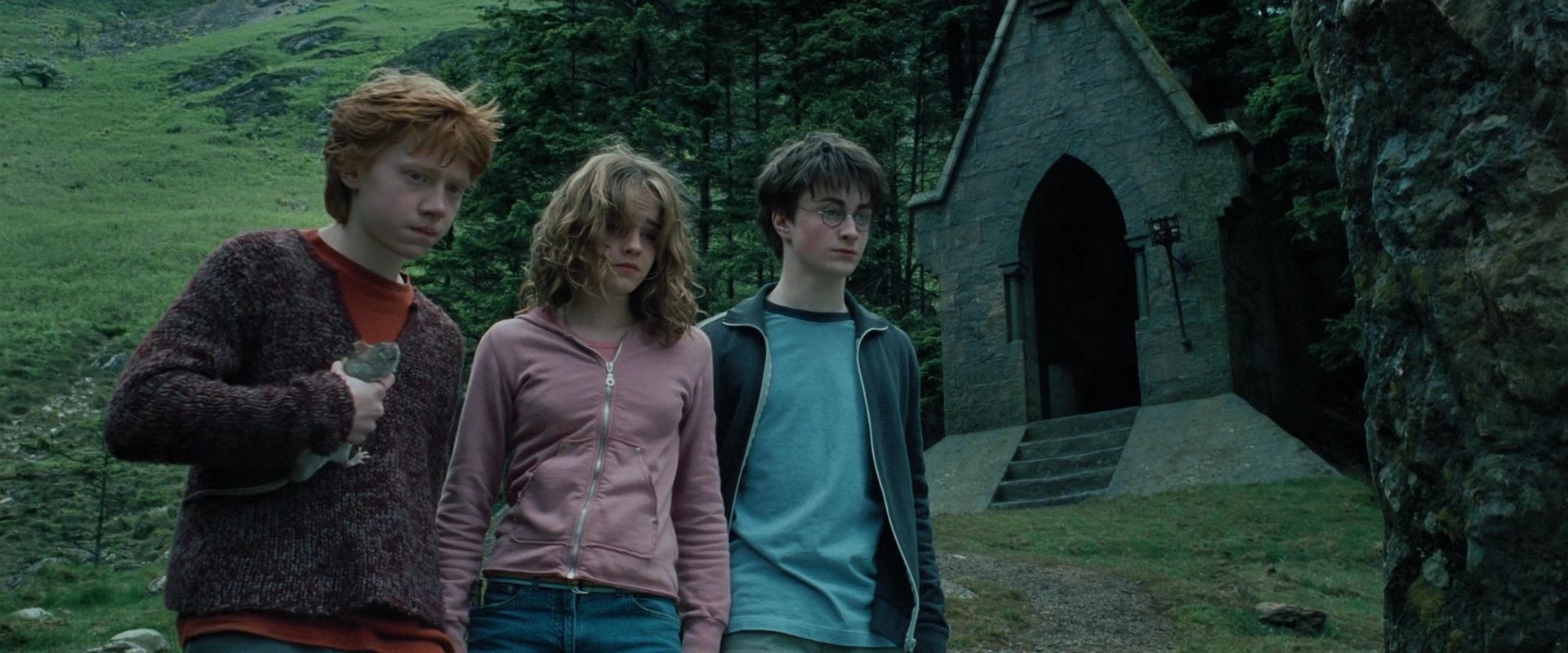
Robes were out, regular ‘muggle’ clothes were in when Harry Potter and his classmates returned to Hogwarts School of Witchcraft and Wizardry in Harry Potter and the Prisoner of Azkaban. Harry, Ron, and Hermione were occasionally seen wearing ‘regular’ clothes in the first two movies, to be sure, but more often than not the young witches and wizards were seen in buttoned-up, magic boarding school attire — ties, sweater vests, and formal black robes decorated with their House insignias.
Director Alfonso Cuarón and his team flipped that balance on its head; though the students still dutifully wear robes in class, their attire is casual and comfortable elsewhere on the grounds of the school. Even in class, their robes aren’t as seemingly well-kept as they were for the first two years of Harry’s magical education; it becomes clear in the scene in which Hagrid teaches his first Care of Magical Creatures class, for example, that while Harry has clearly learned how to approach intimidating magical beasts with empathy, he never really learned how to tie a tie.

The child actors were starting to grow up by the time Azkaban went into production, and the movie is better for it; just as the story began to become darker and more nuanced, so too did the personalities and performances of the kids. Puberty, increased maturity, and greater inter-personal conflict between the young witches and wizards — paired with aesthetic choices, like the aforementioned abandonment of formal robes in casual settings — marked a shift away from the more child-friendly storytelling of the previous installments and toward the more mature storytelling of the later installments in the series.
The wardrobe decision is seemingly — at least upon first glance — a minor aesthetic detail. But it, alongside other storytelling decisions, actively serves a greater function of removing barriers of emotional engagement with the story — allowing us, in ways big and small, to relate to the characters and their world better, so that we are more invested in what happens to them. When they’re wearing T-shirts, sweaters, and hoodies, the young witches and wizards look more like us. Because of this, we can better envision ourselves in their world, even if we don’t consciously recognize it.
One of the biggest flaws with many of the Harry Potter movies is that they have so much plot to cover in such relatively short runtimes that they too often rush through poignant emotional moments in favor of hitting the next story beat as efficiently as possible. When it comes to character development, one of the best ways to keep people invested is actually to slow things down at key moments that matter in order to give us space to feel what the characters are feeling.
Prisoner of Azkaban occasionally rushes plot points, but it mitigates that flaw better than most movies in the series by including scenes that have little to nothing to do with moving along the plot, but are essential in generating empathy for the characters. It serves little point to the plot, for example, when we watch Harry and his friends eat candies that make them sound and act like animals — or blow hot steam out of their ears — in the warmth of the Gryffindor dormitory as it pours down rain outside, or when Harry, shrouded in an invisibility cloak, throws snowballs at bullies before playing with his friends’ winter beanies outside of Hogsmeade. But this downtime spent with our primary characters in the presence of their friends — scenes full of merriment and laughter — is as important as the drama in the main plot to our understanding of who these characters are and what is at stake for them.
These scenes make us care about and believe in their friendship. And, like the decision to have them wear regular clothes, these scenes give us relatable moments to latch on to amidst all of the magical mysteries and brooding, mystical drama. These scenes, along with small details like having a kid sit on a wall in the back of a Hogwarts courtyard by himself playing a flute while Harry, Ron, and Hermione march through on their own mission, make this magical fantasy feel much more ‘real.’
Remembering to let the narrative breath in order for us to emotionally engage in private moments with characters and giving us relatable focal points that help us immerse ourselves in a foreign world are important lessons to consider — and that writers too focused on plot often don’t get right — when novels are adapted for the cinema.

All of the Harry Potter movies are visually captivating; it is stunning to see the spells, creatures, and exotic locales of the series come to such vivid life onscreen. Prisoner of Azkaban, in particular, uses the unique power of visual storytelling to its advantage when adapting J.K. Rowling’s book. Alfonso Cuarón and his team clearly put great thought and care into having the visuals truly enrich our experience of the story, as opposed to merely translate words into images.
Take the aforementioned scene of the boys hanging out eating candies in the Gryffindor dormitory; the scene starts outside of the castle with the camera focused on tumultuous rain pattering against a window at night before it seamlessly glides through the window into the warm, joyful dormitory. Another sequence begins with a shot of a dementor drifting moodily over a field of flowers on the shore of the lake opposite Hogwarts; the flowers wither under a wave of frost as the creature passes by, before the scene cuts to Professor Lupin’s classroom, where he teaches his students how to protect themselves from the things that they fear most with magic. The visual contrast in these scenes elegantly conveys the dramatic contrast between the chaos of the outside world and the characters’ (presumed) safety inside of the walls of Hogwarts.
Take, too, the visual transitions that give the story’s progression through time structure. The change of each season throughout the film is marked by a wide shot of the hulking, twisted Whomping Willow as it shakes leaves — and later, snow — off of its twisted branches. This works cinematically well enough as a motif to mark the passage of time; that the Whomping Willow ultimately ends up being a crucial location in the film’s climax adds additional weight and purpose to the selection of the Willow as this visual motif.
Under the direction of Cuarón, Prisoner of Azkaban visually soars; it adheres faithfully to the plot and characterizations laid out by J.K. Rowling in her novel, but plays, too, to the strengths of the cinematic medium.
Early in the film, the Knight Bus races through the streets of London, squeezing and stretching its way through traffic in a scene edited together thrillingly with rapid cuts and an energetic score. At Hogwarts, the scene in which Lupin introduces his students to a boggart is crafted out of several sweeping, frenetic camera movements cut to a jazzy score as the students face and laugh at their fears — but, as soon as Harry confronts the boggart and it begins to change its shape, Lupin intervenes; the footage ramps down into slow motion and the images become more still as he abruptly interrupts the playful fun. Later, while Harry plays Quidditch in the pouring rain, tension is built by the visual chaos created by dementors fly in and out of sight among the grey storm clouds. And in the film’s climactic sequence, the sound of a ticking watch plays pervasively on the soundtrack, mixed just loudly enough to be perceivable without being distracting, as we witness a visually and dramatically dynamic sequence in which Harry and Hermione travel through time to undo a series of dramatic events with life-or-death stakes.
These creative aesthetic decisions elevate Harry Potter and the Prisoner of Azkaban beyond being merely a beat-for-beat movie adaptation of the plot of the book. Directorial decisions big and small in this film recognize the unique tools available to a cinematic storyteller, and use them to not just bring the written word to the big screen, but breathe new life, emotion, and perspective into it as well.
 Story / Telling