
“I’m the creature. I ate her.”
Bong Joon Ho’s The Host, like its cinematic ancestor Godzilla (1954), personifies American hubris in the form of a rampaging monster that assaults a major Asian metropolis. Unlike Godzilla, The Host satirizes the people of the story as much as it critiques them. In doing so, it doesn’t just play by the rules of its genre; it pays homage to and subverts the genre’s conventions to make nuanced thematic statements — and to keep us on the edge of our seat.
The fear of nuclear annihilation by America that rippled across Japan post-World War II gave birth to Godzilla; the relationship between Japan and the US at the time was fraught with tension, and that classic film reflects that.
The modern history of South Korea is deeply linked to American military action as well, but the nuances of the relationship that Korea has had with the US since the Korean War are quite different. Therefore, while The Host similarly brings a monster to life as a result of American military bravado, the social commentary in Bong Joon Ho’s movie is broader and significantly more comedic than that of Godzilla. Godzilla communicated the fear of American military might in a monster movie format. The Host does, too. But The Host doesn’t dwell on horror as much as it lingers on satire.
The Host begins in a drab American military bunker. There, an American military mortician orders his Korean assistant to dump bottles of formaldehyde down sink drains that feed directly into the Han River. The Korean man protests briefly, then follows his orders anyway. Years later, a horrifyingly mutated amphibious monster emerges from the Han River to terrorize Seoul. Oops.
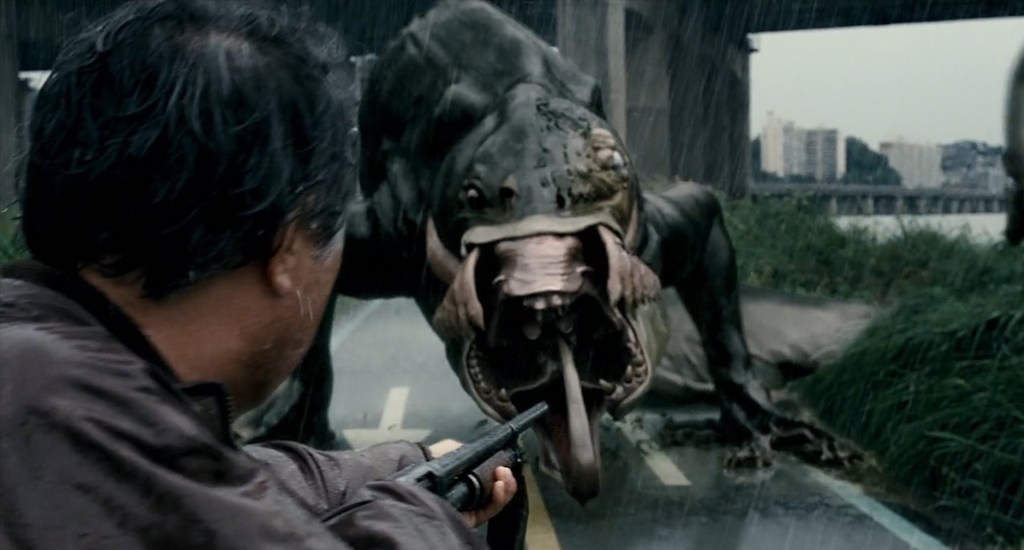
American arrogance creates the monster of The Host. But Bong Joon Ho doesn’t just leave his commentary at that. Several scenes are included in the film in which we witness — either on TV or in person — the response of American military officers and the US government to the monster they created.
News reports spread a rumor that the monster has unleashed a virus upon Seoul, forcing residents to quarantine in their homes while American military barricades shut down access to the city’s waterfront.
Late in the film, an American scientist indicates that the film’s protagonist, Gang-Doo, must be lobotomized because the ‘virus’ has reached his brain. He then sits down with another scientist — in full earshot of everyone else in the room — and delivers a dramatic monologue about how the virus was completely made up by the Americans.
He arrogantly assumes that none of the Koreans could possibly speak English. Gang-Doo, shocked, pops his head out from behind a curtain. “No virus? You mean there’s no virus?”
They try to carry on with the operation anyway.
Bong Joon Ho finds creative opportunities throughout the film to satirize American arrogance in subtler ways, too.
When the monster first attacks, the Koreans react by running away in terror, screaming, and cowering for their lives… as they should. The monster sprints through the riverside park, snatching up victims at random.
As the monster starts to devour the people of Seoul, a young, white, American male races into danger with a proud cry of “let me help!” He runs after the monster, picks up a concrete tile from the ground, and dramatically shot-puts it toward the beast. It shatters on the ground. In typical American fashion, he rushes into the scenario deluding himself into thinking that he alone can save everyone singlehandedly.
He doesn’t. He gets eaten by the monster.
The comedy is dark and relentless — and it’s not just Americans who are satirized in The Host. That opening scene in the military bunker is followed by back-to-back scenes that seem to satirize Bong’s own Korean people as they discover and respond to the mysterious new monster in the Han River as it begins to mutate.
In the first of these two scenes, two fisherman stand in waist-deep water; one scoops something up into a blue teacup. “What the heck is this?” he asks his friend, who replies, “That’s pretty gross. Is it a mutation?” They accidentally knock the cup — and whatever mutated creature was in it — back into the river. “How many tails does that thing have?” one of them nonchalantly asks the other as the creature swims away. Their decision to let the creature go and not recognize the potential danger of it while it is still harmless will have ripple effects.
Bong Joon Ho plays this entire scene out in detached wide shots; we never get a clear view of the fishermen’s faces. They’re detached from the consequences of their actions; we are detached from the scene.
The next scene takes place on a bridge in Seoul in the pouring rain. A businessman stands on the edge of the bridge, looking down in horror at the water below. Bong Joon Ho frames him in an alarming close-up; the drops of rain are magnified as they drip off of his mouth, nose, and chin. “Did you guys see that?” he says, exasperated with fear. Bong cuts to a shot of the water, which is being pummeled by rain; a crescent-shaped wave seems to have broken out in the river below. “Something dark in the water. You really didn’t see it?”
The scene cuts from this alarming close-up of the businessman to a wider, looser two-shot of his business associates, who are looking at him like he’s completely gone off the deep end. “What the hell are you talking about?” one of them asks. The businessman stares at them with a piercing gaze full of anger as he says, “Morons, to the very end.” He jumps. We watch him fall in slow motion in a wide shot as the music swells.
This scene strikes a decidedly different tone than the previous scenes. This tonal shift forces us to pay attention and causes us reflect on what it all means. Upon reflection, this scene seems to be making a statement that things got to be as bad as they did because average men heard peers sound the alarm of impending doom… and dismissed them.
This prologue create an unsettling tension between humor and horror that only continues to escalate as the story unfolds. It’s not only a compelling set-up for the monster movie that follows, but for a satire in which no one is safe from criticism.

Bong Joon Ho is a master of telling stories with massive tonal shifts that shouldn’t work, but do. There’s a scene in this movie in which we see a young child, trapped in a sewer, covering the mouth of another child so that he doesn’t scream in a shot tight enough for only one of their dirtied faces and horrified expressions to be in focus; we then see the monster above them vomiting human bones into the sewer, and then witness the reverse shot — from the monster’s perspective — of the broken skeletons pummeling the ground. In a very different scene, Gang-Doo chucks a can of beer into the Han River and a tentacle snatches it up; instead of being scared, the crowd around him gets excited, and Bong Joon Ho cuts to a static wide shot from behind them as about a dozen people start chucking random things into the water (“Have some beer nuts, too!”).
These scenes can coexist in the same movie because the tonal shifts actively make thematic statements — or at least make us pay attention to them — and because they are essential to our understanding of the plot.
Stupidity, arrogance, and the American military unleashed something absolutely horrifying upon Seoul; if the horror was not present, we would not recognize the depth of the consequences that came out of that stupidity and arrogance. Denial, a lack of care, and incompetence from the general populace both allowed this monstrous terror to grow to an untenable point and prevented people from stopping it in its tracks when it first began its reign of terror; satirizing a diverse array of characters’ responses to the monster by heightening their responses into the realm of absurdity make this message clear.
Subtlety can sometimes make a thematic statement pass by unnoticed. Say what you will about the tonal shifts here, but you’d be hard press to miss what the movie’s getting at.
One of the most admirable and enjoyable things about Bong Joon Ho’s movies is that though they often grapple with meaningful themes, it is clear that he prioritizes making his films fun to watch. Themes and big ideas aside, the roller coaster ride of laughter and fear makes The Host remarkably entertaining.
“Until I slit that beast’s stomach and at least find Hyun-Seo’s body,” Hyun-Seo’s grandfather solemnly says in one scene, “I’ll never leave this world in peace.” As soon as he finishes expressing this thought, a man in a hazmat suit slips and falls to the ground in the background.
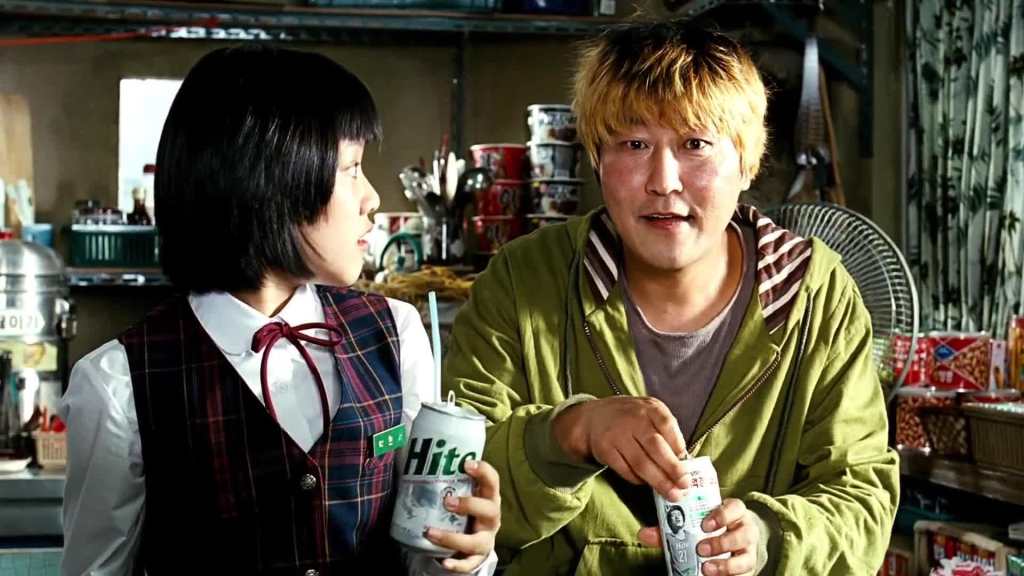
There is a remarkable amount of slapstick humor in The Host; far more than anyone should reasonably expect in a horror movie.
We first meet the film’s protagonist, Gang-Doo, asleep with quarters stuck to his cheek at work at his father’s riverfront food stand. When he wakes up, he grills a squid for a customer; realizing that he’s hungry, he rips a leg off of the squid and eats it himself. When he sees his daughter, Hyun-seo, in the distance, he abandons the squid as it starts to burn and runs toward her. He trips over his baggy sweatpants and falls to the ground. In the food stand, they watch Gang-Doo’s sister’s professional archery competition on TV; he hands his daughter a beer, to which she incredulously remarks, “This is alcohol.” His response? A nonchalant, “You’re in middle school now.”
He’s kind of a bumbling idiot. Throughout the film, he falls asleep at inopportune moments, lets go of his own daughter’s hand as they’re fleeing from the monster, and can never seem to get anything right unless he stumbles into a solution by complete and utter accident.
Gang-Doo is far from the typical action or horror movie protagonist; he’d be more at home in a dry slapstick comedy. His family isn’t much better off. His brother is a raging alcoholic and his sister would be a world-champion archer… if only she actually took her shots when she was supposed to instead of running out the clock waiting for the perfect moment to let go.
They aren’t heroes… and that’s kind of the point.
In a traditional monster movie, the heroes would most likely be soldiers. Not in a Bong Joon Ho movie.
The American military swooped into Korea, created a monster, took no blame for it, covered their tracks, caused outright panic… and then left the clean-up for the unwitting masses to deal with. The “heroic” types in The Host are actually the villains. Bong Joon Ho is fully aware of genre conventions, and uses subversion of those conventions to keep his stories interesting.
He pays loving homage to them as well, for good measure.
After the monster finishes its initial rampage, the survivors of the attack quarantine themselves in a gymnasium to host a mass funeral for the dead and wait for further instructions from the authorities. The aforementioned man in the hazmat suit enters the room dramatically. Gang-Doo’s brother confronts him with an obvious question: “Shouldn’t you start by explaining what’s happening?”
The man in the hazmat suit pauses — then says, “An explanation should be appearing on the TV news now. To save time, we’ll let the news serve as explanation.”
The man delivers the line deadpan, but it’s hilarious, because of course that’s what would happen at that point in the story.
But, in typical Bong Joon Ho fashion, it actually doesn’t. The TV doesn’t work, and the news isn’t on. We laugh at the joke, then chaos breaks out in the gymnasium.
There’s a wink, a nod, and then subversion. It keeps us on the edge of our seats.
 Story / Telling