
“You’ll see that life isn’t like your fairy tales.”
A mournful, hummed melody plays on the soundtrack as the camera twirls from a disorienting track along wet stone into a straight-on close-up of a young girl’s face as she lies bleeding on the ground outdoors at night in the opening shot of Pan’s Labyrinth. The blood retreats into her nose as the camera zooms into her eye, where we escape from this grim reality into a fantasy world. Voiceover narration tells us of an underground realm “where there are no lies or pain,” where “there lived a princess who dreamt of the human world.” In a sweeping wide shot of the ruins of this world, we see the princess running up a set of spiral stairs; she looks remarkably similar to the girl whom we saw bleeding.
In her dying moments, Ofelia escapes into fantasy, envisioning herself as a princess on a quest to fulfill an ages-old prophecy. Escaping into fantasy is how, in her final moments, she manages to smile in spite of all of the horror and pain. It doesn’t save her, but it brings her some level of peace. A fairy tale helps her make sense of chaos.
In this opening scene, Guillermo del Toro establishes what Pan’s Labyrinth is about: fantasy as both an escape from and a means to make sense of reality.
Ofelia lives in Spain in 1944. The country has been torn apart by civil war and fascism. Rebels hide out in the forests, and Spanish soldiers loyal to dictator Francisco Franco hunt them down to crush their resistance. Captain Vidal, a heinous sadist, is in charge of one of those camps — and Ofelia finds herself living in his camp as his stepdaughter after his mother becomes pregnant with his child. There, Ofelia witnesses pain and suffering that is nearly unbearable for adults to grapple with, let alone comprehensible for a child.
So, she escapes into fantasy. Del Toro cuts between her fantasy world and the real world fluidly; it is intentionally murky what is real and what is imagined. Each world is given equal consideration, and each mirrors the other.
In one sequence, Ofelia buries her head in a book while walking through the woods; the camera glides freely through the environment around her, drifting behind trees as Del Toro cuts seamlessly between her adventure and action shots of a troop of Vidal’s cavalry galloping into the same forest on a quest to murder their opposition.
Ofelia narrates a story about a toad that has been living in the roots of a once-beautiful fig tree; his presence in the tree has caused the tree to wilt and die. She makes it her mission to place three magic stones in the toad’s mouth — “only then will the fig tree flourish again.”
This narration accompanies not just the images of her reading her book, but the images of Vidal and his men as well. The fluidity of the camera movement and the transitions between these scenes and the connective tissue of the narration thematically unite them. Vidal and his men are an evil force that is corrupting something beautiful; perhaps, Ofelia thinks, she could bring good back to the world if she is brave.
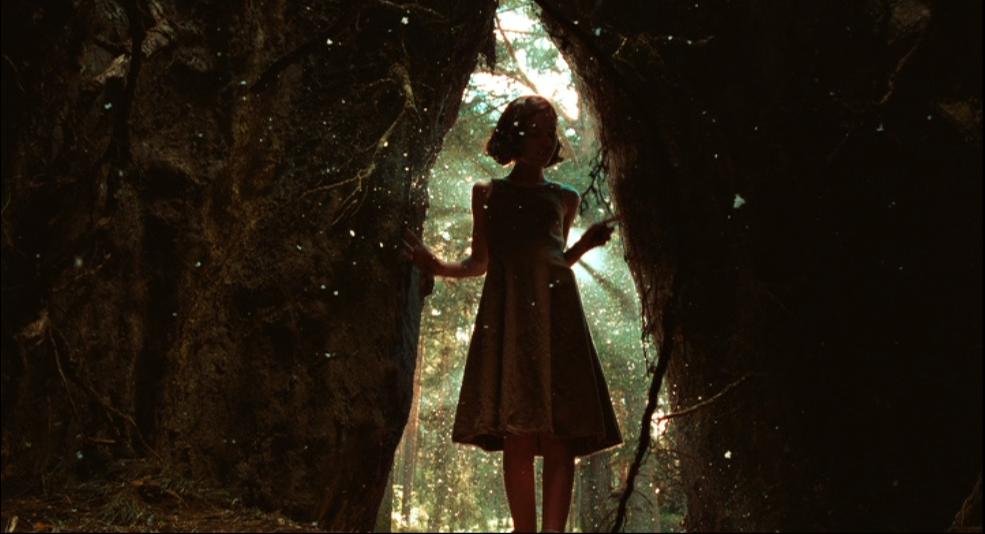
Ofelia crawls into the fig tree through dark and scary spaces filled with massive bugs; she pushes herself forward through mud as the camera tracks behind a root and then into a clearing nearby outside, where the fascists are inspecting an abandoned rebel camp. The rebels hide from their pursuers in the forest nearby — within earshot, but safe. Del Toro cuts back to the inside of the tree, where Ofelia confronts the massive toad. He eats the stones and his skin deflates while his massive stomach erupts out of his mouth.
As the sequence cross-cuts between a heroic shot of the rebels and Ofelia confronting the toad, a hopeful, optimistic parallel is established.
In her fantasy, as in her reality, Ofelia recognizes that there are evil forces at work in the world; in her fantasy, unlike in her reality, Ofelia is able to directly confront the root cause of this evil and stop it in its tracks.
Her bravery wins the day; she completes her quest and is able to save something beautiful — the fig tree. We feel optimistic that the rebels will be able to complete their quest as well.
But then Ofelia emerges from the fig tree caked in mud; her beautiful dress has been dirtied beyond recognition, it is dark outside, and rain begins to pour down from the thundering sky.
The hope instilled by her fantasy is gone; she is 11 and scared and alone.
Shortly thereafter, Captain Vidal hosts a dinner for his fascist friends. While they devour a sumptuous feast, Vidal passes around copies of new food ration cards — “from now on,” he says, “one ration card per family.” A guest pushes back on the ethics of this policy, politely, by saying that that might not be enough to feed a family. “If people are careful,” a priest says while scooping extra food on to his plate, “it should be plenty.”
Ofelia’s next foray into a fantasy world directly parallels this scene. She enters what appears to be a medieval dungeon where a pale, demonic man with saggy skin and no eyes, sits at the head of a long table overrun with food. This beast’s position at the head of the table mirrors the position that Vidal took at his own table at the aforementioned dinner.
The ceiling of this dungeon is covered with paintings of the pale man devouring children. Ofelia was told by the faun who directs her fantastical adventures that she cannot eat anything off of this table or risk certain death; these foreboding images should be enough of a warning to validate this. But she is hungry and struggling and has never seen such a sumptuous feast before, so she eats a grape off of the pale man’s platter. The pale man viciously rears to life, popping eyeballs into his hands and standing up crookedly, ready to kill.
The pale man does not enjoy his own hoarded feast himself — but should anyone take what he deems is his, he viciously devours them.
The horror of this fantasy directly relates to the more subdued, systemic horror perpetuated by Vidal and his ration cards.
Ofelia barely escapes from this dungeon alive. As both her fantasies and reality become increasingly horrific, she loses her confidence, and the once simple nature of her fantasies is lost forever, replaced by darker, more twisted imaginings.

When Ofelia first meets the faun who sends her on these quests, she trusts him without question. But as her reality falls apart — and as adults pass their cynicism on to her — she becomes more guarded and questions the motivations even of the mystical creature. It’s easy to start to doubt him; he moves suspiciously and oscillates his speech between high praise and stark demands.
Though Ofelia follows the faun’s lead unquestioningly at the start, by the end, she rejects him, choosing instead to adhere to her own moral compass and reject the decrees of others. She doesn’t know who to trust anymore — all she knows is what she believes to be right and what she feels is wrong.
Pan’s Labyrinth tells a dark story, but Guillermo del Toro’s message here isn’t fully cynical; even in the film’s darkest moment, she smiles as fantasy provides her with comfort even amidst intense suffering, and it is clear that fairy tales and fantasy have taught her essential life lessons that the broken adults in her life could not.
Just as the story shifts fluidly between fantasy and reality, the emotional notes shift fluidly between horror and hope, despair and whimsy, sadness and awe. Del Toro portrays the resistance fighters as rugged, fiercely admirable heroes, which provides balance in this reality against the abject horror, misogyny, and brutal violence perpetuated by Vidal and his men. Ofelia’s fantasies are richly, gorgeously designed — and the creatures within them are so compelling — that we are entranced even as those scenes devolve into darkness.
Ultimately, the resistance fighters and Ofelia’s fantasies and dreams have much in common; both are driven by a persistent hope that evil can be overcome. But unlike more innocent fairy tales, Pan’s Labyrinth does not shy away from the notion that while hope and magic are real, they are only sometimes enough to triumph over darkness.
 Story / Telling