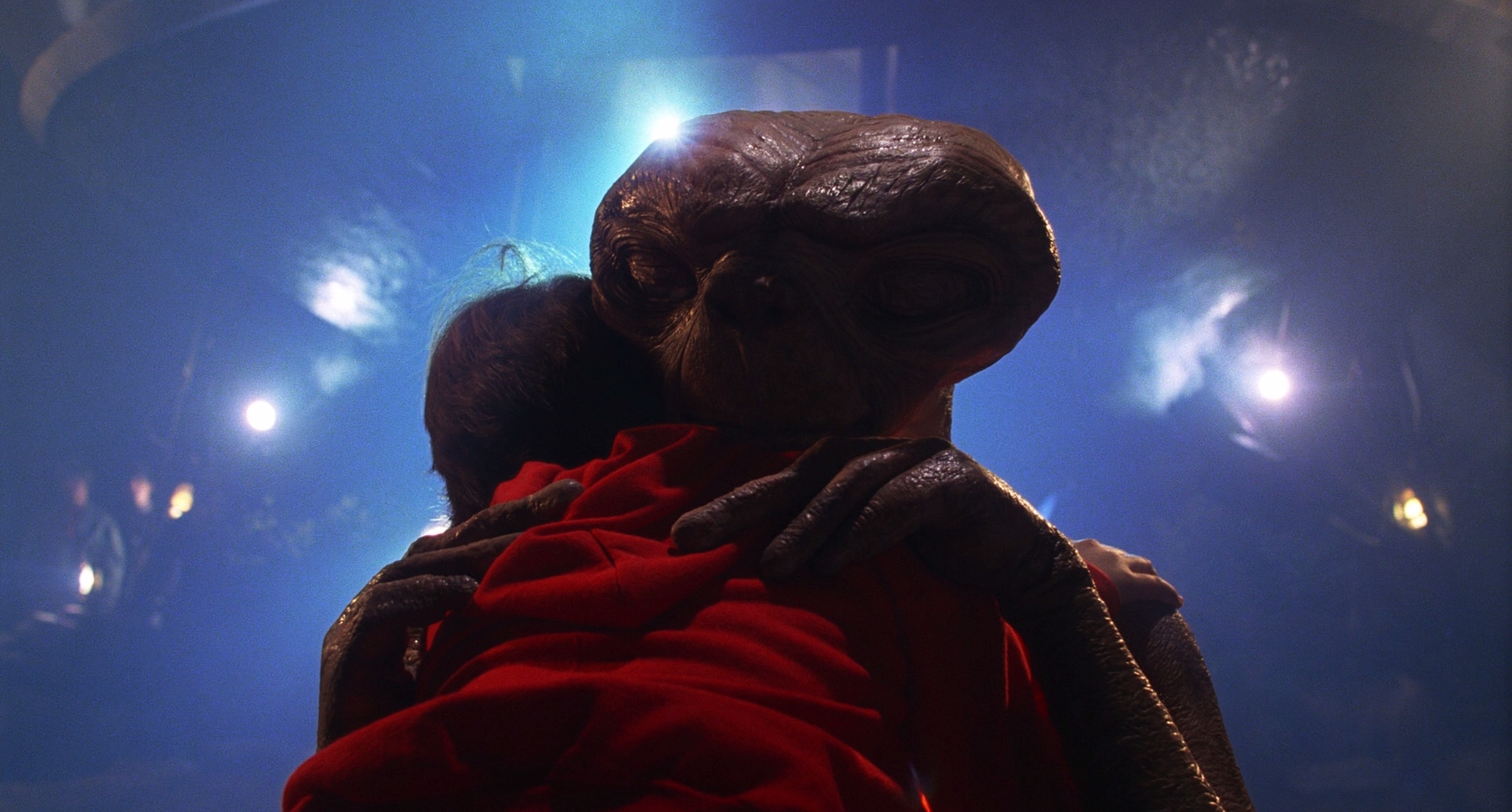
“You could be happy here. I could take care of you.”
A spaceship illuminates a clearing in the woods at the beginning of E.T. The Extra-Terrestrial. Spielberg’s camera lurks behind tree branches as we observe small, hunched-over extraterrestrials emerge from the ship. These alien beings are shrouded in shadows. Our view is obscured by foliage. John Williams’ score is, at first, suspenseful and unsettling.
Most movies about aliens visiting earth assume that extraterrestrials are hostile. E.T. begins with stylistic choices that lead us to believe that these beings are, potentially, not to be trusted. The filmmaking urges caution.
But when Spielberg cuts to the inside of this spaceship, the tone begins to shift. Williams introduces more whimsical melodies into the score as the camera dollies past close-ups of mushrooms and other cultivated alien plant life. We then see a clear wide shot of the extraterrestrials foraging for food outside of the ship. An owl hoots on the soundtrack and the aliens all simultaneously pause their work; their chests glow red in unison until the presumed danger has passed.
Spielberg then cuts between a close-up shot of extraterrestrial hands digging up a plant and a close-up of an alert rabbit. The parallel is clear. These extraterrestrials are harmless herbivores; our mistrust was misplaced.
Plant in hand, the alien walks back to his ship. Spielberg places him in the center of the bottom of a very wide frame, surrounded by massive redwood trees. Like the rabbit, he is a small being in a very large world. The music swells as we look up at those trees from the extraterrestrial’s point of view. The orchestral score resolves into melodies of warmth and wonder as the alien gazes out at the lights of the suburban sprawl below him.
This peaceful moment is cut short by three cars abruptly descending into the clearing. The alien shrieks in terror and we formally enter his point of view as he races back to the ship. The foliage that the camera races through is partially illuminated by red light — the red light glowing from the alien’s chest.
We see the feet of adult humans stomping through the mud, and keys dangling from an adult man’s waist. We never see their faces — only parts of them, as if we were looking at them from the perspective of someone not that far off of the ground. The chase ends with a dramatic shot of a line of men silhouetted against bright lights and smoke. They’re intimidating. Flashlights in hand, they watch as the spaceship lifts off.
These men instill fear in the harmless aliens, causing them to leave one of their own behind on earth. As seen from the point of view of the extraterrestrials, adult humans are villains.
This opening scene codifies the film’s manipulation of perspective to make thematic statements. Stylistic choices first make us assume that alien life is something that we should be afraid of. As soon as we assess the situation more clearly, however, we realize that that assumption is wrong.
This group of men do not assess the situation to seek understanding — they rush into action in an effort to subdue and control what they do not understand. It is this mindset, and the actions that it causes, that makes them the villains of this story.

Contrast this scene with the sequence in which Elliott comes face-to-face with E.T. for the first time. Smoky haze eerily covers Elliott’s backyard at night. Elliott, like the adults before him, is facing the unknown. The mood that Spielberg conjures in this moment would elicit fear and caution in anyone; nothing about the atmosphere indicates that Elliott is wise to confront whatever is out there on his own.
But he does.
He walks into the adjacent cornfield with curiosity in spite of his fear, seeking nothing more or less than to understand what is out there.
When E.T. and Elliott see each other for the first time, Spielberg cuts between close-ups of their faces as they both scream in fear. Elliott and E.T. are roughly the same height, and their close-ups are framed roughly the same. After a frantic montage of shots of Elliott screaming, the camera abruptly dollies back in a wide shot, zipping through the corn stalks as if it had become E.T. running away.
By mirroring their reactions to one another and framing their shots in roughly the same way, Spielberg communicates that they are equals.
When Elliott returns to his backyard, a red light illuminate trash cans that have been knocked over and a gate swinging shut. This red light mirrors the red glow of the aliens’ chests when they feel danger. It’s not a naturalistic lighting decision, but it makes a statement: humans are more of a potential danger to other lifeforms than they are to us.
The next morning, Elliott leaves a trail of Reese’s Pieces in the woods for the alien as a peace offering. The man with the dangling keys is seen from afar, frustrated by his lack of control over the situation.
In several scenes throughout E.T., we see the adults from the beginning of the film going to extreme lengths to capture E.T. — including spying on Elliott’s neighborhood by listening in on private conversations.
Meanwhile, Elliott teaches, feeds, and dresses E.T…. then tries to help him phone home.
Elliott and E.T. form a powerful connection because of these displays of compassion. Elliott is ultimately able to experience E.T.’s exact feelings at the same time that the extraterrestrial feels them.
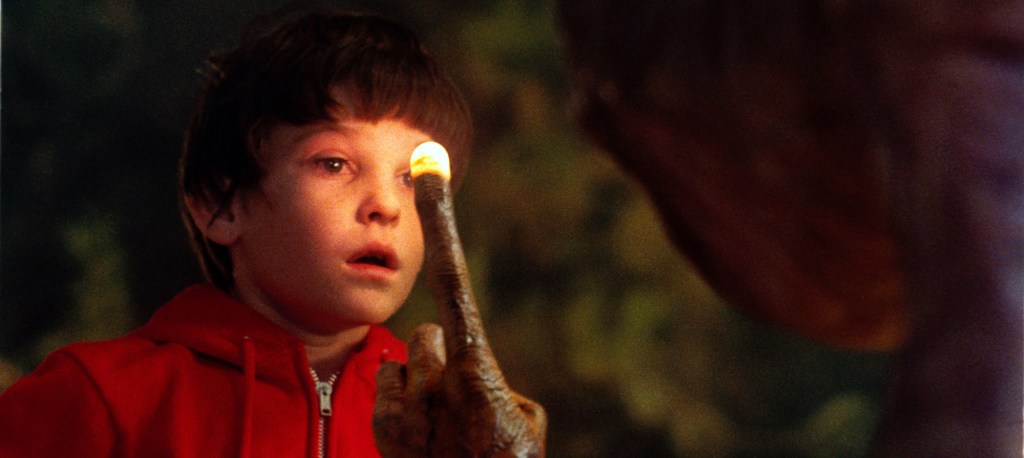
This unique connection gives rise to comedy (such as in the infamous scene of E.T. drinking beer that is cross-cut with Elliott releasing the frogs in his biology class) as well as heart-wrenching drama (such as in the scenes near the end of the film, in which men in hazmat suits strap E.T. to a hospital bed as he lays dying).
Their emotional connection is also an obvious metaphor for the film’s central theme: empathy.
Elliott approached something that he feared — E.T. — with empathy and compassion. None of the adults can feel what E.T. feels because they never sought to understand him. The quarantine bunker that they turn Elliott’s house into in the end as E.T. lays dying is the perfect example of this; the adults seek so desperately to protect themselves from any potential threat and try so hard to preserve E.T. as a scientific specimen that they ignore the soul in front of them.
The adults look down on E.T., and Spielberg frames their scenes in this way.
Scenes between the children and E.T. are framed more intimately, with E.T. on their level as an equal.
In the aforementioned frog scene, the camera follows Elliott’s biology teacher as he dispassionately drops chloroform into jars filled with living frogs. We don’t see the teacher’s face — just his body and his hands. This tracking shot is wide enough for us to see several jars of frogs at once. The teacher tells his students that once the frogs are knocked out, they will dissect them in the name of science. It’s a cold and clinical speech; the lives of the frogs exist only to serve humans in their pursuit of knowledge. It’s a clear parallel to how the adults view E.T..
But Elliott won’t stand for it. Elliott stares directly into his frog’s eyes in an intimate over-the-shoulder shot that shuts out the rest of the class from our view. He doesn’t care that killing the frogs could help advance human knowledge. He only knows that killing them is wrong. Emboldened by his connection with E.T., he takes action in spite of any of the consequences and chaos that he knows could follow: “Run for your life! Back to the river!”
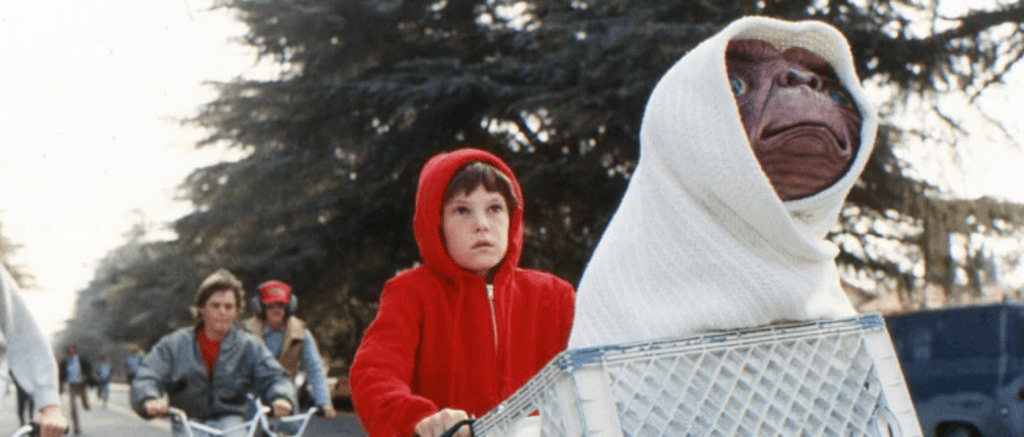
By contrasting the reactions of adults and children in these scenarios, Spielberg makes E.T. The Extra-Terrestrial an unequivocal celebration of childlike empathy, curiosity, and compassion — and a condemnation of adult cynicism and selfishness. We recognize that we might be more inclined as adults to have the kind of reaction to alien “invaders” that the adult characters in the movie have… but we also recognize that Elliott’s reaction is how we should approach things that we’re afraid of or know little about. That’s why we smile when Elliott and his friends take off into the sky in their bikes, E.T. in his basket, to escape the adults chasing them.
If aliens do land on earth, instead of capturing and dissecting them right away, E.T. posits that it would be better for us to seek to understand them first. Doing so could create something that is arguably more meaningful than clinical knowledge: a magical connection.
 Story / Telling
Thank you for your thoughtful review. Especially for your points on how Spielberg’s direction can equalize E.T. with Elliot, Gertie and Mike which are indeed spot-on.
LikeLiked by 2 people