
“You do what you can to make sure you’re still around after you’re gone.”
The first thing that you notice when you start watching David Lowery’s A Ghost Story is the size, shape, and look of the frame. The film was shot in a square, 4:3 aspect ratio and edited with rounded corners. There is a slightly washed-out look to the images.
In the opening scene, we watch C (Casey Affleck) and M (Rooney Mara) talking to one another softly on their couch. The conversation is warm and intimate. The aesthetic of the frame, paired with the lack of cuts to coverage of the scene, makes us feel as if we’re watching a clip from a home movie that we aren’t supposed to be viewing. The scene fades out and back in frequently, breaking this moment up as if it was edited together using flashes from a memory.
“When I was little and we used to move all the time, I’d write these notes and I would fold them up really small. And I would hide them,” M tells C. “They’re just things I wanted to remember so that if I ever wanted to go back, there’d be a piece of me there waiting.”
This conversation hints at both the theme — our desire to imbue our lives with meaning and leave something of ourselves behind when we’re gone — and the plot — in which the Ghost of C, a piece of him, is left behind in the home that they lived in.
When the story shifts from being about C and M’s life to being about C’s afterlife, the square frame evokes a new feeling for us. Lowery intended for the aspect ratio to feel claustrophobic — to trap C’s Ghost “in a box.” In that way, the format of the movie reflects the character’s turmoil; as he is trapped within the walls of his home, so too is he trapped within the walls of the square frame.
The script for A Ghost Story was reportedly only 30 pages long, and the dialogue throughout it is sparse. We learn about C and M and their relationship in brief fragments, and the most memorable speech in the film is reserved for an ancillary character who rants on and on at a party about how all matter will eventually be consumed by the dying sun and expanding universe.
But A Ghost Story remains engaging in spite of this. Its intentional, thoughtful stylistic choices say far more than words ever could. The form of the filmmaking bears more emotional weight than the dialogue and provides more surprises for us than the beats of the plot. The most effective storytelling methods in this movie are purely cinematic.
Though the story plays out chronologically, time moves differently in A Ghost Story than it does in a traditional movie.
Lowery lingers on scenes far longer than we expect him to. He makes us an active observer by staging the majority of sequences in boldly-composed shots that last for an extraordinarily long time.
Early on in the movie, M becomes frustrated by C’s unwillingness to help pack up the house as they prepare to move. This sequence concludes with a lengthy shot of the exterior of their ranch home at sunset. M drags a heavy piece of furniture clumsily from the front door to the edge of the lawn, drops it, lets out an exasperated sigh, turns, and walks back into the house. In most movies, the scene would end there, but it doesn’t — Lowery holds on to the wide shot of the house and forces us to reflect on the full magnitude of this moment. If it was rushed through in the edit, this scene would merely be another story beat to highlight M’s frustration with C. But dwelt on, this moment forces us to feel at least some of the isolation that M feels because of C’s detachment. As she feels left out on her own, in this moment, so are we.
In other early scenes and flashbacks, Lowery puts great distance between them by isolating one of them in focus in the frame and having the other out of focus in the scene. This stylistic choice both foreshadows the role that C’s Ghost will play in the rest of the film, and contrasts with how C and M are seen in the happier, intimate scenes of memories, in which they are both on the same focal plane.
Lowery takes great care not to overly romanticize their relationship. Their love has ups and downs, romance and conflict.
When M visits C’s body in the hospital mortuary, the scene mostly plays out in a wide shot of the room. In a traditional movie, the scene would end as soon as M exits the frame after covering C’s body with a sheet. But Lowery forces us to stare at the empty wide shot of the room for an entire minute before anything else happens.
Empty space during or at the end of emotional scenes gives the audience time to process the emotions of the scene. Having this much empty space after a scene, however, is atypical. It’s a bold choice that demands and rewards an audience’s patience. The duration of this and many other shots in A Ghost Story allow us to superficially process what happened as we would in any other movie, then feel our own discomfort, then process our feelings even more deeply and notice details in the frame that we otherwise never would have been able to notice.
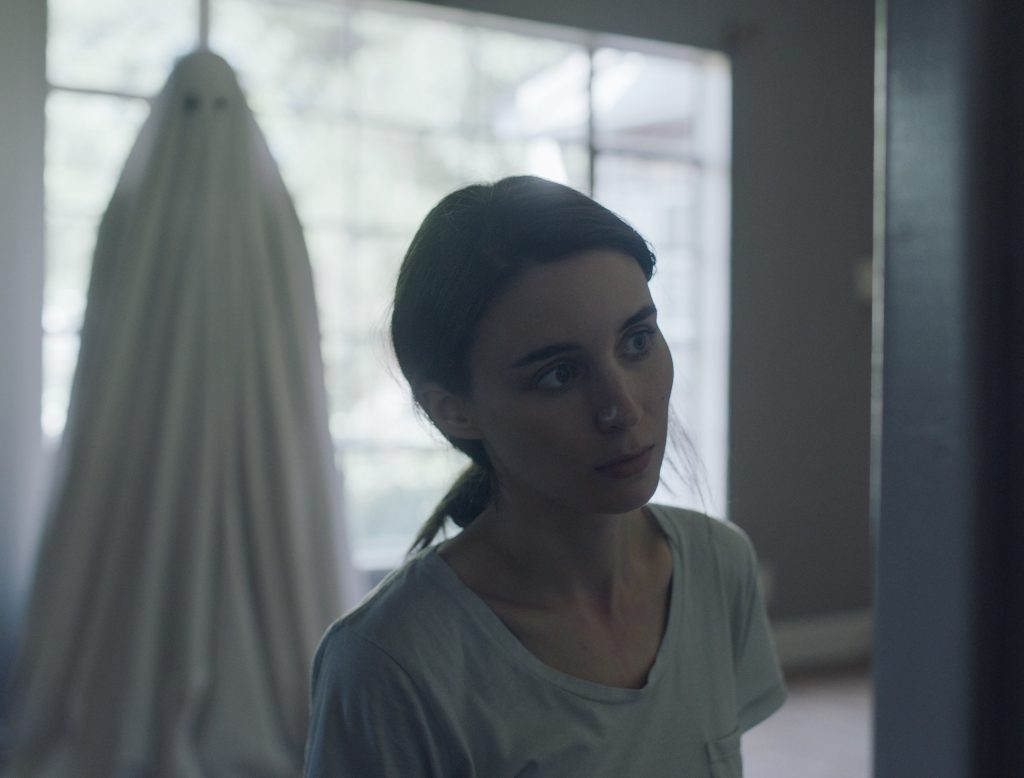
The longest, boldest scene takes place in M’s kitchen after C’s death. Grieving, she sits on the kitchen floor eating a pie baked by one of her close friends. She tries to numb her pain with the endorphins from food, but still begins to cry; we watch her for what feels like an eternity as she continues to eat. C’s Ghost watches her from the living room; he does not move. Lowery holds on this shot for nearly five straight minutes — no camera movement, no coverage, no character movement until the very end. Just M, eating her pie, tears subtly rolling down her face, while C’s Ghost dispassionately observes her.
The surface-level intent of this scene is obvious fairly quickly: even though she had been holding her emotions together in public, M is clearly struggling and grieving, to the extent that she is turning to binge-eating to cope. But the scene persists long after this is abundantly clear.
At first, this feels frustrating. Then, it starts to feel uncomfortable — invasive, even. The duration — and stillness — of the shot makes us feel like we’re not supposed to be watching her in such a vulnerable, private moment. But the shot continues to hold, and she keeps eating the pie, and we start to focus in on the little details, like the tears that linger on the edge of her nose for just a second before dropping to the floor.
We want to comfort her, but we can’t. We want C to comfort her, but he can’t.
And we feel far more in five minutes than we would if the scene had only been thirty seconds long.
The way that this scene is presented — with all of its frustration and in all of its simplicity — is crucial to our emotional engagement with the rest of the movie. It puts us in the exact same position that C is in as a Ghost. For the rest of the movie, as he watches life move on around him, we can empathize with his plight because we were forced to experience this painful scene from his point of view. Whether consciously or unconsciously, we assign all of the emotions that we feel during this pie-eating scene to him for the rest of the movie: our discomfort, frustration, sadness, and helplessness.
From that scene on, we at least think that we know exactly how C’s Ghost must be feeling.
It’s brilliantly effective emotional storytelling.
Because of this, a later shot — a close-up of M driving away from it all in her car at sunset — generated for me not just the expected conflicting feelings of sadness and hope, but a kind of numb panic as well. The stylistic choices create emotional ripple effects that add new layers of emotional meaning to many scenes in unexpected ways.
M leaves behind the Ghost of C in that house — both literally and metaphorically. Time becomes increasingly fragmented from then on out in the movie. All scenes involving the Ghost move at a slightly slower speed than scenes featuring the living. Decades go by in an instant. New people move in and out of the home. C’s Ghost intervenes in their lives once — then never again once he realizes the impact that it could have.
Then, as A Ghost Story speeds faster and faster into the future and we see what becomes of this plot of land on which C and M built their life together, we can’t help but reflect on the overwhelming helpless that comes with thinking about the distant future of the people and places that we hold dear to us. Then, as the story crashes back into the far past of that same land, that helplessness is felt in an even more poignant way. The drunken party guest’s rant resonates in our minds as we watch: “everything that ever made you feel big or stand up tall, it’ll all go.”
Time is the enemy of us all, and though we associate places with both our happiest memories and our deepest traumas, they too will be lost with time. It’s an overwhelming thought that is deeply and frighteningly explored during the Ghost’s unwitting journey through various eras.
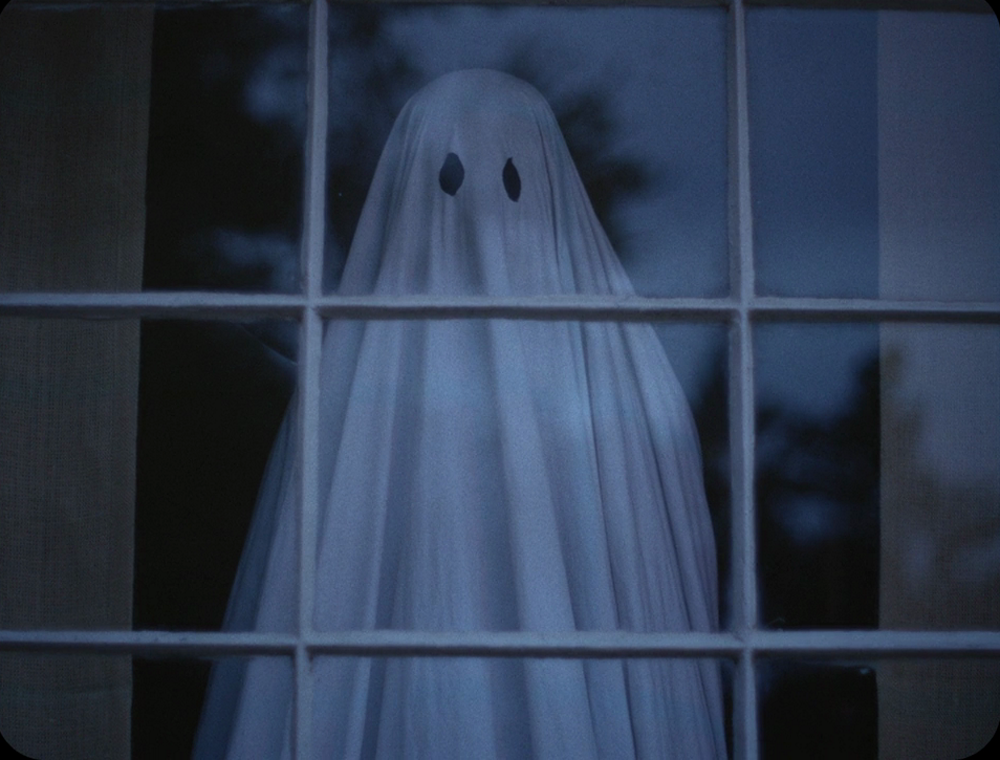
In this sequence — and in more subtle scenes — A Ghost Story examines unsettling thoughts about our own mortality, place in the universe, and individual legacy. Little of it is comforting. C’s Ghost sees another Ghost through a window in the neighboring house. “I’m waiting for someone,” the other Ghost tells him. “Who?” “I don’t remember.” The camera lingers on C’s Ghost standing in his own window and dollies back slowly to let us process the impact of this statement.
A Ghost Story could have simply been about this, and it would have been effective, cynical storytelling. But Lowery, to his credit, decides to challenge his own assumptions and leave us with some resolution and peace.
After C passes away, M finds comfort and solace in their shared possessions and one of his old songs, and leaves a small note in the wall — a reminder of her and their memories together.
C’s Ghost’s quest, through the ages, is to find that note to gain closure to the story of his and M’s shared life in that home. In the end, he finds it, and he can rest.
There is a surreal peace that comes with the resolution of this that defies the cynicism and helplessness generated by all of the aforementioned scenes.
In the end, we construct our own meaning to our lives to find peace within the chaos of the world, and though we may be insignificant in the grand scheme of the universe, we are significant to each other, and maybe that is all that matters.
 Story / Telling