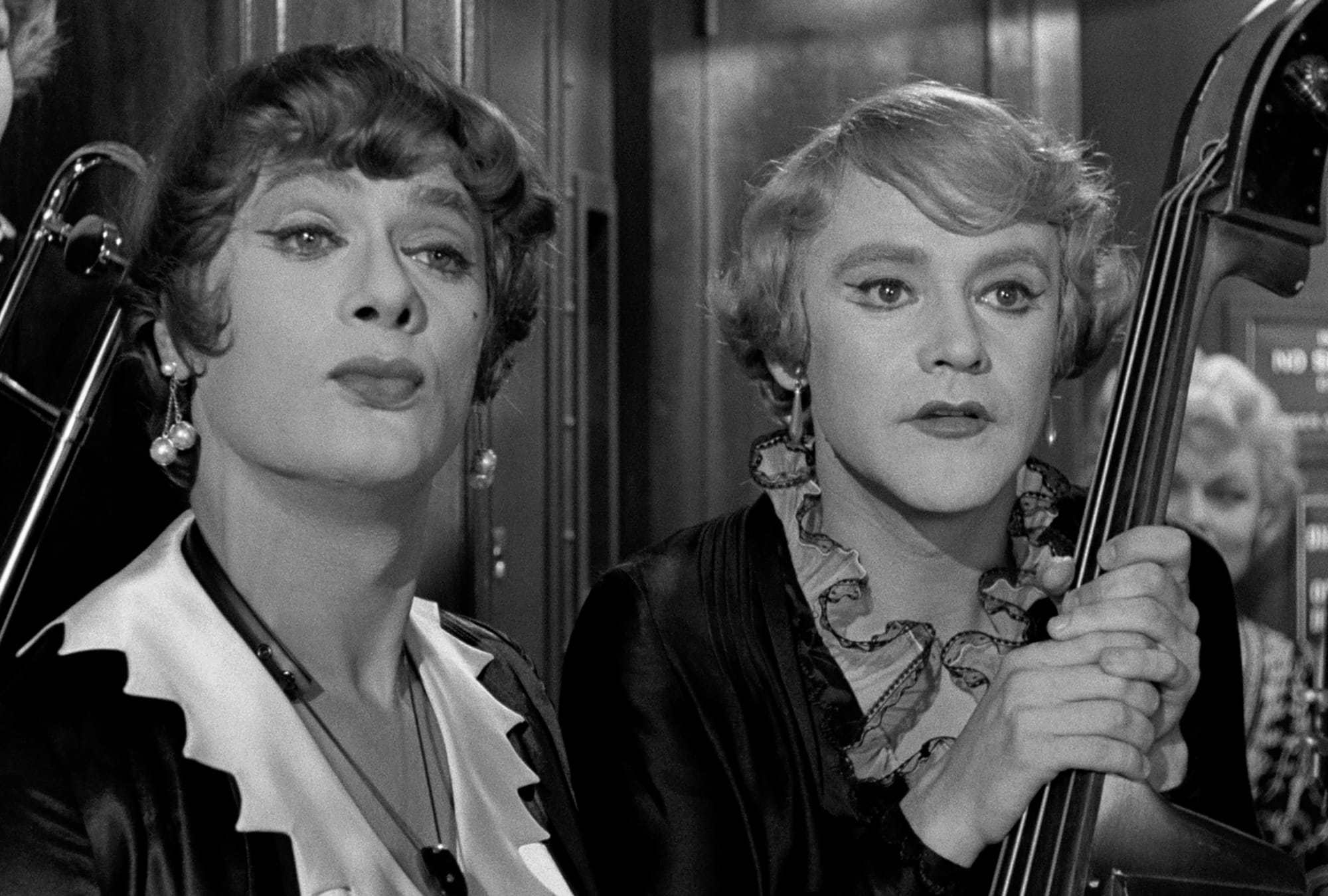
“We’ve been playing with the wrong bands.”
The opening scene of Some Like It Hot would feel right at home in a film noir or classic gangster movie. A hearse drives down the wet streets of Chicago at night. Police sirens wail. Gunfire breaks out in the streets. Faces are shrouded in shadows. We see a coffin filled with bottles of whiskey, and a superimposition tells us that this scene is playing out in 1929… the middle of the Prohibition era in the United States.
Much of the dialogue in this opening scene is witty — “Look, Chief, I better blow, because if Colombo sees me, it’s gonna be ‘goodbye, Charlie,'” a double agent named Toothpick Charlie says; “Goodbye, Charlie,” the Chief of Police replies.
But other than this understated humor, the scenes are played straight.
It’s hardly the opening that you’d expect in one of the most beloved comedies of all time. Every scene involving the aforementioned villain “Spats” Colombo (who is named after the type of shoes that he wears) feels tonally out of place from the rest of the film. Later in the first act, the movie’s protagonists — an upright bassist named Jerry and a saxophonist named Joe — get caught as unwitting witnesses to multiple murders in a garage in a scene based off of the real-life St. Valentine’s Massacre. It’s a sequence that is about as violent as you could get in Hays Code-era Hollywood — there’s a reiteration of the line “Goodbye Charlie,” followed by a flurry of machine-gun fire.

Each time that these gangster villains appear onscreen, there is immediate tension. There’s no question about it: Spats Colombo and his gang are no laughing matter.
The comedy begins as soon as we meet Joe and Jerry. When they become Josephine and Geraldine — then Josephine and Daphne — the comedy starts to soar. Some Like It Hot is undoubtedly intended to make us laugh. So why does this tonal disconnect exist? Why the gangsters and the noir elements in a movie that is otherwise full of so much fun?
It is generally a good idea to maintain a consistent tone throughout a story. But Billy Wilder and his co-writer I.A.L. Diamond break that rule here, and it works for two reasons. The first, and most important, is that the entire comedic gimmick of Some Like It Hot — Joe and Jerry masquerading as women — relies on those two characters doing something that is wildly out of character for their baseline personalities… and keeping that schtick up for their entire adventure.
From the moment that we meet Spats Colombo — and especially after that scene in the garage — we know that he’s extremely bad news. The stakes are set at nothing less than life or death. Because of this, we never question Joe and Jerry’s commitment to their chosen characters of Josephine and Daphne, even when they make it more than a thousand miles away from immediate danger. If the gangster threat was posed as comedy, and if the scenes with Spats never escalated into full-fledged violence, we wouldn’t buy it.
Secondly, setting the movie during this Prohibition / gangster era also complements the characters’ journey in the movie’s primary narrative. Joe and Jerry’s adventure as Josephine and Daphne is ultimately about them discovering their own repressed femininity (which Jerry in particular embraces), and developing empathy for women — “I tell you, it’s a whole different sex!” — whom they previously objectified.
Setting the film during Prohibition relates directly to the impulse for repression that Joe and Jerry must overcome in order to play their parts well. Prohibition showed us that repression isn’t good for society… and aren’t Joe and Jerry much better off after they embrace all sides of themselves?
There is a lot of gender-based humor in Some Like It Hot, and the whole cross-dressing schtick leads to many laughs. In lesser hands, this story could’ve been offensive — especially by today’s standards. But Wilder, Diamond, and their brilliant actors — Tony Curtis and Jack Lemmon — avoid potential pitfalls that could have led to a negative reception.
Key among the ways that they do this is by having the characters develop empathy for that “whole different sex” — and convey that shift with not just humor, but compassion.
When Joe and Jerry first dress up in women’s clothes and put on makeup, they are embarrassed. But soon, Jerry in particular finds it to be good fun. He ogles the women that they end up on the Miami-bound train with — “Look how she moves! It’s like Jell-O on springs. Must have some sort of built-in motor or something.” He’s thrilled at the idea of being surrounded by uninhibited women in close quarters, comparing it to a dream he once had: “I was locked up overnight in a pastry shop, and there was goodies all around. There was jelly rolls, and mocha eclairs, and sponge cake and Boston cream pie…”
But then, the tables turn. Jerry — as Daphne — receives “her” own direct, unwanted attention from a man almost immediately upon arrival at their hotel in Florida. A millionaire businessman named Osgood chases after Daphne before “she” even has time to check in to her room. He tries to grope her, flirts with her, and makes his own advances on her in the elevator after barely introducing himself.
Osgood’s harassment is a revelation for Jerry — a lesson in empathy for a character who used to not have much of it.
But, they see Osgood as their best bet at escaping from the threat of Spats and his gang. Because of this, “Daphne” continues to give Osgood attention (while keeping him at a distance). As “she” does, however, Jerry allows himself to get swept up in it all; he even starts to enjoy it. Osgood takes “Daphne” out dancing all night in a very funny scene late in the film; when we see Jerry the next morning (still dressed as Daphne), he is giddy with excitement at having agreed to marry “her” suitor. When confronted about this by Joe — “why would a guy wanna marry a guy?” — “Daphne” happily exclaims, “Security!”
During their dance, Jerry realized that sometimes, at least, he might just like switching up traditional gender roles — he may have liked “following” in a tango for once instead of leading.

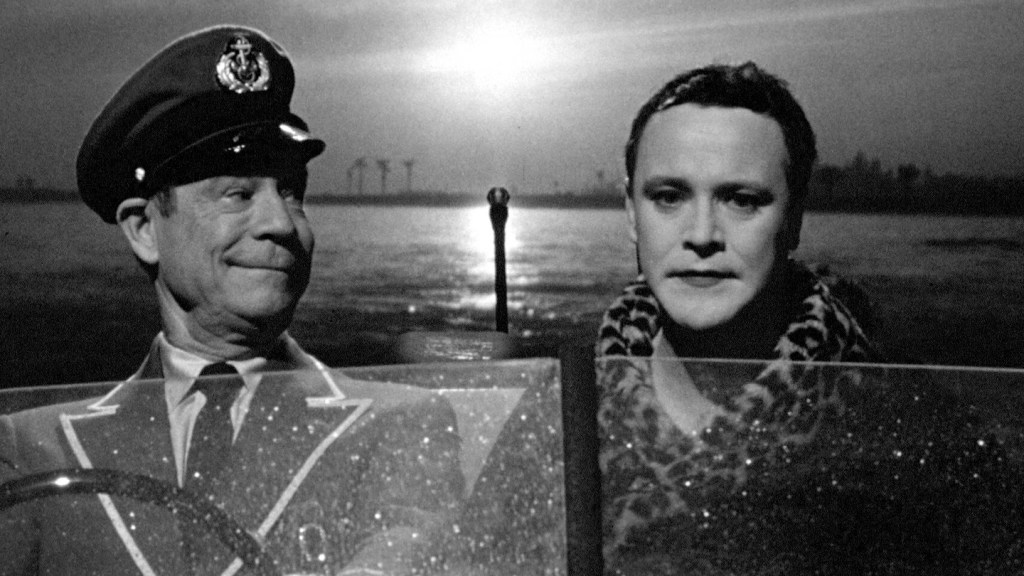
Joe also experiences the other side of traditional courtship gender roles when he poses as a millionaire from the Shell Oil family in order to woo Marilyn Monroe’s character, Sugar. To make her want to seduce him, he plays “hard to get,” telling her that no woman has ever been able to make him feel anything. She aggressively tries to seduce him on Osgood’s yacht, which more often is seen as something that men do. He acts submissive while hilariously attempting to make himself appear to be wealthy and important (“Water polo? Isn’t that terribly dangerous?” “I’ll say — I had two ponies drowned under me.”). This reversed-gender-roles-seduction scene cross-cuts with the dancing date between Osgood and “Daphne”; together, the sequences are both thematically linked and comedic gold.
Some Like It Hot is an immensely entertaining film that features some of the wittiest dialogue ever written for the screen. The movie is constructed out of a fascinating mix of conflicting tones, absurd comedy, genuine compassion, and gender studies. It all works together harmoniously.
Monroe’s character, Sugar, is under-developed; the two men-as-women are far stronger characters, and have almost all of the best moments and funniest lines in the film. But in spite of this, Some Like It Hot remains a gem in the pantheon of movie history. If it has some flaws, well, as Osgood would shrug and say: “Nobody’s perfect.”
 Story / Telling