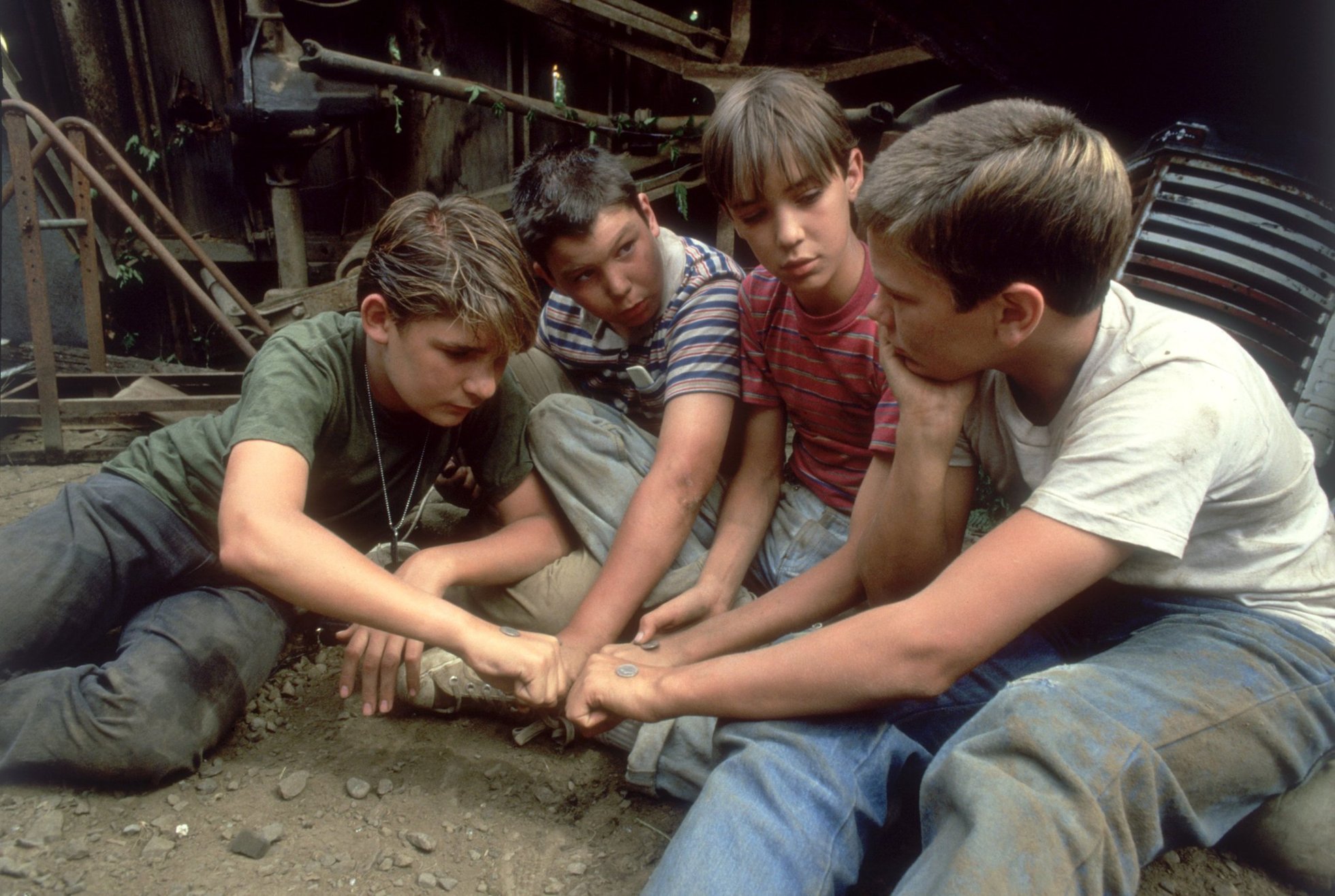
“I never had any friends later on like the ones I had when I was twelve.”
There are two gangs of boys in Stand By Me. The first group that we meet — Gordie, Chris, Teddy, and Vern — are all 12-year-old outcasts. The other group — led by alpha bully Ace Merrill — are all older teens. Both groups do stupid things that only young guys would do — for example, the older boys carve cobras into their arms with razor blades, while the young boys run away from a speeding train on rural train tracks, wade through swampy waters full of leeches, and accidentally shoot a pistol at a trash can in the back alley of a small town business. Both groups tease and make fun of each other in nearly every conversation. And all of them — young and older — are from broken homes.
That is, however, where their similarities end.
The older crew serve as both antagonists and foils for the 12-year-old boys. Both groups are after the same thing, and the above similarities make them comparable — but the differences in how they each react to what they find, and how they treat each other on their respective journeys to get there, is ultimately what makes the story compelling and what reveals the movie’s themes.
The title, too, helps reveal the movie’s themes. Titles provide a lens through which the viewer (or reader) processes the events of any given story, and should therefore be considered carefully. Stand By Me is an adaptation of a Stephen King novella called The Body. King’s title directs your focus to the plot, which is about the young boys’ search for a dead body. Stand By Me refers instead to what the story is thematically about… and is the better title for it.
“When the night has come / And the land is dark / And the moon is the only light we’ll see / No, I won’t be afraid / Oh, I won’t be afraid / Just as long as you stand, stand by me,” Ben E. King sings in the iconic song that screenwriters Raynold Gideon & Bruce A. Evans and director Rob Reiner pulled the title from, and which accompanies the end credits of the film. The boys’ quest to find the body is (nearly) irrelevant. What the movie is truly about is echoed in those lyrics: when things get dark, we won’t be afraid, so long as our friends and loved ones are by our side.
The main quest in Stand By Me ends in a standoff between the young kids and their bullies; both want the glory of having found the dead body for themselves. Ace resorts to the bullying tactics that have become second nature to him in order to strong-arm the younger boys into retreating. But together, for the first time in their lives, they find the strength to hold their ground. When Ace is confronted with a threat of violence against him, he doesn’t know what to do — and, because he only knows how to get what he wants through intimidation and fear, no one stands by him when push comes to shove. Gordie, meanwhile, is supported by his friends against Ace, because their bonds were formed not through fear and anger, but through openness and understanding.
In this way, Stand By Me is not just a coming-of-age adventure story, but a rumination on the dynamics of male friendships at all ages and the importance of male vulnerability.
The movie opens and closes with the adult Gordie reflecting on this chapter of his life, and the main events in the film are framed as a recollection of his memories. This framework motivates voiceover narration and flashbacks, which work together to quickly fill us in on everything that we need to know in order to understand these kids as their story begins.
Within 10 minutes of the start of the movie, voiceover narration, flashbacks, and dialogue exchanges between the boys give us all of the context that we need to understand these characters and their relationships with one another. It’s efficient, economical storytelling; the writers throw out all of the stops to make sure that each character’s circumstances are clearly understood up front, so that they can spend the rest of the movie’s short run time focusing on how they treat each other because of — and in spite of — those circumstances, in order to meditate on the aforementioned themes.
Teddy “didn’t have much of a chance in life. His dad was given to fits of rage.” “He came from a bad family, and everyone knew he’d turn out bad… including Chris.” And as for Gordie, our narrator: “that summer at home, I had become the invisible boy.”
Vern, the last of the younger group, doesn’t get a narrated introduction, but we learn what we need to know about him from how he behaves in his first scene, and through the reactions of his friends to his arrival. He forgets the secret knock to enter the friends’ treehouse — which is clearly typical of him, judging by how his friends greet him — and his friends cut him off and sing over him as he’s trying to tell them something important. He emotionally shuts down at this and backs off from potential conflict; It’s obvious that Vern gets bullied and is often the butt of even his friends’ jokes. Key here, though, is that they ultimately give him space in which to speak, and as soon as they do, Vern’s natural excitement returns.
Flashbacks teach us a little bit about Vern, some things about the older teens, and much about Gordie and his family throughout the film. Flashbacks are sparked organically by dialogue from other characters, which then triggers self-reflection in the character that the flashback is about. We first learn about the dynamic between Gordie and his deceased brother Denny, for example, when a convenience store attendant says to Gordie, “I remember the year he was all-conference. Quarterback, he played. Boy, could he throw.” That dialogue transitions us seamlessly into a flashback dinner scene, which starts with Gordie’s father telling Denny, “there’ll be some scouts at the game tomorrow.”
In one of the earliest flashbacks, the first thing that we learn about a pair of the older teens is that they don’t want to tell the police that they know where the body of a dead kid is, because they don’t want to get caught for having stolen a car. Through this simple dialogue exchange, we learn that the older teens make decisions impulsively out of fear and self-interest. That gives us enough context to understand their submissiveness toward Ace, their leader, who assumes power over them by demanding that his “friends” do what he wants… or else, while he refuses to listen to their fears and feelings.
By contrast, the younger boys are shown in many scenes throughout the film crying together and holding space for one another as they discuss their families, dreams, and fears. Even when they disagree or fight, they acknowledge each others’ emotions. This respect and acceptance for one another forms bonds that keep the team together even when the land is dark.
The most poignant scenes in Stand By Me are simple, but to this day are groundbreaking; it is not too often that a story celebrates young boys who cry and feel things deeply and who have other male friends who give them a shoulder to cry on without judgment when they do.
The ending is bittersweet; the adult Gordie narrates what happened to each of the boys as they got older and drifted apart. This coda is a lesson in the transience of childhood friendships — but also of their immense, formative importance, and of the profound power of surrounding yourself with the right people growing up.
Stand By Me tells a story that is often funny and full of adventure. But in the end, it is most memorable for the truth that it explores, and for the emotional compassion that it shows for its young men.
 Story / Telling