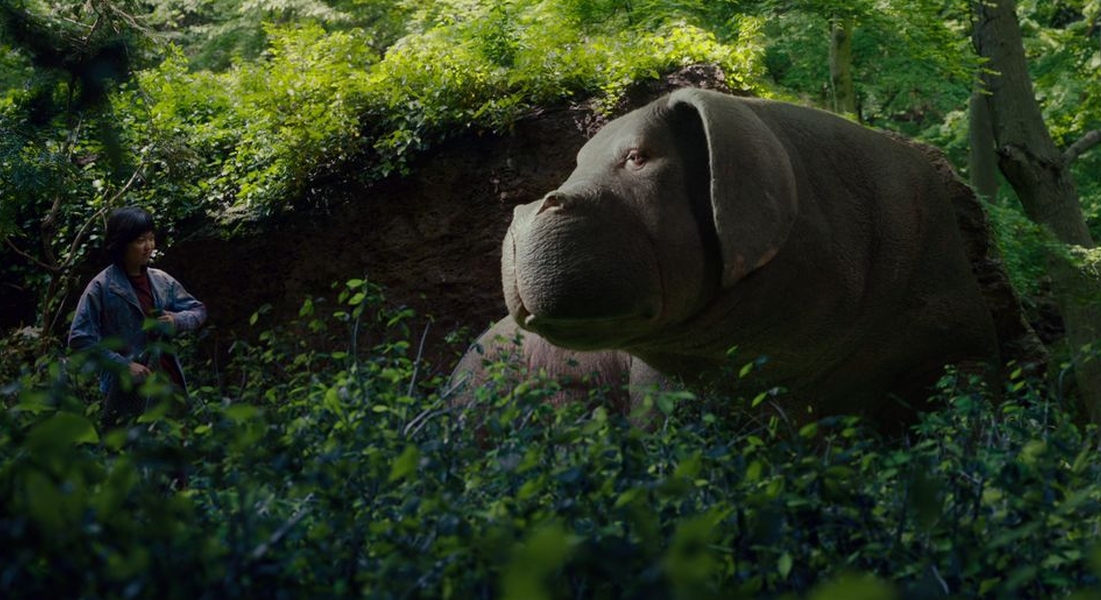
“All food production is exploitative.”
Bong Joon-Ho’s movies are known as much for their scathing social commentary as they are for their abrupt tonal shifts. While watching Okja, for example, you start off by laughing at over-the-top performances and peak capitalism parody, become emotionally invested in the innocent friendship between a girl and her “super pig”… and then, ultimately become so horrified and upset that you might just question your decision to ever eat meat again — especially if you’re an omnivorous animal lover.
This tonal balancing act works for two reasons: first, because the shifts don’t just come out of nowhere — they are established right from the disorienting start while we’re meeting characters and learning about their world; and second, the story of Mija and her love for the super pig Okja is played straight while all of the other characters’ stories are played as parody, which gives viewers someone to emotionally latch on to while the rest of the characters are caricatures. Her story elicits affection; the others elicit laughter and disgust. We experience these dueling factions separately first. Then, as the plot threads become more and more interwoven, those three disparate reactions all feel appropriate together, even as they tear us apart.
It’s a bold emotional juggling act that begins before the first shot even appears onscreen; the musical score that plays underneath the introductory logos starts out as the chimes of funeral bells before it abruptly shifts into the rapid strums of a happy, bouncy acoustic guitar.
We meet the villains first. The opening scene introduces us to Tilda Swinton’s Lucy Mirando, CEO of the Mirando Corporation, as she struts around a massive factory at the start of a corporate presentation; she tells her employees that she knows that her father was a cruel man — we later learn that he manufactured napalm to melt people’s faces off in war — but that the modern Mirando Corporation is different. Their mission today is to help save the increasingly starving human race by producing a new sustainable source of food: the “super pig.”
“We know these walls are stained with the blood of fine working men,” she says about the factory itself. (It looks like it.) “But today, I reclaim this space, to tell you a beautiful story. Now the rotten CEOs are gone. It’s Mirando’s new era with me, and with new core values, environment, and life.”
Yeah, right.
The previous CEO, Nancy Mirando, was ousted for untold reasons besides being “totally ignorant about humanity.” When we meet Nancy later in the film, it’s obvious that she isn’t ignorant at all — Lucy is far more inept; she’s just less compassionate, and doesn’t care as much about making people think that she’s good.
Tilda Swinton plays Nancy, too. Swinton playing both characters is a hilarious statement on the optics of corporate image — the marketing might be different, the product may be “new,” and the CEO may be a different human, but at the end of the day, they’re often subscribing to the same mindset, just wearing a different wig (metaphorically speaking).
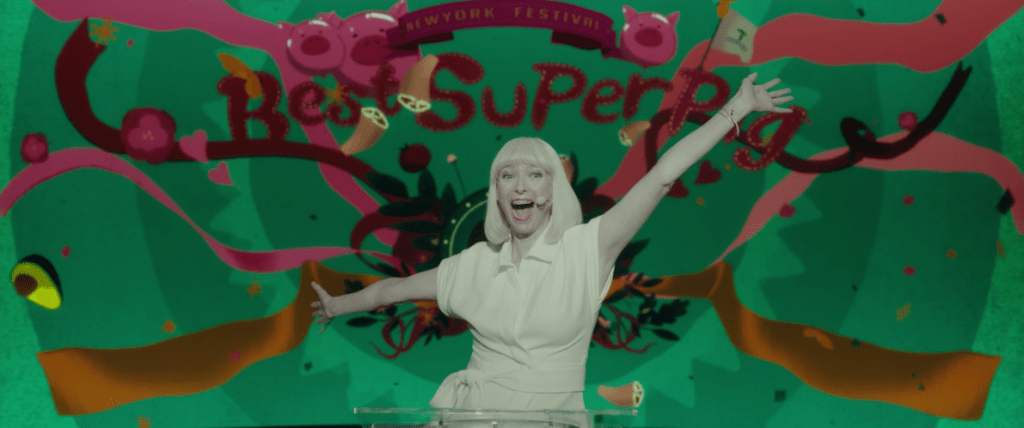
This opening scene is flashy, lively, and energetic. The camera moves in sweeping tracking shots across the factory floor. Lucy — bleach-blonde wig on her head and braces on the top row of her teeth — addresses a crowd of Mirando employees with great pizazz (and some profanity). Her right-hand man watches her from the rafters, mouthing her words along with her. On a screen behind Lucy, graphics and animations visualize the concepts and statistics that she speaks about. Sometimes, these animations take over the full screen so that we can formally process them, too. There are a multitude of competing visuals and a lot of information thrown at us at all once. By the end of the sequence, the overload feels a little unsettling… and the content strikes an odd tone.
Why would the Mirando Corporation stage this kind of elaborate launch event to announce a Super Pig Competition that won’t happen for ten whole years? “I’ll be dead by then!” an elderly employee groans; everyone laughs.
It’s all about ego, image, and maximizing long-term profit.
Every scene dealing with characters from the Mirando Corporation takes shots at those kinds of self-centered corporate drivers. One of the funniest takes place in a boardroom high above the Manhattan skyline during a crisis meeting meant to analyze the damage caused by the Animal Liberation Front’s attempt to rescue Okja in Seoul. Fourteen or so employees crowd around a small conference room table to stare at a television screen, and then a half dozen or so people debrief outside of the conference room later. The debrief is mostly a venting session for Lucy; no one else really speaks. By the looks on their faces, few of them even care.
In that glass-walled tower high above the ground, Lucy deludes herself and everyone else there that they’re not at fault; she plays the victim and blames “terrorists” for making them “look bad.” Lucy regurgitates company talking points about how great the Mirando Corporation is, but doesn’t come up with any solutions to the problem at hand. Her right-hand man calmly offers a suggestion: “The girl, you’re thinking of bringing her to New York, aren’t you?” He sips espresso, and Lucy’s jaw drops at the completely logical, obvious idea that she so clearly was never going to think of on her own… “I was about to say that!” she says emphatically. He smiles, having diligently present a solution while allowing his boss to claim it as her own. Many corporate employees, I’m sure, can relate to that.
Most employees at Mirando seem to do the bare minimum asked of them by this crazed CEO — see the bored receptionist, inept security guard, and apathetic truck driver in Seoul for additional examples — but that’s likely for the best. After all, look at what happens to the people who care: “This is what company loyalty looks like!” an executive screams right before running full-speed into an open car door and falling to the ground.
Swinton’s performances as Lucy and Nancy Mirando are both over-the-top, but the wildest performance in Okja belongs to Jake Gyllenhaal as TV personality and Mirando Corporation spokesperson, Johnny Wilcox. When the TV cameras are rolling, he’s appears to be an overly-excitable animal lover. The moment that the cameras stop rolling, however, he’s a whiny, neurotic, self-absorbed trainwreck with a high-pitched, exasperated voice.
His “love” for animals on TV and his behind-the-scenes brutality toward them is the perfect embodiment of the hypocrisy and self-absorption that is criticized in Okja.
Though he claims to love animals, he can’t wrap his head around even basic notions of treating them well. In awe of how perfect a super pig specimen Okja is, Wilcox asks the farmer — Mija’s grandfather — what his secret was in raising her so well. The farmer answers.
“He just let her run around,” Wilcox repeats, shocked. “How beguiling.”
His personality makes him an excellent spokesperson for the Mirando Corporation.
The scenes involving Wilcox and other Mirando characters are full of camera movement and whip pans, caricature-like performances, and frenetic performances. Their world is heightened to ridiculous extremes to allow Bong Joon-Ho to clearly make his point.
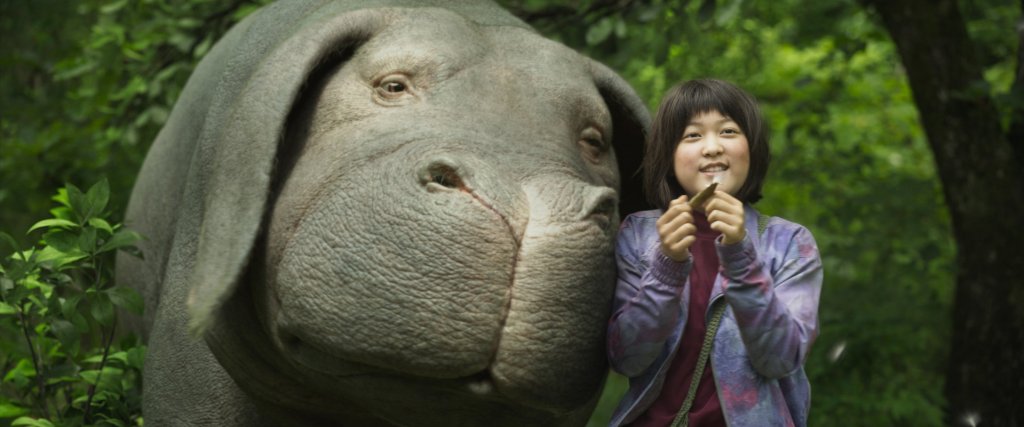
Contrast that with the much more restrained style of filmmaking and performances in the scene that introduces us to Mija and her super pig, Okja. The scene begins with a serene wide shot of green, misty mountaintops, then takes us into the forest, where we see a series of vignettes — shot with little camera movement — of Mija playing with Okja in idyllic settings: a grove, a natural pool, a waterfall. The pace of the editing is slower, the music more peaceful. Their relationship is calm and intimate; she naps on Okja’s side in the forest, and we see her lifted in and out of the bottom of a frame as Okja breathes. The camerawork and editing patterns only become more energized during a scene in which Mija nearly falls to her death off of a cliff; as she clings on to a rope for dear life, Bong Joon-Ho cuts to a close-up of the super pig’s eye and follows that with dramatic shots of Okja analyzing her surroundings as she searches for a solution, devises a plan, and makes a sacrificial leap to save her human’s life.
Okja’s rescue of Mija may be a contrived sequence, but it does its job. From that scene onward, it’s clear that Okja is fiercely intelligent, loyal, and capable of love. Playing Okja and Mija’s relationship out earnestly gives us the emotional buy-in that we need to not just intellectually understand that the Mirando Corporation is evil… but to feel it in our guts. Mija’s compassion is unique — a stark contrast to the rest of this chaotic, self-interested world.
To further emphasize her uniqueness within this story, Bong Joon-Ho makes her stand out visually, too. As Mija attempts to rescue Okja from her captors in Seoul, we see — in an overhead shot of a train station stairwell — her red jacket & purple pants stand out against the muted blue, grey, and brown suits worn by the surrounding sea of businessmen and women. Later, that outfit visually pops against the fluorescent-blue lights in the hallway in the downtown Seoul Mirando Corporation office.
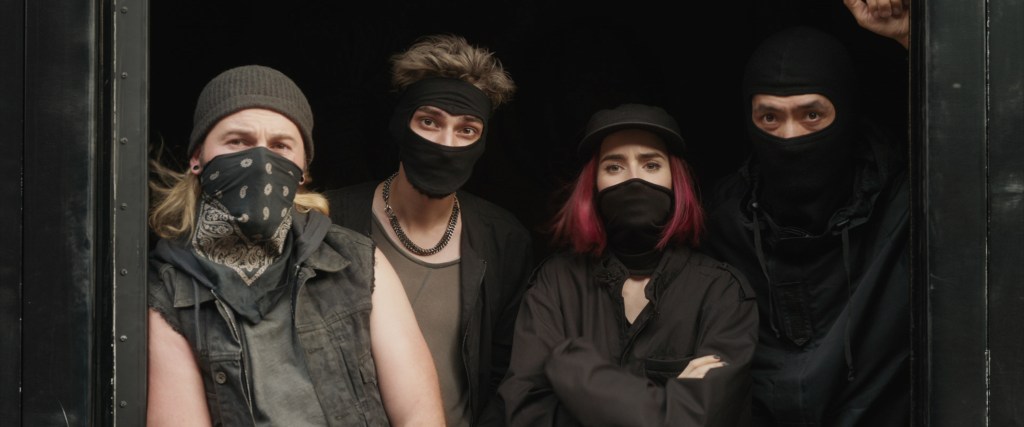
By the end of the movie, only Mija and Okja escape either ridicule or outright condemnation by the filmmakers, and perhaps that’s fitting. Even the Animal Liberation Front (ALF) is portrayed in parody (albeit much more lovingly than the Mirando employees). They first appear wearing ski masks while intimidating the truck driver transporting Okja in Seoul to pull over — but they make it very clear that they are “not terrorists.” Before they crash that truck inside of a busy tunnel, they go out of their way to make sure that everyone in the other vehicle is wearing their seatbelts. And, though they brandish weapons while trying to get the animal to safety, they reassure Okja’s captors: “We come in peace!”
The truck chase and ALF rescue that ensues is accompanied by a musical score of mariachi horns. The ALF fighters shield Okja from tranquilizer darts by opening up umbrellas in slow motion to the tune of “Annie’s Song” by John Denver (“you fill up my senses like a night in a forest, like the mountains in springtime, like a walk in the rain…”). They beat up their pursuers with non-lethal weapons, then earnestly yell back “I’m so sorry we hurt you, it wasn’t our intention, okay?” as they escape. They break the law to rescue animals, but one of them, nicknamed Silver, won’t even eat a tomato because it was ripened with chemicals and transported in trucks.
“I admire your conviction, Silver, but your pallid complexion concerns me,” their leader says in a deadpan manner.
Their motivations are kind, and they are presented as heroes… but they’re also a tad bit ridiculous.
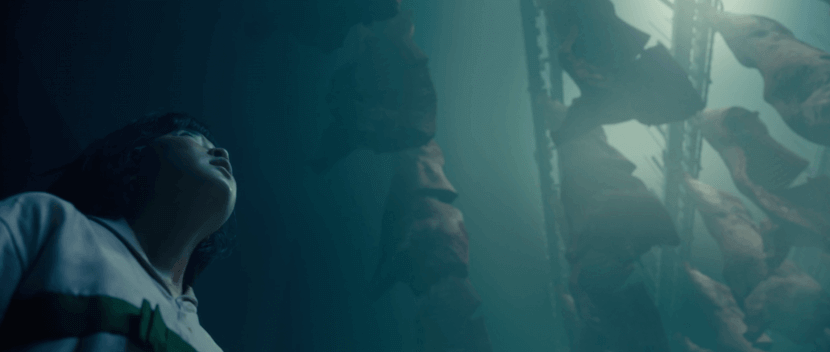
All of this humor and absurdity culminates in scenes of terror and sadness. The scenes of Okja’s mistreatment at the plant in New Jersey look and feel like they’re straight out of a horror movie. Disgusting abuse is carried out in a warehouse with stained, paint-chipped walls and ugly blue and yellow fluorescent lighting.
Then, when we see a man cleaning up a pool of blood, carcasses being sawed in half, and kennels of super pigs being lined up for the slaughter, the emotional weight of the Mirando Corporation’s actions hit us deeply. It’s a lot to take in, and the movie very abruptly stops being funny.
There is an uplifting ending, at least, which gives us some level of respite from the negative feelings conjured up by those final scenes. But it’s hardly enough to make us feel good about everything that we now cannot unsee.
“Why do you want to kill Okja?” Mija asks Nancy in the end.
“Well, we can only sell the dead ones,” she replies with a smile.
That sums it all up, in a nutshell. Pleas for compassion don’t dissuade the corporate executives from their ruthless pursuit of profit. Thankfully — though depressingly — solid gold does.
In the end, Okja is an interesting case study for how to blend a multitude of genres and tones together into an emotionally compelling piece of storytelling. It’s a movie that can make you laugh, make you cry, make you anxious, and make you feel like you got hit in the gut as you question your dietary choices. Okja may not be perfect, but that alone surely means that it’s fiercely effective.
 Story / Telling