
“I think I can handle it.”
Spirited Away overflows with creativity, captivates the imagination, pulls at heartstrings, and stirs the intellect. The boldness of its artistic vision has few peers, and it is clear that Hayao Miyazaki poured not only expert craft but love into every frame. It’s a movie that takes metaphors — some straightforward, others abstract — and places them inside of witches and dragons and pigs and inventive locations so colorful and beautiful that it is possible to appreciate them simply as compelling entertainment, or in more philosophical, thematic terms, if you so choose.
Miyazaki’s greatest film is ultimately about many things: staying true to your values in a greedy world, refusing to play victim to your circumstances and instead working to get yourself out of bad situations, never forgetting those who helped you and loving them back in return, the hypocrisy of those who profit off of labor exploitation, and the importance of remembering that children’s feelings and instincts should not be ignored, for they carry more intelligence and wisdom than adults often give them credit for.
It’s also about a girl lost in a magical world full of witches that turn into birds, dragons that turn into humans who were once rivers, radish and duck spirits that relax in hot tubs, talking frogs, and six-armed men who work alongside soot sprites to keep the flames of a furnace alive.
Spirited Away is a magical journey full of profundity, humor, visual splendor, and heart.
And Chihiro, the film’s protagonist, is one of the most exemplary characters in any movie geared toward children. She is not a princess or a warrior, but an ordinary girl. We see her afraid, disgusted, and crying herself to sleep. We watch her hold her head between her knees, curled up in a ball, in moments of despair. She doesn’t shy away from expressing all of her emotions.
But after she cries… she gets up. She persists. She allows herself to rely on others — without apology — when she needs help. She helps others even when she is in a bad place. And through her perseverance, she learns how to hold her own in a hostile world and earn the respect and love of others without ever compromising her values or the qualities that make her uniquely her.
She emerges from her struggles unchanged, merely grown; the challenges and trauma that she faces do not break but strengthen her. The Chihiro at the end of the film is a self-assured version of the Chihiro from the beginning of the film. The lessons that she learns along the way lead to maturity and grace.
Adversity teaches her the skills that she needs to adapt to her new home, make friends in her new school, and face one of the most difficult challenges in life: staying true to yourself in a greedy, materialistic, cut-throat world.
“A new home and a new school. It is a bit scary,” her dad says as they drive back down the forest path at the end of the movie.
“I think I can handle it,” Chihiro replies.
How she learned how to handle it is both a poignant lesson for children and a profound reminder for adults.
We first meet Chihiro curled up in the backseat of her parents’ car, clutching a bouquet of flowers. Her parents remain optimistic about their move as they drive toward their new home; her dad excitedly points out her new elementary school. As their car drives by it, we see Chihiro lift her head up to look out of the window; the school passes by in the window’s reflection as Chihiro sticks her tongue out at it. “I liked my old school,” she says, sadly.
Her parents ignore her emotions. Instead, her mom tells her to “pull herself together,” for they have a busy day ahead of them.
That busy moving day is derailed by a wrong turn down a mysterious forest path. Chihiro’s dad, excited by the thought of adventure, barrels down the bumpy road without a second thought (“I’ve got four-wheel drive!”). Chihiro instinctively knows that this is a bad idea — “Dad, are you sure…?” — but her parents ignore her opinion, dismissing it because parents know best, of course. Then, when they stumble upon a mysterious, dark tunnel, Chihiro is hesitant still — “It’s creepy, dad. Can’t we go back?” — but her parents, again, ignore her concerns.
Her cautionary attitude and intrinsic sense of right vs. wrong saves her later, as her parents gorge themselves on food that she instinctually knows should not be touched. They become roaring, gluttonous pigs. She stays human.
While all of this is happening, visual clues as to what’s to come are inserted into the frames: moss-covered stones shaped like frogs and other creatures jut out of the grass in the abandoned amusement park; we will later see these same animals alive and flourishing in the bathhouse. These stones, the Shinto shrine at the edge of the forest, and the rows of abandoned restaurants that only come to life at night are all elegant world-building details that hint at the larger story before we really know what is going on.

As amorphous black blobs with white eyes begin to appear and night falls over this “abandoned” amusement park, our senses are overwhelmed by incredible visuals. A ferry, illuminated by warm-colored lanterns, crosses a dark pool of water. Floating masks turn into full-bodied spirits as the boat docks ashore near the bathhouse. The night becomes darker and darker, and more and more colorful characters appear.
The attention to detail and inspired design behind even the most incidental background characters is astonishing.
In the midst of all of this splendor and chaos, Haku rushes Chihiro to safety through the shadows; they race past hidden storerooms and rows of pigs in pens as he directs her safe passage through the bathhouse grounds. We see so much, and it’s a lot to process — the sheer number of pigs alone warrants pause, for how many greedy humans are now being raised to be spirit food…? But Miyazaki doesn’t linger; as Chihiro is overwhelmed by her introduction to this world, so are we.
“Look for Kamaji,” Haku tells her. “Ask him for work. If he refuses, keep asking. If you don’t work, Yubaba will turn you into an animal. The work is hard, but it will protect you.”
Yubaba, the witch who lords over the bathhouse, made a pact long ago to give work to anyone who wants it, but if people don’t work, they cannot live. It’s a harsh reality — though not one that is particularly far off from the social pact that we make in modern society.
Yubaba is an embodiment of greed. She exploits her workers, makes them sleep on the ground in shared rooms, and demands that they take nothing for themselves — all tips of gold left behind by a river spirit go directly back to her. She herself lives in luxury and gives all of the extravagances that money can buy to her big baby Bo, whom she spoils rotten.
She enlists Haku to do dangerous deeds for her, exploiting his desire to learn magic; yet, when he is badly hurt in the line of duty, she casts him aside to die. The working class means nothing to her if they are not directly benefitting her. She’s the perfect villain for a movie about finding your way and place within capitalistic society.
“Yubaba controls us by stealing our names,” Haku tells Chihiro. Individuality is the enemy of conformity and servitude; remembering who you are is an act of defiance in this world. But Chihiro refuses to bend to Yubaba’s will in spite of her stealing her name and instead calling her “Sen.” She refuses to “shut [her] mouth,” as Yubaba demands by literally zipping up her mouth to prevent her from speaking.
Chihiro is horrified by the cruel setting that she is thrust into… but she doesn’t resign herself to mindless service. She doesn’t just sit and cry her eyes out after she comes to terms with the fact that her parents have been turned into pigs, waiting for the slaughter. She sits, cries her eyes out… and then tells Haku, “I promise to work hard” as she rushes back into the bathhouse to change things for the better.
She works hard to get herself out of bad situations and reclaims her independence and autonomy through sheer force of will.
After Haku tells her to find Kamaji, Chihiro makes her way down to the boiler room. Kamaji tells her that he does not need any more help; he has soot sprites to chuck coal into the fires for him. Chihiro picks up a piece of coal anyway, determined to work to earn her freedom. Kamaji notices, and encourages her (however harshly): “Finish what you started.”
She drags the heavy stone forward. Sparks fly into her face. She flinches… and she throws. The coal enters the fire.
She doesn’t complain. She takes charge of her circumstances and does what she needs to do.
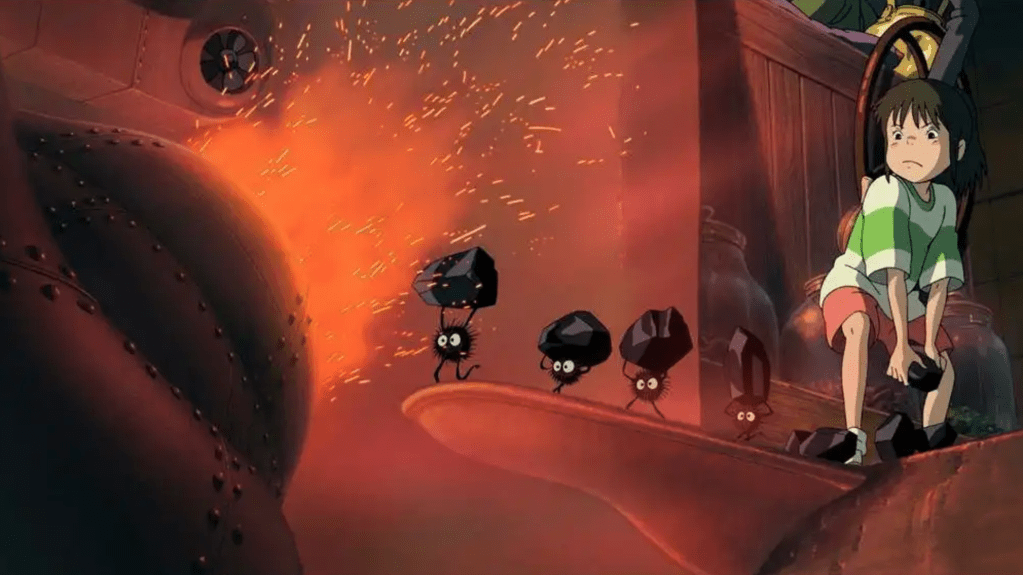
As these themes develop and the story unfolds, we continue to witness ever more imaginative visuals — soot sprites eating colored sprinkles with glee, the six arms of Kamaji moving in perpetual motion to allow him to turn a gear and pull strings and grab hay and eat sushi all at once, and the splendor of the bathhouse as it fills with a colorful cast of characters enjoying their relaxing getaways.
The attention to visual detail is one of Spirited Away‘s many joys. Each scene is filled with so much life. Miyazaki is not content to linger on a wide shot of the bathhouse in the rain to establish the setting of a new scene. He instead cuts to a second establishing shot that shows off two levels of the bathhouse lit up at night, and in that shot we are able to peer through the windows to watch characters milling about in their own unique ways while they get ready for the evening. The second shot is unnecessary from a narrative perspective, but adds continued breadth to the film’s world-building all the same.
Later in the film, Yubaba makes a phone call, not on a phone… but through a chattering skull. In another scene, Bo, as a baby mouse, steps into a footprint filled with cursed slug splatter; he shakes as if cursed himself, and the soot sprites around him earnestly mimic the hand motion that they watched Kamaji perform for Chihiro moments earlier to break her spell. Bo then shudders with relief.
And, while Zeniba and Chihiro talk about what Chihiro must do to free herself from Yubaba’s grasp, the baby mouse and bird nibble on cookies in the foreground while No Face happily cuts a slice of cake for himself off to the side. All of these peripheral details give the film so much richness and make the spirit world feel so unique and full.
Within this unique and full and scary world, Chihiro learns valuable lessons from her newfound friends. She learns about reciprocity and love from Haku; he rescues her, and she frees him from his endless servitude by reminding him of who he once was. She learns about rolling up her sleeves and doing what needs to be done from Lin.
And she learns valuable lessons in unexpected ways through her interactions with the film’s most mysterious character, No Face.

Glimpses of No Face early on in Spirited Away build suspense around the character so that when he becomes a key part of the story, we’re already invested in his character. At the start of her journey, Chihiro glimpses No Face on the bridge to the bathhouse… and then he abruptly disappears. He seems to wander on the periphery of society; no one lets him in to the bathhouse where the other spirits play. Until Chihiro, that is.
He’s an outcast — non-verbal, passive, and always alone. This is why, when Chihiro gives him attention, he becomes obsessed with her and showers her with gifts of stolen bath tokens to show his appreciation. She brings him hope when she invites him into the bathhouse, but when she rejects his gifts, he falls back into loneliness and despair.
Later, when the horrible “Stink Spirit” leaves golden nuggets behind in the bathhouse, No Face sees how enamored the bathhouse workers are by the gold… so he learns how to create gold in the palm of his hand and offers it to anyone who will take it. He believes that if he gives gold to people, they will love and pay attention to him.
To a degree, he’s right. This former outcast quickly becomes the center of all attention as the workers clamor for his riches. No Face feeds off of their greed — literally and metaphorically — and becomes increasingly gluttonous. But he knows that the love and admiration being piled on him isn’t real… and he lashes out with rage at the realization that he still isn’t able to experience genuine connection even with all of the attention.
His loneliness spirals into destruction until Chihiro approaches him with empathy, healing, and grace. In spite of all that he has done, she recognizes No Face for what he is: a lost and lonely soul. In spite of her own hardships, she chooses to pause and extend kindness to him.
She purges No Face of his gluttony and releases him from the bathhouse. After this, when he indicates that he wants to join her on her journey on the one-way train to Yubaba’s sister’s home, she lets him sit by her side. No Face is grateful for her companionship as they sit together in silence, the neon signs of far-off train stations approaching then receding from view.
On this train, for the first time since she arrived at the bathhouse, Chihiro finds herself at some level of peace.
When she and her friends arrive at Zeniba’s house, the good witch welcomes them all into her home without hesitation. In their company, No Face finds himself experiencing the connection that he always craved. He is given food, warmth, and company. Together, Zeniba and No Face weave a bracelet for Chihiro. He smiles as he weaves; he feels useful. For the first time, he too finds himself at some level of peace.
After Chihiro leaves, No Face chooses to stay with Zeniba. He has learned that craving approval from the masses will never lead to happiness; individual connections among those who will not judge you for who you are all that matter.
In a subtle way, No Face serves as a mentee of sorts for Chihiro; she teaches him how to stay true to himself and make meaningful connections with other people — and in so doing, she reinforces her own values. Helping him overcome his struggles helps her grow a little more fulfilled and wiser, too.

Chihiro’s journey is one of self-discovery, self-empowerment, and strength. The challenges that she faces and the places that she goes to are wildly inventive, but the lessons that she learns are familiar and poignant, as relevant in our world as they are in the spirit realm.
The film ends with Chihiro and her parents leaving the abandoned amusement park; as they exit through the same tunnel that Chihiro was so wary of at the start, Chihiro stays true to her promise to Haku to not look back… but after all that she has been through, she can now look forward without fear.
 Story / Telling
2 thoughts on “Spirited Away (2001)”