
“When the Lord closes a door, somewhere He opens a window.”
The Sound of Music is bookended by aerial shots of the majestic peaks of the Alps. In the beginning of the film, Julie Andrews’ Maria frolics freely through fields and hills in that mountain range, singing and dancing alone. At the end of the film, she traverses those same fields and hills with her new husband and seven stepchildren, on the run from Nazi Germany, still clinging on to her relentless hope as her family leaves Austria for Switzerland. The repetition adds complexity: in the beginning, the hills “fill [her] heart with the sound of music” and are symbolic of Maria’s free spirit. In the end, they still represent freedom… but in a more nuanced way.
The Sound of Music tells two parallel stories that add depth to one another; neither alone would be as compelling as both are together. Both stories involve outsiders coming into and changing an established way of life. In the primary plot, it’s a peaceful integration — Maria enters the Von Trapp family and breaks down emotional barriers in order to bring openness, love, and music back into their lives. The secondary plot involves forced assimilation, as the Nazis take Austria by force and make Austrians bend to their will. In both stories, the outsider changes the existing culture — one for the better, and one for the worse.
These interwoven stories add depth not only to the plot, but to the characters; consider how Captain Von Trapp’s patriotism and commitment to his values redeems him as a character more than the familial plot ever could alone. Without the scenes of Von Trapp ripping the Nazi flag in half or trying to convince Rolf that he can still save his soul, not even Christopher Plummer’s immense charm would make us forget that Georg Von Trapp is still a man who is introduced to us blowing a whistle to get his children to fall in line.
Consider too the depth of character development that the interwoven plots add to the character of Maria — she appears to us as a whimsical young woman with a nearly-naive level of optimism; her worldview is proven to not be naiveté so much as an active choice as the movie progresses and her faith in goodness is challenged by very real threats.
Maria is quick to bring a dose of positivity to every situation. But when she is hunkered down behind a gravestone with her stepchildren, hiding for their lives, and the youngest child, Gretl, asks, “Would it help if we sang about our favorite things?” she replies unequivocally, “No, darling. This is one time it would not help.”
In popular culture, The Sound of Music is mostly known for its optimism. Listening to the music out of context, it’s easy to understand why. Its songs are earnest and cheery — “My Favorite Things,” “Do Re Mi,” “The Sound of Music,” and so on. These happy, catchy, almost-cloying-on-their-own musical numbers and the scenes that accompany them early on in the movie — children dancing and singing on a mountaintop while Maria plays an acoustic guitar, for example — are what commonly come to mind when The Sound of Music is brought up in pop culture. But to consider The Sound of Music for only the catchy positivity of those songs would be to miss the surprisingly rich depth of its storytelling, which can only be processed when both parts of the whole are looked at together.
Prior to viewing the film for the first time, I was more likely to associate The Sound of Music with the yodeling, dancing goat puppets than the Von Trapp family hiding from Nazis in a convent cemetery at night. But as I watched the movie, many of these initially happy songs and scenarios evolved and took on new meaning for me.
With the music as well as the opening and closing scenes, it is, again, repetition of familiar material in a new context that adds complexity to the storytelling. By the end of the movie, songs that once felt almost frivolous become audacious anthems of hope, particularly those that are performed at the climactic concert after the Nazi takeover of Austria.
The first time that we hear “Do Re Mi,” for example, we see Maria and the Von Trapp children sitting blissfully in a field having a picnic. With this song, she teaches them a skill: how to sing. Later, when they reprise “Do Re Mi” at the concert for Austria, they use that skill to delay capture while Captain Von Trapp figures out how to get his family out of the situation that they’re in. His eyes dart around the stage as he sings about tea and jam while observing the Nazis who watch them from the wings.
As with “Do Re Mi,” the first time that we hear many of the songs often introduces a character to a new skill, or a new mindset (“My Favorite Things,” “Climb Every Mountain”). Then, when the song is reprised, the character is most often seen putting that mindset or skill to the test. Because of this, the first time that we hear a song in The Sound of the Music is generally more fun, but the reprise is typically more powerful.
The choice of when to reprise a song often speaks to a larger theme. Note that, in the final shot, as we the family crossing the Alps toward safety, it is not “The Sound of Music” that is reprised, but the Reverend Mother’s most poignant lesson: “climb every mountain, ford every stream, follow every rainbow, ’til you find your dream — a dream that will need all the love you can give, every day of your life, for as long as you live.”
And then there is “Edelweiss,” which manages to not only become more thematically complex and emotionally dynamic in its reprisal — but also serves as the single most important moment of emotional resolution and character development for Captain Georg Von Trapp in not just one but both of the parallel storylines.
The first time that we hear the song is the first time that we hear him sing at all; his performance of “Edelweiss” — softly sung to his children in the living room of their home — is the first time that Von Trapp allowed warmth, love, and music back into his home since the death of his wife. He laughs and smiles as his eldest daughter joins him in harmony. The song resonates with joy during this scene; by singing to his children, he overcomes deep emotional wounds and internal conflict.
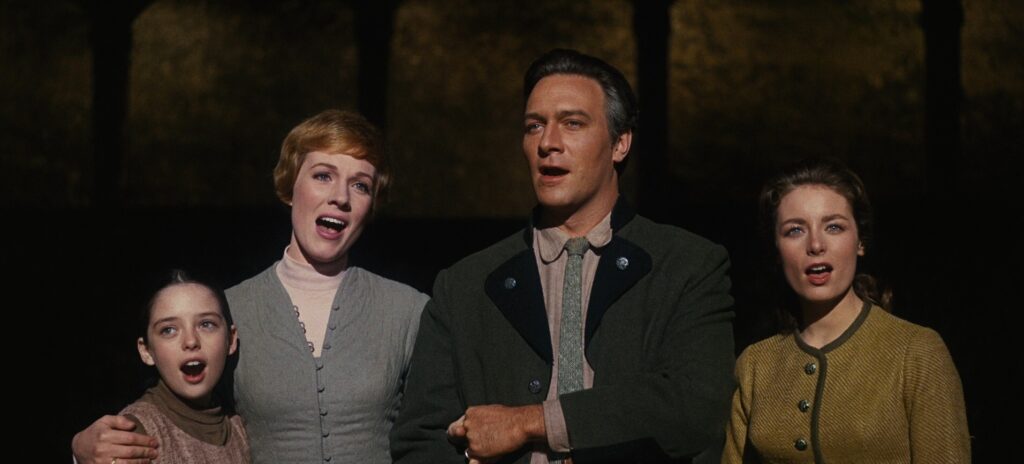
The next time that we hear “Edelweiss,” Captain Von Trapp is onstage holding the same acoustic guitar that he played at home, but this time he is performing for Nazis. In this scene, the song serves not as a moment of connection but as a melancholic farewell to both his way of life and his homeland. Tears come to him instead of laughter. As he begins to break down, Maria joins him onstage to sing the harmony. The reprise itself is sad, but the strength of the love and connection shown by the Von Trapp family toward each other at this moment of the concert is moving; love creates hope.
There’s also repetition between the two courtships in the Von Trapp family. Rolf and the eldest Von Trapp child, Liesl, are first seen together outside of a gazebo in the pouring rain, brightly lit and dancing on benches. They sing the cringe-inducing-by-modern-standards “Sixteen Going on Seventeen” to each other to profess their young love. It’s a problematic song, the funniest and least offensive line of which, made all the more hilarious due to Rolf’s lack of self-awareness, is: “You need someone older and wiser telling you what to do. I am seventeen going on eighteen; I’ll take care of you.” But it also establishes visual and musical motifs that add to character development later on in the film.
The song itself is reprised when Maria and Liesl have a heart-to-heart conversation about love and Liesl’s future near the end of the film. In that scene, the song is more tender, and takes on a different emotion and tone.
In between these two versions of that song, Maria and Captain Georg have their own courtship scene in the same gazebo, set to the tune of “Something Good,” a less problematic musical profession of love. Maria and Georg’s scene is much more subdued than that of the younger lovers; therefore, it is filmed in longer takes and wider shots, edited with far fewer cuts, and its characters remain still in the frame instead of dancing apart. They embrace each other in a gorgeous silhouette.
The aesthetics of each of these courtship scenes match the maturity of the relationships that they commence.
Between the beats of these repeated moments and musical reprisals are so many other memorable scenes that are brought to vivid life through beautiful visuals and charismatic performances. I haven’t even touched upon the maturity and grace by which the romance of Baroness Schraeder and Captain Von Trapp amicably ends, or the fascinating choices of the character of Max Detweiler, who sways between loyalty to the Von Trapps and submissive cowardice in the face of Nazism. The movie is long, clocking in at nearly three hours. It fills that run time with so much.
The Sound of Music is both compelling and entertaining for all of these reasons and more; it is not just a good movie musical, but a good story well told.
 Story / Telling