
“You have to invite me in.”
Snow falls slowly in the darkness.
“Squeal like a pig,” a young boy says.
We first see Oskar as an out-of-focus reflection in a window. When the focus falls on him, the image that we see of his reflected body is skewed, layered as if there are two Oskars stacked on top of one another. He stares out at the snow-covered courtyard of his apartment complex. It’s a drab and uninspiring place.
The brutality of his muttered words, the hunched-over look of his body, and his dreary, cold, lonely surroundings tell us everything that we need to know about him.
Oskar is an outcast in school. In class, he exists on his own focal plane — his teacher and his peers remain out of focus as he raises his hand to answer a question. When we first see him being bullied, the camera stays close to his face as he backs himself up against a set of lockers. No one comes to his rescue. Everyone and everything beyond him is out of focus. He is visually and emotionally isolated from his peers.
An older man, Hakan, and a young girl, Eli, arrive at the apartment complex in the dead of the night. They move their sparse belongings inside, and Hakan immediately covers their windows with cardboard. It is clear that they do not want to be seen.
The world that we meet Oskar, Hakan, and Eli in is cold, oppressive, and detached. So are the relationships in their lives. It is fitting, then, that the story unfolds in the cold, dark Swedish winter.
All of the stylistic decisions made by director Tomas Alfredson — in particular, the shot compositions and editing choices — elegantly bring the cold, tumultuous, painful world of these characters to life.
Violence, for example, is viewed from afar. Brutality is the logical conclusion for characters who have been backed into corners with no way out. It is almost always conveyed, then, as a matter-of-fact, emotionless decision.
Alfredson chooses to sit with the violence and horror in poetic wide shots.
We see Hakan meet, greet, and murder his first victim in one unbroken wide shot. Tall, dead trees and mounds of white snow cover the majority of the frame. The action is impersonal; he has done this hundreds of times before. He comes prepared with everything that he needs to fill a gallon jar full of blood and not get a drop on him.
The rest of the violence plays out with similarly detached aesthetics. Oskar holds his breath underwater, and the severed head of his bully slowly sinks down to the bottom of the pool behind him. We watch Hakan fall from the hospital window, and the shot does not cut away until several beats after his impact below. One of Eli’s victims burns in her own hospital bed; the camera simply holds on to our view as the flames rise.
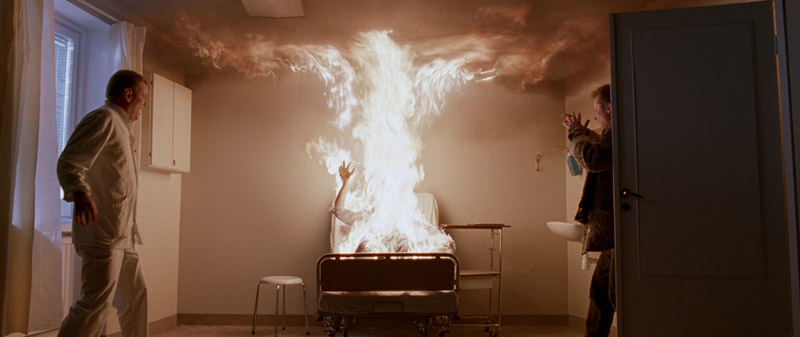
It’s all brutal, but oddly serene.
Eli may take on the appearance of a 12-year-old girl, but we learn that she has been trapped in that state for hundreds of years after being mutilated and turned into a vampire. She needs perpetual darkness and human blood to stay alive.
Several scenes make it evident that she could hunt her own food if she wanted to. But instead of bearing her burden alone, she selfishly manipulated Hakan — and likely many others before him — to do her bidding for her.
It is never explicitly made clear how Hakan became involved with Eli. We merely see him commit atrocities to keep Eli alive. What he gets out of it is left up to the viewer to decide. None of it can be good.
Hakan makes an error early on in the film that causes him to act recklessly. This puts him in a position that he cannot escape from. As his world closes in around him, we see him small in the frame, isolated, with no one left to turn to.
His choice to serve Eli ends in pain, suffering, and a horrific death.

In the end, when his usefulness runs its course, she unceremoniously sucks the last bit of life out of him and casts him down into the cold snow below.
Hakan’s tragedy, however self-inflicted, is the key to understanding the true horror of Let the Right One In.
Without his scenes, it could be easy to view this movie as a moody love story between two tragic, young outcasts, each of whom fills a void in the other’s life.
Alfredson attempts to manipulate us into seeing that uplifting vision of this story. The scenes between Oskar and Eli are shot intimately, in sharp contrast to the detached wide shots of violence or the shallow-depth-of-field shots of Oskar that introduce him in his isolation. Eli and Oskar are often seen in close-ups together as their relationship develops. Their softly-spoken dialogue indicates that they understand and care about one another.
With Eli, Oskar is no longer a bullied outsider; he has a companion and a defender. With Oskar, Eli has a young friend who can diminish her own loneliness.
But beneath this is a sinister, horrifying motivation.
After the death of Hakan, Eli needs someone else to do her dirty work for her. Who better to manipulate than a young male outcast with violent inclinations…?
Eli rescues Oskar from his bullies with a fierce display of loyalty and the promise of companionship. In turn, he “rescues” her, and they run away together.
As Oskar and his stowaway leave town on a train, headed to an unknown destination, Oskar stares out of the window at the snowy scenes passing by. As he thinks about his future with Eli, he is as upbeat as we’ve ever seen him. The film ends, leaving us with a deeply unsettling feeling about where that future will take him.
And so the cycle of abuse and manipulation continues.
“You have to invite me in,” Eli says to Oskar late in the film, as she stands in front of his apartment’s front door. “Is there something in the way?” he taunts. She enters the apartment without his explicit permission. To Oskar’s horror, Eli begins bleeding from her back, head, ears, and eyes.
“No! You can come in!” he yells, running toward her. With his embrace, he gives her permission to stay.
The title of the film is a warning. Oskar is too naïve, desperate, and isolated to heed it.
That is the true horror of this vampire “love” story.

 Story / Telling
One thought on “Let the Right One In (2008)”